
Consumers

US consumer spending dropped by 0.2 percent in September

Written by Joseph Nordqvist

Published: 04:06, November 1, 2014

US consumer spending dropped in September by 0.2 percent, the first drop in consumer spending in eight months, according to a report by the Commerce Department released on Friday.

The drop comes following a surge in consumer spending of 0.5 percent in August. It is an indicator that the US economy may be losing momentum as it enters the fourth quarter.

Personal income increased modestly in September, by 0.2 percent, which is the smallest rise since December.

These figures are far lower than what most analysts had expected. Many had forecast that consumer spending would slow down a bit in September, however, still increase a bit, by around 0.1 percent. In regards to personal income most analysts had forecast a 0.3 percent rise.
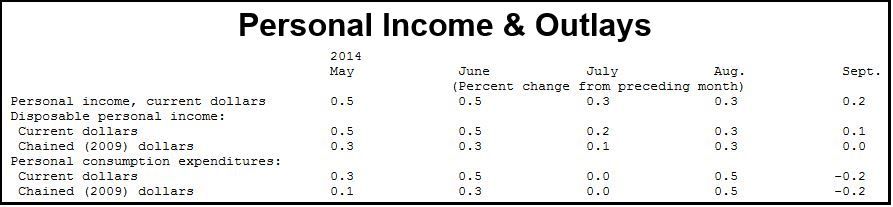
US Personal Income & Outlays

(Photo courtesy of the US Department of Commerce)

“Private wages and salaries increased $12.6 billion in September, compared with an increase of $36.3 billion in August. Goods-producing industries’ payrolls increased $0.7 billion, compared with an increase of $4.8 billion; manufacturing payrolls decreased $0.3 billion, in contrast to an increase of $2.2 billion. Services-producing industries’ payrolls increased $11.9 billion, compared with an increase of $31.4 billion. Government wages and salaries increased $1.4 billion, compared with an increase of $0.9 billion.”

Joseph Nordqvist Avatar

Other News

Hiring pressure persists in technical, health and teaching jobs, OECD finds

Oct 30, 2026

Small manufacturers face different costs in the shift to new supply chains

Oct 29, 2026

Crowded hedge fund trades can deepen market falls, IMF research finds

Oct 29, 2026

Electronic payments are linked to easier credit for small businesses

Oct 29, 2026

China’s carbon market may reward cleaner plants while increasing output

Oct 29, 2026

Groundwater pumping can create costs that arrive years later

Oct 29, 2026

Commodity shocks are spreading from energy to food and metals

Oct 28, 2026

Why training an AI replacement can create a dilemma for workers and employers

Oct 28, 2026

Why tariff changes can reach importers at different times

Oct 28, 2026

Large businesses are far more likely to use AI for cybersecurity

Oct 28, 2026

Plastic packaging recycling rose in the EU as waste generation also increased

Oct 28, 2026

Export controls work differently when trading partners act together

Oct 28, 2026

Online shoppers report late deliveries more often than other problems

Oct 28, 2026

Restaurant review alerts were linked to better ratings when staff acted on complaints

Oct 27, 2026

Foreign-controlled firms account for a small share of EU businesses but a larger share of jobs

Oct 27, 2026

Paid AI customers switch providers as new models appear

Oct 27, 2026

AI agent audits depend on records the agent cannot erase

Oct 27, 2026

A rural hospital payment program kept facilities open while inpatient capacity fell

Oct 27, 2026

Customer feedback changed how rural financial agents served their communities

Oct 27, 2026

Non-bank finance need not weaken interest-rate policy, new model finds

Oct 27, 2026