

The American Wind Energy Association (AWEA) is reminding that wind energy can reduce CO2 emissions from power plants. The Environmental Protection Agency is about to impose CO2 pollution limits from existing power stations.
According to AWEA, every US state is already enjoying reduced emissions, thanks partly to wind energy. It adds that wind energy can help further bring down CO2 pollution, and at affordable prices.
The AWWA recently published a white paper, The Clean Air Benefits of Wind Energy, which found that wind energy is a:
- reliable,
- affordable,
- widely-available,
- and rapidly-scalable source of CO2 emissions reductions.
Many states already familiar with wind energy
Tom Kiernan, CEO of AWEA, said:
“Wind energy is one of the biggest, fastest, cheapest ways states can comply with the forthcoming EPA rule limiting carbon pollution from existing power plants. And the best part is that many of these states and their utilities are already familiar with the affordable, reliable product that wind energy provides.”
“While the details are still to come, we’re confident that wind energy can play an even bigger role in helping states generate carbon-free energy and drive local economic development in the process.”
Below are some of the key findings in the new report:
- Last year, 167.7 megawatt-hours (MWh) of wind energy was produced in the US. It reduced CO2 emissions by 126.8 million tons, which is the equivalent of taking about 20 million vehicles off the road.
- The following states reported the highest carbon reductions from wind energy: Wyoming, Minnesota, Wisconsin, Oklahoma, Missouri, Iowa, Colorado, California, Illinois and Texas.
- The following states achieved a 10%+ reduction in carbon emissions compared to 2011 from wind energy alone: Washington State, Vermont, S. Dakota, Oregon, Nebraska, Minnesota, Kansas, Iowa, Idaho, Colorado, and California. Wyoming, Oklahoma and Wisconsin reported reductions of just under 10%.
- Wind energy also lowers emissions of sulfur dioxide by almost 347 million pounds annually, and nitrous oxide by 214 pounds per year.
- Several studies have shown that wind energy can easily provide a much larger share of the country’s electricity needs, which in turn would mean even greater emissions reductions. According to the National Renewable Energy Lab (NREL), if 20% of electricity came from wind energy carbon emissions would be reduced by 25%, and 30% would reduce it by 37%.
Thanks to improved technology, wind energy costs have gone down by 43% over the last four years. With an average hub height of just over 80 meters, there is now better access to steadier wind speeds.
Mr. Kiernan said:
“Wind energy is a proven generating resource that is available to help all states affordably and reliably achieve the carbon emission reductions to be proposed by the EPA soon.”
The US wind energy industry has doubled its installed capacity every six months since the end of 2005. Ten years ago, the industry installed 296 MW’s worth of wind energy equipment, by 2012 the figure reached 13,000 MW.
Today there are more wind projects under construction than at any time in US history.
Since 2009, thirty-one percent of all newly installed electric generating capacity has been wind energy, second only to natural gas. At 42%, wind energy was the biggest source of all new generating capacity in 2012.
The current wind turbine fleet in the US provides as much electricity as 53 coal plants or 14 average nuclear power stations.
Europe shows the way
Several European countries have shown that wind energy is both a reliable and effective way of reducing carbon dioxide emissions.
Spain, Portugal, Ireland, Germany and Denmark lead the world in getting the largest share of their electricity output from wind energy, and they have all seen significant declines in carbon intensities of their electric sectors.
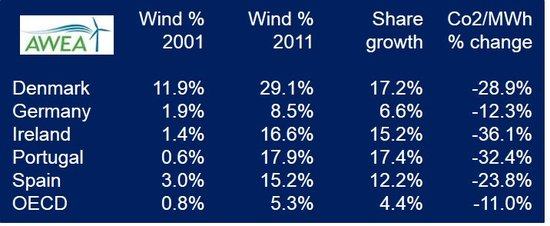
(Source: AWEA)
The table above shows the close link between wind generation growth and a fall in carbon intensity. “Interestingly, Germany would have seen a far larger decline in carbon intensity had it not, for unrelated reasons, reduced the share of electricity it obtains from nuclear energy from 29.6 percent in 2001 to 17.7 percent in 2011,” says the report.
As Europe becomes more concerned about its dependence on Russian natural gas, the European Commission has put forward a proposal on energy security which includes a wider use of renewable sources, including wind energy.
