

Business sentiment in Germany hit a nearly two-year low after sliding for six consecutive months. The prestigious Munich-based think tank, the Ifo Institute, reported on Monday that its Ifo Business Climate Index for industry and trade in Germany slid in October to 103.2 points, compared to 104.7 in September.
The news put a dampener on the initial surge in European bank share prices on Monday following Sunday’s publication of the ECB and EBA stress test results.
Not only did expectations of the current business situation in the country fall, but predictions for the next six months turned more negative too. “The outlook for the German economy deteriorated once again,” Ifo wrote.
The business climate in manufacturing declined considerably, the report informed. Perceptions of the current manufacturing situation were considerably less favorable in October, and are only slightly higher than the long-term average, while expectations for the next six months are gloomier.
Capacity utilization rates declined to 83.7, which was a 0.3 of a percentage point fall.
The only people to express moderate confidence for the next six months were manufacturing exporters.
The business climate in wholesaling improved after falling for three months running.
Business expectations continued to be marginally negative.
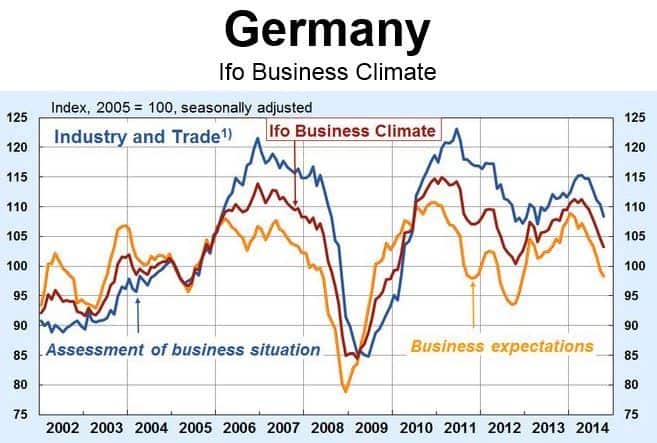
(Source: Ifo Institute)
While retailers are more negative about their current situation, they are slightly more hopeful about the near-term future.
The business climate indicator showed a slight decline in the construction industry, “but remains at a very good level,” the report emphasized. Construction companies view their current business situation as slightly better than before, but their business expectations fell to a one-year low.
German business leaders have become more pessimistic amid news of Eurozone weaknesses, deflation concerns, geopolitical tensions, and German economic policy.
Germany started off the year with decent growth, and then suffered a shock 0.2% GDP contraction in the second quarter. There is serious concern that the country is sliding into a recession. Technical recession is when there is no growth (or there is contraction) for two consecutive quarters.
Several international organizations, including the IMF and OECD, have significantly downgraded their forecasts for German GDP growth.
Ten percent of all German exports go to Ukraine and Russia. Business leaders say the economic sanctions against Russia by the West are seriously harming their growth outlook.
The Ifo Business Climate Index is a monthly survey involving 7,000 businesses in retailing, wholesaling, construction and manufacturing across Germany.
