

New data reveals that 2014 was the hottest year since scientists began keeping records 135 years ago.
According to climate experts at NASA and the National Oceanic and Atmospheric Administration, the 1.4-degree Fahrenheit increase (0.68 C) since 1880 shows that long-term warming patterns is a very real phenomenon, raising concerns about human activities that produce greenhouse gases – contributing to global warming.
The researchers gathered data from 6,300 land-based weather stations around the world. NOAA scientists concluded that the average surface temperature in 2014 was 1.24 degrees Fahrenheit higher than the 20th century average of 57 degrees Fahrenheit – surpassing previous records set in 1998 and 2003.
Nine of the 10 warmest years on record have occurred since 2002.
Record highs were set in large areas of every inhabited continent. In addition, ocean temperatures were unusually warm, which scientists say were the cause of destructive Pacific storms. What is more worrying is that ocean temperatures rose without an influence from El Niño (a major Pacific Ocean current oscillation).
According to the Intergovernmental Panel on Climate Change, rising temperatures can cause ocean levels to rise, cause disruptions to global agriculture, radically change weather patterns, and increase the spread of tropical diseases.
Global warming is the major challenge of our generation
“Climate change is perhaps the major challenge of our generation,” said Michael H. Freilich, director of Earth sciences at NASA, one of the agencies that track global temperatures.
“Greenhouse gas trends are responsible for the majority of the trend that we see,” said Gavin Schmidt, director of NASA’s Goddard Institute for Space Studies in New York. If emissions continue to rise Schmidt said that “we may anticipate further record highs in the years to come.”
“It shows very clearly that it has been the warmest year on record in the oceans but it wasn’t quite the warmest year in the land records but combined it did give us the warmest year,” he explained.
Temperatures rose in a considerable amount of area
Thomas Karl, director of Noaa’s National Climatic Data Center, said there was a “considerable amount of area where we saw the record highest temperature observed, such as many portions of Europe and every ocean had parts that were [the warmest on record]”.
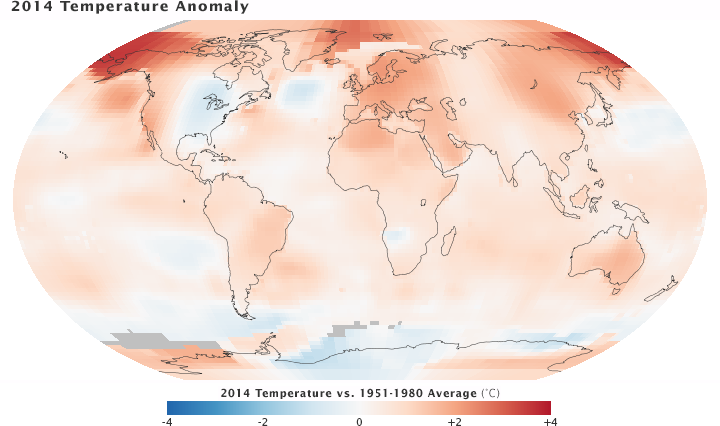
However, Dr Karl noted that not every part of the planet recorded temperatures higher than the long-term average.
“There were actually some areas that were cooler than average, particularly across some parts of the US that were much cooler than average,” he noted.
“But that was overwhelmed by the far greater proportion of land and ocean areas that was much warmer than average or record temperatures.
“If you put it all together then it comes out as the warmest year on record.”

Chart of the temperature anomalies for 1950-2014, also showing the phase of the El Niño-La Niña cycle. (Image Credit: NASA/GSFC/Earth Observatory, NASA/GISS)
John Grunsfeld, associate administrator for the Science Mission Directorate at NASA Headquarters in Washington, said:
“NASA is at the forefront of the scientific investigation of the dynamics of the Earth’s climate on a global scale. The observed long-term warming trend and the ranking of 2014 as the warmest year on record reinforces the importance for NASA to study Earth as a complete system, and particularly to understand the role and impacts of human activity.”
“NOAA provides decision makers with timely and trusted science-based information about our changing world,” said Richard Spinrad, NOAA chief scientist.
“As we monitor changes in our climate, demand for the environmental intelligence NOAA provides is only growing. It’s critical that we continue to work with our partners, like NASA, to observe these changes and to provide the information communities need to build resiliency.”
