
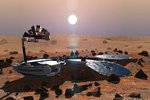
The British-led Beagle 2 Mars Lander, which scientists believed had been lost in 2003, has been found partially deployed on the red planet’s surface, thus ending a mystery of what happened to the mission.
Beagle 2’s Entry, Descent and Landing (EDL) sequence worked, astronomers said. The lander successfully touched down on Mars on Christmas Day, 2003. It had managed to partly deploy its solar arrays.
The lander, a collaboration between industry and academia, hitched a ride to the red planet on the European Space Agency’s long-lived Mars Express mission. It had been expected to deliver world-class science from the surface of Mars.
The HiRISE camera, fitted onto NASA’s Mars Reconnaissance Orbiter (MRO), took images which compellingly showed that the lander was there. According to scientists at the University of Leicester in England “These images show potential targets on the surface of Mars for the lander and key entry and descent components within the expected landing area.”
The lander touched down at the Isidis Planitia, an impact basin close to the equator.
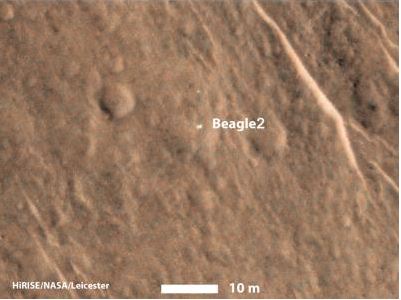
A color image of Beagle 2 Lander on Mars (Image: HIRISE/NASA/Leicester).
Members of the Beagle 2 team, which included scientists from Leicester University and NASA, analyzed the images. They believe they show the Beagle 2 lander is what appears to be a partially deployed configuration. They think they have identified the rear cover and the main parachute close by.
The Leicester University team wrote:
“The HiRISE images are consistent with the lander’s size and shape.Changes in light reflections between different images suggest that the object is “metallic” (in the sense of having a shiny surface) – again consistent with Beagle 2.”
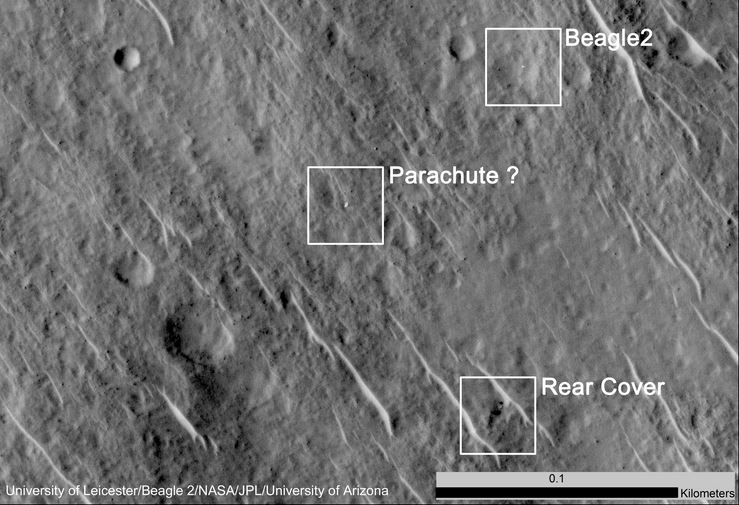
Scientists believe this image shows the parachute and rear cover of the Beagle 2 lander (Image: NASA/JPL-Caltech/Univ. of Arizona/University of Leicester).
The leader of the Beagle 2 project was Professor Colin Pillinger who died in May 2014. He worked alongside scientists from the Department of Physics and Astronomy at the University of Leicester, as well as EADS Astrium (today called Airbus Defece and Space). His team members said he would have been delighted at today’s news.
Professor Mark Sims, from the Space Research Centre (SRC), who worked as a Beagle 2 team member, said”
“I am delighted that Beagle 2 has finally been found on Mars. Every Christmas Day since 2003 I have wondered what happened to it and had nearly given up hope of ever knowing.”
“These images show that we came so close to achieving the goal of science on Mars and vindicate the hard work put in by so many people. Beagle 2 showed the fantastic innovation skills available from UK academia and industry and was an inspiration.”
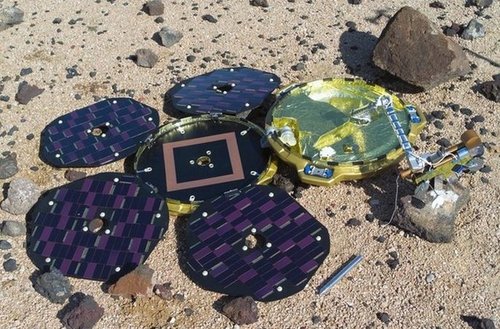
Beagle 2’s mission was to look for signs of life on Mars (Image: UK Space Agency on a simulated Mars surface).
Dr. John Bridges, who also works at the SRC and led the selection of the Beagle 2 Landing Site and was commissioned as a HiRISE co-investigator of the recent images, said:
“It’s great to see Beagle 2 on Mars. This would not be possible without the high resolution and colour capabilities of the HiRISE camera on NASA’s MRO where each pixel is 25 cm across. We can use the things we learnt from Beagle 2 in the 2018 ExoMars Rover mission.”
NASA quoted Richard Zurek of JPL (NASA’s Jet Propulsion Laboratory), project scientist now for Mars Reconnaissance Orbiter (MRO) and previously for NASA’s still-missing 1998 Mars Polar Lander, who said:
“I can imagine the sense of closure that the Beagle 2 team must feel. MRO has helped find safe landing sites on Mars for the Curiosity and Phoenix missions and has searched for missing craft to learn what may have gone wrong. It’s an extremely difficult task, as the craft are small and the search areas are vast. It takes the best camera we have in Mars orbit and work by dedicated individuals to be successful at this.”
Chief Executive of the UK Space Agency, Dr. David Parker, said:
“The history of space exploration is marked by both success and failure. This finding makes the case that Beagle 2 was more of a success than we previously knew and undoubtedly an important step in Europe’s continuing exploration of Mars.”
