
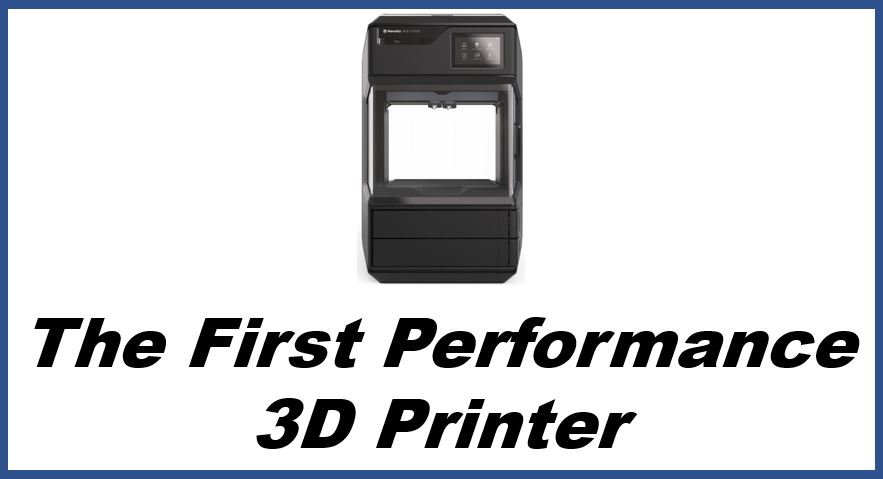
Pioneer of desktop 3D printing, MakerBot, has introduced Method, the first performance 3D printer. Performance 3D printers bridge the gap between industrial and desktop 3D printing. They bring features that designers and engineers didn’t previously have access to, at a considerably lower cost.
The MakerBot Method 3D printer includes:
- Dry-sealed material bays.
- An ultra-rigid metal frame.
- A circulating heated chamber.
- Precision PVA water soluble supports.
- Dual performance extruders.
It also has built-in sensors and automation features that provide the user with a seamless experience.
Stratasys, the company that owns MakerBot, says that the printer’s industrial features mean that it delivers a high level of precision.
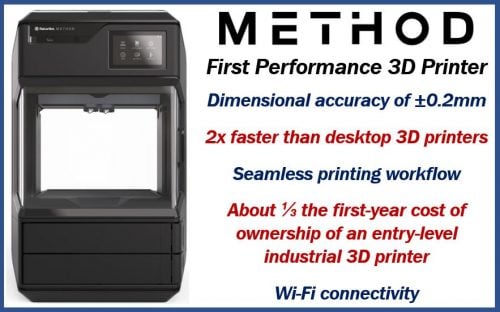
3D printer allows people to become more agile
Nadav Goshen, CEO of MakerBot CEO, said:
“In an age of disruption, businesses are under pressure to innovate and bring products to market faster. Current desktop 3D printers derive their DNA from hobbyist 3D printers and are insufficient for many applications in the professional segment.”
“We believe that Method is the next step in helping organizations adopt 3D printing at a larger scale. Method provides a breakthrough in 3D printing that enables industrial designers and mechanical engineers to innovate faster and become more agile.”
“It is built for professionals who need immediate access to a 3D printer that can deliver industrial performance to accelerate their design cycles. Method is developed to bring industrial technologies into an accessible platform, breaking the price-performance barrier and redefining rapid prototyping in the process.”
What is 3D printing?
3D printing is a technology that uses 3D printers to create three-dimensional objects. Printers get their information from digital (computer) files. They create objects by adding layer after layer. 3D printing is a type of additive manufacturing. It is the opposite of subtractive manufacturing.
3-dimensional printers can create objects of virtually any geometry or shape. Companies are using them in, for example, construction to make buildings or parts of buildings. Car manufacturers, medical device makers, aerospace companies, and many other sectors are currently using 3D printing technology.
Experts say that one day there will be 3D printers for virtually anything. We will eventually be able to 3D print a new shirt, spare parts for our vehicles, and even our lunch in our homes.
In December 2018, MIT scientists explained how their 3D printer makes transparent glass on an industrial scale. Cazza Technologies says that it plans to 3D print a skyscraper.
