

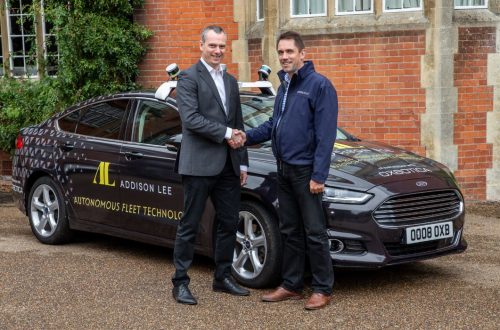
Taxi firm Addison Lee Group plans to have self-driving cars in London by 2021. It has agreed a wide-ranging strategic alliance with Oxbotica, a British leader in self-driving vehicle software. Addison Lee says the alliance will accelerate the implementation of self-driving vehicles in the streets of London.
Under the agreement, the collaborating companies will develop, deploy, and operate autonomous cars. Addison Lee aims to provide London customers with self-driving taxis by 2021.
According to an Addison Lee press release:
“The long-term aim is to take greater share of an expanding car services market for connected autonomous vehicle technology, forecasted to be worth £28 billion in the UK by 2035.”
“Addison Lee Group aims to use its trusted brand to offer affordable, quality, ride-shared services to passengers currently underserved by existing driven transport modes, as well as explore opportunities to provide corporate shuttles, airport, and campus-based services.”
Addison Lee and Oxbotica
The two companies will pool technology, expertise, and on-the-ground resource to explore driverless car services. These cars will be environmentally friendly and safe. They will also continue delivering ‘exceptional customer experiences.’
The two companies will work closely together to create digital maps of over 250,000 miles of public roads in and around London. These maps will have data on the position of every road sign, traffic light, kerb (USA: curb), and landmark. The maps are crucial for the deployment of autonomous vehicles.
Opportunity for greater mobility
Private vehicle ownership is declining. City populations, on the other hand, are increasing. Demand for car services is increasing. Additionally, the global transport services market is experiencing considerable growth. The premium segment, especially, is expected to grow significantly – by up to 21% by 2030.
This combination of factors provides an opportunity for targeted investment in future-looking technologies. Specifically, technologies that alongside traditional vehicles help meet this growing demand.
By leveraging the strengths of Addison Lee and Oxbotica, the alliance will open new opportunities. The alliance will be better able to reach consumers in new segments and markets.
The two companies aim to start in London, then New York and other international markets.
CEO comments
The letters CEO stand for Chief Executive Officer.
CEO of Oxbotica, Graeme Smith, said:
“This represents a huge leap towards bringing autonomous vehicles into mainstream use on the streets of London, and eventually in cities across the United Kingdom and beyond.”
“Our partnership with Addison Lee Group represents another milestone for the commercial deployment of our integrated autonomous vehicle and fleet management software systems in complex urban transport conditions. Together, we are taking a major step in delivering the future of mobility.”
CEO of Addison Lee Group, Andy Boland, said:
“Urban transport will change beyond recognition in the next 10 years with the introduction of self-driving services, and we intend to be at the very forefront of this change by acting now.”
“Autonomous technology holds the key to many of the challenges we face in transport. By providing ride-sharing services, we can help address congestion, free space used for parking and improve urban air quality through zero-emission vehicles.”
“We are proud to be partnering with a British technology pioneer and leader in autonomous vehicle technology, Oxbotica, and together we will continue our British success story in how we revolutionise the way people get around cities.”
