
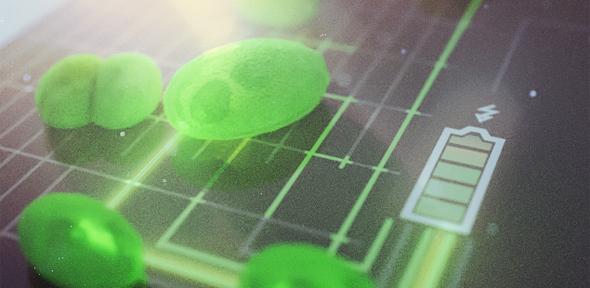
Algae-based solar cells could one day power rural Africa, say researchers from the University of Cambridge in the United Kingdom.
In a paper published in the journal Nature Energy, they describe how they are improving the efficiency of algae-based solar cells in converting solar energy into electricity.
 Algae-based solar cells use photosynthesis to make electricity. Image: Kadi Liis Saar.
Through the natural process of photosynthesis, plants and microorganisms like algae and bacteria have been harvesting solar energy for billions of years.
Biophotovoltaic cells
In biophotovoltaic cells, also known as biological solar cells, scientists are using the photosynthetic property of such organisms to convert solar energy into electricity.
“Photosynthesis generates a flow of electrons that keeps plants, algae and other photosynthetic organisms alive,” says Paolo Bombelli, a post-doctoral researcher in the Department of Biochemistry and an author of the paper.
“These electrons flow though biological wires and, like the electrical current obtained from a battery and used to power a radio, they are the driving force for any cellular activity,” he explains.
Able to repair themselves
Biophotovoltaic cells are seen as an attractive alternative to the synthetic photovoltaic cells currently used in solar panels because they are environmentally friendly and able to repair themselves.
However, the technological challenge for scientists like Dr. Bombelli and his colleagues is how to get the biological solar cell to convert solar energy as efficiently as the synthetic solar cell.
During photosynthesis, pigment molecules called chlorophylls harvest light and generate high-energy electrons.
Some of the electrons produced during photosynthesis are exported outside the cell, offering the opportunity to capture these to make electricity to power devices.
Separate chambers for generation and delivery
Until now, the design of biophotovoltaic cells had the two processes of charging (generating electrons from light harvesting) and power delivery (transferring the electrons to an electrical circuit) taking place in one compartment.
However, separating the two processes into different compartments allows their competing demands to be met more optimally, says the Cambridge team.
Keeping the two processes in separate chambers also offers other advantages, they note. For example, the charge, which is generated during daylight, could be stored for later use, during the night.
Improved power density
Thanks to this, and other developments, the power density of the new algae-based solar cells is 0.5 W/m2. While this is about five times more efficient than previous versions, it is still only about one tenth of that of conventional synthetic photovoltaic cells.
Dr. Bombelli and his colleagues do not think that algae-based solar cells will be able to generate enough electricity to power a grid system.
However, they do envisage them being very useful in places like rural Africa, where there is no grid system, and there is plenty of sunshine.
Another attractive feature of algae-based solar cells is that they could be produced directly by local communities, unlike semiconductor-based synthetic photovoltaics that have to be shipped from dedicated manufacturing facilities.
“This a big step forward in the search for alternative, greener fuels,” Dr. Bombelli concludes.
Video – Biophotovoltaic devices
In the following video from Cambridge University, Dr. Bombelli describes the work that he and his colleagues are doing to develop biophotovoltaic devices such as the algae-based solar cells.
