
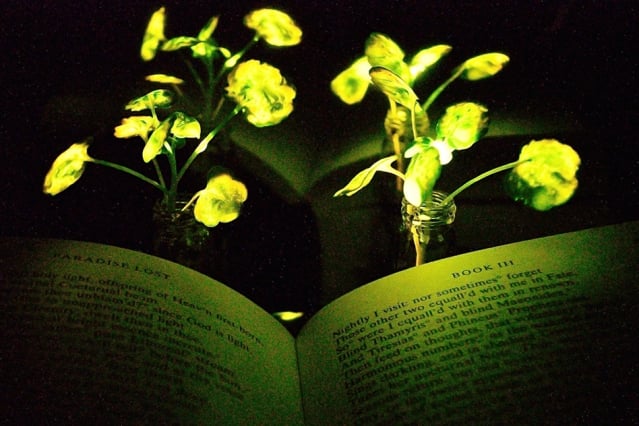
Chemical engineers in the United States have devised a way to turn watercress seedlings into glowing plants that can emit a dim light for nearly 4 hours.
In a paper published in the journal Nano Letters, the Massachusetts Institute of Technology (MIT) researchers describe how they got the plants to emit light by embedding specialized nanoparticles in their leaves.
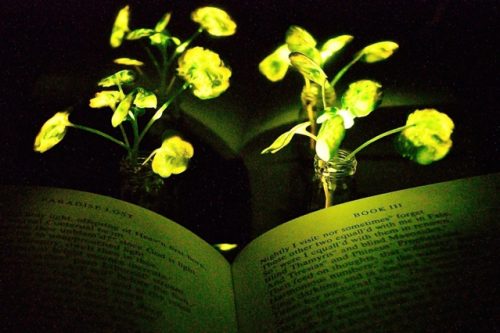
With further adjustments, the researchers believe that they can increase the amount and duration of the light from the glowing plants. Image: MIT/Seon-Yeong Kwak.
The team, led by Michael Strano, a professor of chemical engineering at MIT, believes that with further work, it will be able to make glowing plants that are bright enough to illuminate a workspace.
Plant nanobionics
Strano’s lab is pioneering “plant nanobionics” – a new field in which scientists get plants to do extraordinary things by implanting them with nanoparticles.
The team is particularly interested in getting plants to do work that is currently done by electrical equipment.
“Plants can self-repair,” says Prof. Strano, “they have their own energy, and they are already adapted to the outdoor environment.”
His group has already devised a plant that monitors droughts and another that detects explosives and sends that information to a smartphone.
As around one fifth of the energy that is consumed worldwide goes into lighting, Prof. Strano believes that getting glowing plants to take on that work is “an idea whose time has come,” and presents a “perfect problem for plant nanobionics.”
The researchers imagine a future in which, for example, plants can function as desk lamps that you do not have to plug in. The energy to power the light comes from the plants’ metabolism.
They say the technology could be further developed to give low-intensity light for indoor and even outdoor use – imagine trees that glow instead of electrically-powered street lamps.
Charged nanoparticles embedded into leaves
The team created the glowing plants using three types of nanoparticle, each loaded with a different substance. The first type of nanoparticle carried luciferin, the compound that makes fireflies glow; the second carried the enzyme luciferase, which acts on luciferin to trigger the light-emitting reaction; and the third type of nanoparticle carried a coenzyme that helped the process by removing a byproduct that blocks luciferase activity.
The team suspended the charged nanoparticles in a solution and then immersed watercress seedlings in the solution at high pressure. This forced the nanoparticles to enter the plants’ leaves through their stomata – the tiny pores through which they exchange gases with their surroundings.
The larger nanoparticles carrying the luciferin and the coenzyme gathered in the spaces between the cells occupying the mesophyll, or the inner layer of the leaves. The nanoparticles carrying luciferase were much smaller, small enough to enter the cells of the mesophyll.
As the nanoparticles carrying the luciferin discharged their load, the compound entered the cells where it reacted with luciferase to emit light.
In the first set of experiments, the team could only get the glowing plants to emit light for around 45 minutes. But eventually, they extended this to 3.5 hours.
A watercress seedling that is about 10 centimeters in length emits around one-thousandth of the amount of light that a person would need to read a book by. However, the team thinks it can increase the amount and the duration of the emitted light by adjusting the concentration and release rates of the compounds carried by the nanoparticles.
Trees as streetlamps
The team has many ideas about how to further improve the technology, including a way to spray the nanoparticles onto the leaves, which might work for transforming trees into large glowing plants.
The researchers have also worked out that they can switch off the glowing plants using nanoparticles that carry a compound that stops the luciferase from acting on luciferin. This might be used to get the plants to switch off under certain conditions, such as during daylight hours.
The aim is to have a range of treatments that can be applied to any size or age of plant and that lasts for the rest of the plant’s life.
“Our work very seriously opens up the doorway to streetlamps that are nothing but treated trees, and to indirect lighting around homes,” Prof. Strano concludes.
He and his team believe that their approach is easier to apply and makes a brighter light than those that use genetic engineering to get plants to glow.
Video – glowing plants
The following video from MIT summarizes the work that went into creating the glowing plants with the help of nanoparticles.
