
The Bank of Japan surprised analysts by adopting negative interest rates, while stocks rose as investors hoped the US Federal Reserve would take its foot off the rate hike accelerator pedal. The Japanese yen went south on the news of negative rates.
Markets were stunned when the Bank of Japan cut a benchmark rate below zero – in a move many described as bold – to kick start the country’s economy as unstable markets and decelerating worldwide growth undermine the central bank’s efforts to rid the country of deflation, a problem that has hung around one way or another for several decades.
Yuji Shimanaka, chief economist at Mitsubishi UFJ Morgan Stanley Securities, described JoB’s move as “very bold” and said it marked an innovation since the central bank kicked off quantitative and qualitative easing in April 2013.
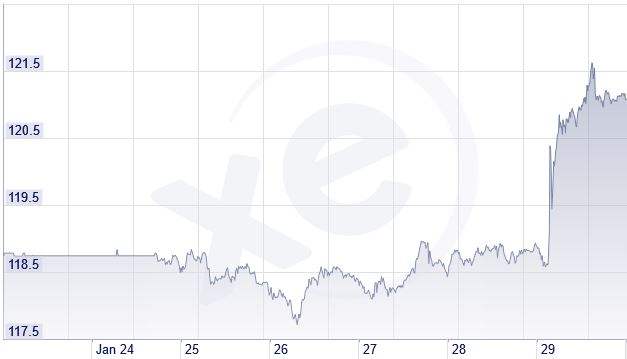 Yens per dollar rate. The moment Bank of Japan went negative on its benchmark rate the yen took a hit. (Image: xe.com)
Most economists in Japan had expected the central bank to use other measures, such as increasing purchases of Japanese government bonds.
After the Bank of Japan (BoJ) said it would charge 0.1% for excess reserves and may consider reducing rates even further if needed, equities surged across the world, the yen slid, and sovereign debt rallied.
There was some anxiety regarding how much ammunition central banks across the globe had left to fight off deflation.
Market Watch quoted Robert Brusca, chief economist at FAO Economics, who said:
“This is an interesting move that looks a lot more like desperation or novelty than it looks like a program meant to make a real difference.”
While Japan’s central bank’s move is seen as a baby step – just a small proportion of deposits will be affected – it does mark a major shift. Bank of Japan joins the ECB (European Central Bank), and the central banks of Sweden, Denmark and Switzerland in pushing their rates into negative territory.
Analysts doubt Feds will pursue hike spree
An abrupt slowdown in US GDP growth in Q4 – 0.7% annualized rather than the 0.8% expected – made everybody wonder whether the Fed would have the stomach for four rate hikes in one year.
Economists say a strong dollar and lukewarm global demand did not help exports.
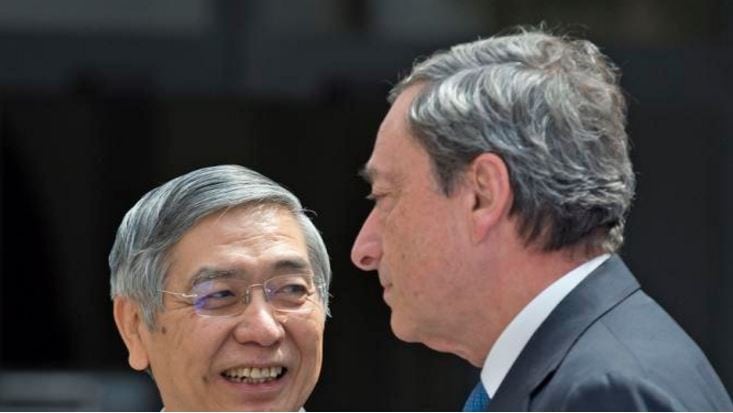 Haruhiko Kuroda, Governor of the Bank of Japan and Mario Draghi, President of the European Central Bank, now joined at the hip in the land of negative interest rates.
Reuters quoted Jason Pride, director of investment strategy at Glenmede, said:
“Four rate hikes this year is not even a possibility. The GDP data, never a good data point to make economic decisions, was a good reason for a relief rally.”
Ten-year Japanese government bonds saw yield tumble to an unprecedented 0.09%, while the yen declined 1.87% against the US currency to 121.03 yen, as it headed to the largest one day fall in more than 12 months.
The Nikkei share index moved up and down, and closed 2.8% higher at the end of the day. US and European shares rose by approximately two percent, while the all-country world stock index (MSCI) gained 1.73%.
Video – Bank of Japan stuns everyone and moves into negative territory
