

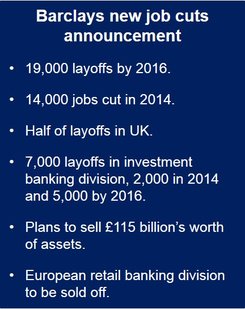
A Barclays massive jobs cut has been announced, with up to 19,000 workers being laid off by 2016, the UK’s third largest bank informed. Half of the redundancies will occur in the UK and 7,000 in the investment part of the bank.
Earlier this week Barclays reported a 5% fall in profits to £1.69 billion, including a 28% slump in investment bank income. The bank had previously warned of lower profits.
A slump in demand for company and government debt has hit Barclays’ investment bank particularly hard. A “bad bank” will be set up which will eventually run down or sell £115 billions’ worth of non-core operations, including its European retail banking division (£16 billions’ worth) and £90 billions’ worth of investment bank assets.
The company will include as non-core operations all its retail banking divisions in France, Italy, Portugal and Spain.
Barclays aims to become a leaner bank
The sell-offs will allow the leaner bank to focus on the following areas:
- Personal and Corporate Banking – which include most of its leading UK retail, corporate and wealth business.
- Barclaycard – a “high returning business with strong and diversified international growth potential.”
- Africa Banking – which Barclays says is a longer-term growth business.
- Investment Banks – which will deliver equities, banking, credit and certain macro products to its client more efficiently.
Barclays CEO Anthone Jenkins said:
“This is a bold simplification of Barclays. We will be a focused international bank, operating only in areas where we have capability, scale and competitive advantage. In future, Barclays will be leaner, stronger, much better balanced and well positioned to deliver lower volatility, higher returns, and growth.”
“My goal is unchanged: to create a Barclays that does business in the right way, with the right values, and delivers the returns that our shareholders deserve. However, the way in which we will achieve this is different. Today, we are setting out how we will reach that goal and create the “Go-To” bank for our customers and clients, our colleagues and our shareholders.”
In April 2014, a sizable minority of Barclays shareholders had voted against its proposal to raise the staff bonus pool to £2.38 billion despite warning about a fall in profits and having to lay off thousands of workers.
Most of Barclays massive jobs cut in 2014
Approximately 14,000 job cuts will occur in 2014, more than the 10,000 to 12,000 Barclays had announced as its target earlier this year.
In 2014, about 2,000 investment bank jobs worldwide will go, plus a further 5,000 by 2016. A total of 26,000 employees currently work in the investment bank.
Approximately 8,000 of the 14,000 announced for 2014 will occur in the United Kingdom. Barclays’ retail division has 32,900 employees in the United Kingdom, plus a further 5,900 in Europe.
In early trading today, Barclays shares rose by more than 5%. In an interview with the BBC, Richard Hunter, head of equities at Hargreaves Lansdown stockbrokers, said:
“The news has been well received, although this is unquestionably a long term game. The separation of non-core assets, a continued reduction of costs and a streamlining and focus on more profitable operations all seem to make strategic sense.”
As investor-patience is wearing thin, these changes must be implemented swiftly, Hunter added.
Worldwide irritation at remuneration of banking executives
During the 2008/2009 financial crisis and the recession that followed, banks and financial institutions worldwide went to their governments asking taxpayers to bail them out. After being criticized for paying their executives too much regardless of performance, they promised there would be reforms and better bonus supervision.
There is growing irritation today by members of the public, lawmakers and investors that nothing has been learned and that financial institutions are back to their old ways.
According to a recent study carried out by eFinancialCareers, banking bonuses have increased globally by 29% over the past 12 months.
The Royal Bank of Scotland tucked away £576 million ($964) for bonuses, despite reporting a gigantic pre-tax loss of £8.243 billion ($13.30 billion).
JPMorgan, the largest bank in the US, awarded its CEO a 74% pay rise after announcing it was to cut its workforce by 8,000 due to financial problems.
