
Beagle 2 lander did not crash on Mars, a team of researchers has concluded, it deployed at least three of its four solar panels after successfully touching down on the Red Planet’s surface – unfolding the panels could not have occurred had it smashed into the ground.
Thanks to an innovative research technique, scientists from De Montfort University and the University of Leicester, both in England, were able to solve the mystery of what happened to the ill-fated, British Mars lander Beagle 2.
Beagle 2 was a Mars lander built in the United Kingdom which was transported by ESA’s (European Space Agency’s) 2003 Mars Express mission. It was an *astrobiology mission aimed at looking for past life on the shallow surface of the Red Planet.
* Astrobiology is the study of the origin, evolution, distribution and future of life in our Universe, i.e. extraterrestrial life and life on Earth.
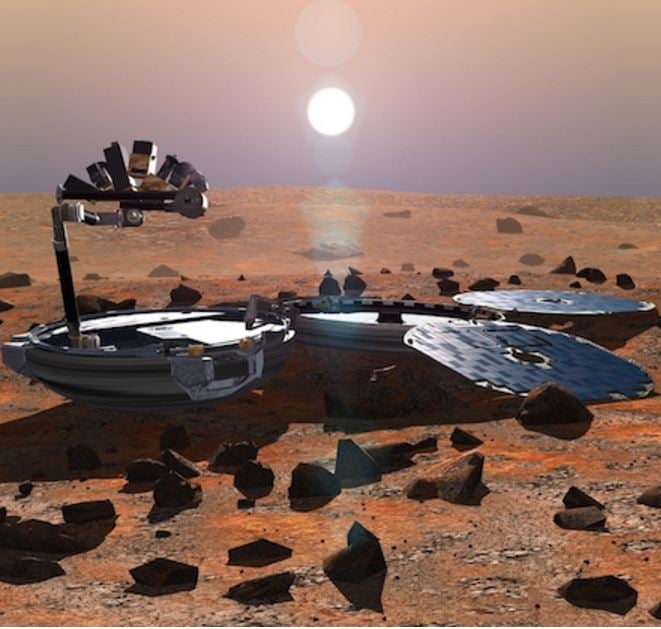 An artist’s impression of Beagle 2 on the Red Planet’s surface. Had the mission been successful, would we now have evidence that life once existed on Mars? (Image: dmu.ac.uk)
No contact with Beagle 2 on Mars’ surface
While being successfully deployed from the Mars Express, no contact was received at the expected landing time on Christmas Day 2003. In 2004, ESA declared the mission lost after several attempts to contact the spacecraft had been made. Everybody thought that Beagle 2 had crashed on the Martian surface.
The lander was presumed lost until ten years later when images taken by NASA’s Mars Reconnaissance Orbiter (MRO) recorded it on the Red Planet’s surface. The MRO camera resolution was not high enough to determine exactly what had happened to Beagle 2.
In this latest research, scientists used 3D modelling technology to demonstrate for the first time that the British probe did not crash.
Beagle 2 unfolded 3 solar panels
Instead, analysis by Teodora Kuzmanova, a lecturer at De Montfort University, who specialises in 3D, found that Beagle 2 managed to deploy at least three of the four solar panels it was supposed to after landing on the Martian surface.
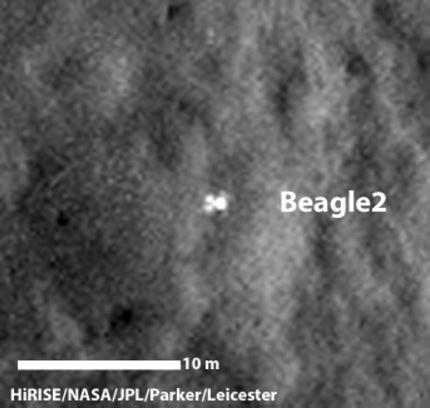 Image taken of Beagle 2 partially deployed on the Martian surface, by the HiRISE camera on NASA’s Mars Reconnaissance Orbiter. (Image: le.ac.uk)
The researchers suggest that perhaps the antenna had been transmitting normally – but the signal was not able to get through because there was not enough power. Had the fourth panel unfolded, things may have been very different.
Former Beagle 2 Mission Manager, Mark Sims, Professor in Astrobiology and Space Instrumentation at the University of Leicester’s Department of Physics and Astronomy, thought up the concept of ‘reflection analysis’ – of matching simulated and real pictures of Beagle 2.
Reflection analysis is based on simulating possible lander configurations while on the surface of Mars and comparing the sunlight reflected by the simulated lander with unprocessed pictures available from the MRO’s HiRISE camera at several different angles of the Sun.
Professor Sims and a team of specialists at De Montfort University realized his concept. They adapted commercially-available software used for visual effects, simulation design, animation and 3D modelling to enable this analysis.
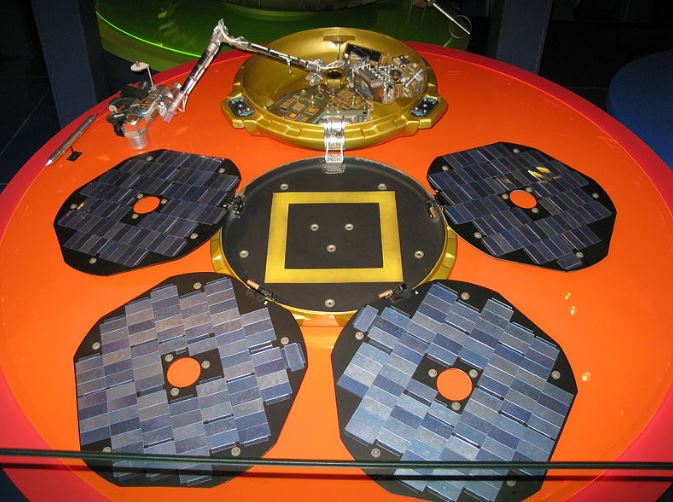 A Beagle 2 replica in the London Science Museum. (Image: Wikipedia)
Nick Higgett, Principal Lecturer/Course Leader MA Multimedia Design at De Montfort University, who led the simulation team, said:
“This has been an exciting collaboration with the University of Leicester’s Space Research Centre. The De Montfort team were responsible for all the 3D simulation work to test the reflection analysis concept.”
“In order to do this, our visualisation specialist Teodora Kuzmanova had to create a physically accurate 3D model of the Beagle 2 Mars Lander with surfaces that would accurately reflect virtual sunlight.”
“The angle of the sun had to be simulated along with position of a virtual camera that could take pictures equivalent to NASA’s Reconnaissance Orbiter. Finally these images had to be pixelated to match the resolution of the Orbiter’s images.”
“We are delighted to say that we have gone way beyond this original plan to reach this exciting conclusion that Beagle 2 did not crash but landed and probably deployed most of its panels. Hopefully these results help to solve a long held mystery and will benefit any future missions to Mars.”
Beagle 2 came close to success
Prof. Sims said that their findings showed frustratingly that Beagle 2 came ever so close to working as intended on the Red Planet.
Prof. Sims added:
“This unique University collaboration between space scientists and digital designers allowed this reflection analysis concept to be put into practice and tested and ultimately produce these exciting results.”
The study confirmed that antenna transmission had probably been hampered by one of the solar panels failing to open up correctly, adding credence to the previously-proposed theory.
This is as close to a definitive explanation of what happened to Beagle 2 we will ever get, without physically landing on Mars itself, the team members explained.
Beagle 2 was a collaboration between academia and industry. Had it been successful it would have delivered world-class science from the surface of Mars. It was sent to the Red Planet to search for signs of life by analyzing soil samples for organic molecules.
Video – Beagle 2 found on Mars
In this University of Leicester video, Prof. Sims explained the Beagle 2 project when pictures of the lander were found in 2014. It was this finding that led to the latest research.
