
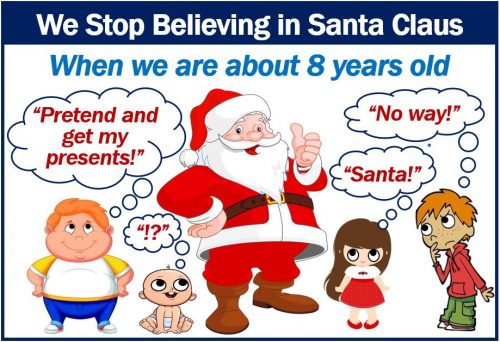
According to an international academic ‘Santa survey,’ we stop believing in Santa Claus when we are about eight years old. It is now that time of year when adults enjoy watching young children’s excitement because Santa Claus is coming. Many adults, it seems, wish they still believed in that fat, jovial, white-bearded bearer of gifts. That is according to the first international ‘Santa survey.’
Apparently, many of us felt betrayed when we found out that it was all just a myth.
The study also found that using Santa to blackmail children into behaving themselves does not work. In other words, the threat of ending up in Santa’s naughty list, for many kids, has no effect at all. Also, many children pretend they still believe in Santa even though they know it’s all fiction.
Killing the Santa Claus myth
One of the main reasons kids lose their faith in the magic of Santa Claus is bumbling parents. Specifically, parents accidentally saying or doing the wrong things.
Chris Boyle asked people across the world to tell him how they discovered that the Santa story was not true. He also asked whether their discovery made them trust their parents less.
Boyle is an Associate Professor in Inclusive Education and Psychology at the University of Exeter’s Graduate School of Education.
He received 1,200 responses globally to his ‘The Exeter Santa Survey,’ the only international survey of its kind. Respondents were mainly adults recalling their childhood memories.
Survey findings
Below is a list of the survey findings so far:
- 34% of adults wished they still believed in Santa. On the other hand, 50% are quite happy that they no longer believe.
- 34% said believing in Santa improved their behavior as kids, while 47% said it did not.
- Children stopped believing in Santa Claus when they were (average) eight years old.
- 65% played along with the myth, even though they knew it was fiction.
- 15% felt betrayed when they discovered Santa wasn’t real; one third said it upset them.
- 31% said it affected their trust in adults when they found out – 56% said it made no difference.
- 31% said their parents defended the existence of Santa when they asked them. 40% admitted he didn’t exist.
- 72% of parents today are happy to play along with the Santa myth. The rest, however, chose not to.
Prof. Boyle overwhelmed by survey response
According to Prof. Boyle:
“During the last two years I have been overwhelmed by people getting in touch to say they were affected by the lack of trust involved when they discovered Santa wasn’t real.”
“It has been fascinating to hear why they started to believe he is fictional. The main cause is either the accidental or deliberate actions of parents, but some children started to piece together the truth themselves as they became older.”
“As much as this research has a light-hearted element, the responses do show a sense of disappointment and also amusement about having been lied to.”
Sweet and funny recollections
Respondents remembered catching their parents consuming Santa’s and Rudolf’s food and drink, and a tipsy father dropping presents. They also remembered the similarity between their parents’ and Santa’s handwriting.
One respondent recalled recognizing the school caretaker playing Santa at a Christmas party when she was a child. Another respondent remembered a teacher asking the class to write about the day they discovered Santa didn’t exist. That teacher, no doubt, got in trouble with parents.
One respondent discovered it was all a myth by setting a trap. The child wrote a secret letter to Lapland. The child’s parents did not know about the letter. When nothing from that secret letter’s list arrived on Christmas morning, the nine-year-old kid concluded that Santa did not exist.
According to a University of Exeter press release:
“One seven-year-old punched a boy at school who said Santa didn’t exist and made his nose bleed. When his mother was summoned to the school he said he attacked him because it was wrong to lie, and he ended up believing in Santa for another three years.”
“Some parents were forced to tell their children the truth because the idea of Santa scared them, including the mother of a five-year-old who was frightened of a strange man coming into their room.”
My own recollection
I (author of this article) will never forget when my eldest son told me at the age of seven that he knew Santa did not exist. Then he said: “Daddy, don’t tell mummy. She still believes!”
