

Be nice to your employees, a team of researchers advises; benevolent bosses get better results. Being nice really does pay off if you want the best results. However, you need to be nice and also enforce clear goals and benchmarks.
Benevolent bosses believe in kindness and compassion, but also in discipline
Chou-Yu Tsai and colleagues wrote about their study and findings in the journal The Leadership Quarterly (citation below). Tsai is an Assistant Professor of Management at Binghamton University’s School of Management.
Subordinates’ perception of benevolent bosses
Regarding benevolent bosses, Prof. Tsai said:
“Being benevolent is important because it can change the perception your followers have of you.”
“If you feel that your leader or boss actually cares about you, you may feel more serious about the work you do for them.”
Prof. Tsai and colleagues wanted to determine how benevolence affected subordinates’ job performance. They also wanted to determine what the effects of lack of benevolence might be.
In other words, they wanted to find out whether the followers of benevolent bosses performed better. Specifically, whether they performed better than the followers of bosses who were not benevolent.
Benevolent bosses and other types
The researchers surveyed almost one thousand Taiwanese soldiers and nearly 200 full-time workers in the United States.
They focused on the performance of subordinates of three leadership styles: 1. Authoritarianism-dominant leadership. 2. Benevolence-dominant leadership. 3. Classical paternalistic leadership.
Authoritarianism-dominant leadership
These leaders asserted absolute authority and control. They focused mainly on completing tasks regardless of costs.
The well-being of subordinates was way down on their list of priorities.
Benevolence-dominant leadership
Their main concern was the personal or familiar well being of their employees.
This type of leader wanted his or her followers to feel supported and have strong social ties.
Classical paternalistic leadership
Their leadership style included a combination of benevolence and authoritarianism. There was a strong focus on task completion. There was also a strong focus on subordinates’ well-being.
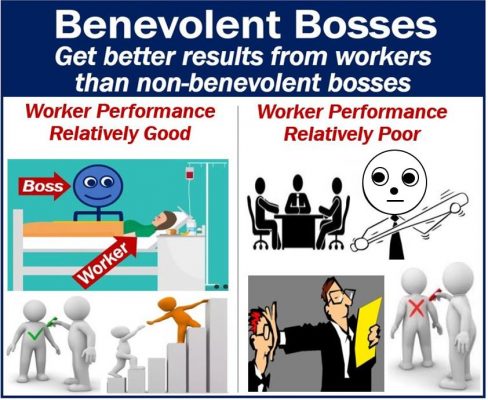
Authoritarianism-dominant leadership, the researchers found, nearly always had a negative effect on workers’ job performance. Benevolence-dominant leadership, on the other hand, nearly always had a positive effect.
In other words, leaders who showed no compassion for their workers had employees with relatively poor job performance. Those that showed compassion, however, motivated their subordinates to become better workers.
Relationship dynamics extends back to childhood
Classical paternalistic leadership also produced good results. In fact, leaders with a combination of benevolence and authoritarianism were as effective as benevolent-dominant leaders.
The reason for this phenomenon, Prof. Tsai believes, may extend all the way back to childhood.
Prof. Tsai said:
“The parent and child relationship is the first leader-follower relationship that people experience. It can become a bit of a prototype of what we expect out of leadership going forward, and the paternalistic leadership style kind of resembles that of a parent.”
Shelley Dionne added:
“The findings imply that showing personal and familial support for employees is a critical part of the leader-follower relationship.”
“While the importance of establishing structure and setting expectations is important for leaders, and arguably parents, help, and guidance from the leader in developing social ties and support networks for a follower can be a powerful factor in their job performance.”
Dionne is a Professor and Associate Dean of Binghamton University’s School of Management.
Effect of benevolent bosses is not cultural
The researchers had expected that the Taiwanese soldiers would react differently from the American full-time workers. However, the results were consistent across the two groups. Therefore, it seems that the impact benevolent bosses have on worker performance is not cultural.
Francis Yammarino said:
“The consistency in the results across different cultures and different job types is fascinating. It suggests that the effectiveness of paternalistic leadership may be more broad-based than previously thought, and it may be all about how people respond to leaders and not about where they live or the type of work they do.”
Yammarino is a Distinguished Professor at Binghamton University’s School of Management.
Prof. Tsai’s advice for managers is to put more effort on focusing on the well-being of their employees. In fact, they should place even more of an emphasis on their well-being than they do on hitting targets. In other words, never underestimate the positive impact that benevolent bosses have.
Prof. Tsai said:
“Subordinates and employees are not tools or machines that you can just use. They are human beings and deserve to be treated with respect.”
“Make sure you are focusing on their well-being and helping them find the support they need, while also being clear about what your expectations and priorities are.”
“This is a work-based version of ‘tough love’ often seen in parent-child relationships.”
Other team members
Prof. Tsai’s other colleagues were:
– An-Chih Wang (Andrew), Assistant Professor of Management, China Europe International Business School.
– Seth Spain, Assistant Professor of Management at Concordia University. Assistant Professor, Management
– Hsiao-Chi Ling of Kainan University.
– Min-Ping Huang, Professor at the College of Management, Yuan Ze University.
– Li-Fang Chou, Assistant Professor of Psychology, National Cheng Kung University.
– Bor-Shiuan Cheng, Distinguished Professor of Industrial/Organizational Psychology, National Taiwan University.
There have been many studies on what constitutes good leadership. In 2014, researchers from the University of Illinois investigated whether narcissists were good leaders.
Citation
“Benevolence-dominant, authoritarianism-dominant, and classical paternalistic leadership: Testing their relationships with subordinate performance,” An-Chih Wang, Chou-Yu Tsai, Shelley D.Dionne, Francis J.Yammarino, Seth M.Spain, Hsiao-Chi Ling, Min-Ping Huang, Li-Fang Chou, and Bor-Shiuan Cheng. The Leadership Quarterly, https://doi.org/10.1016/j.leaqua.2018.06.002.
Video – Benevolent bosses
This Binghamton University video talks about bosses who show compassion to subordinates.
