
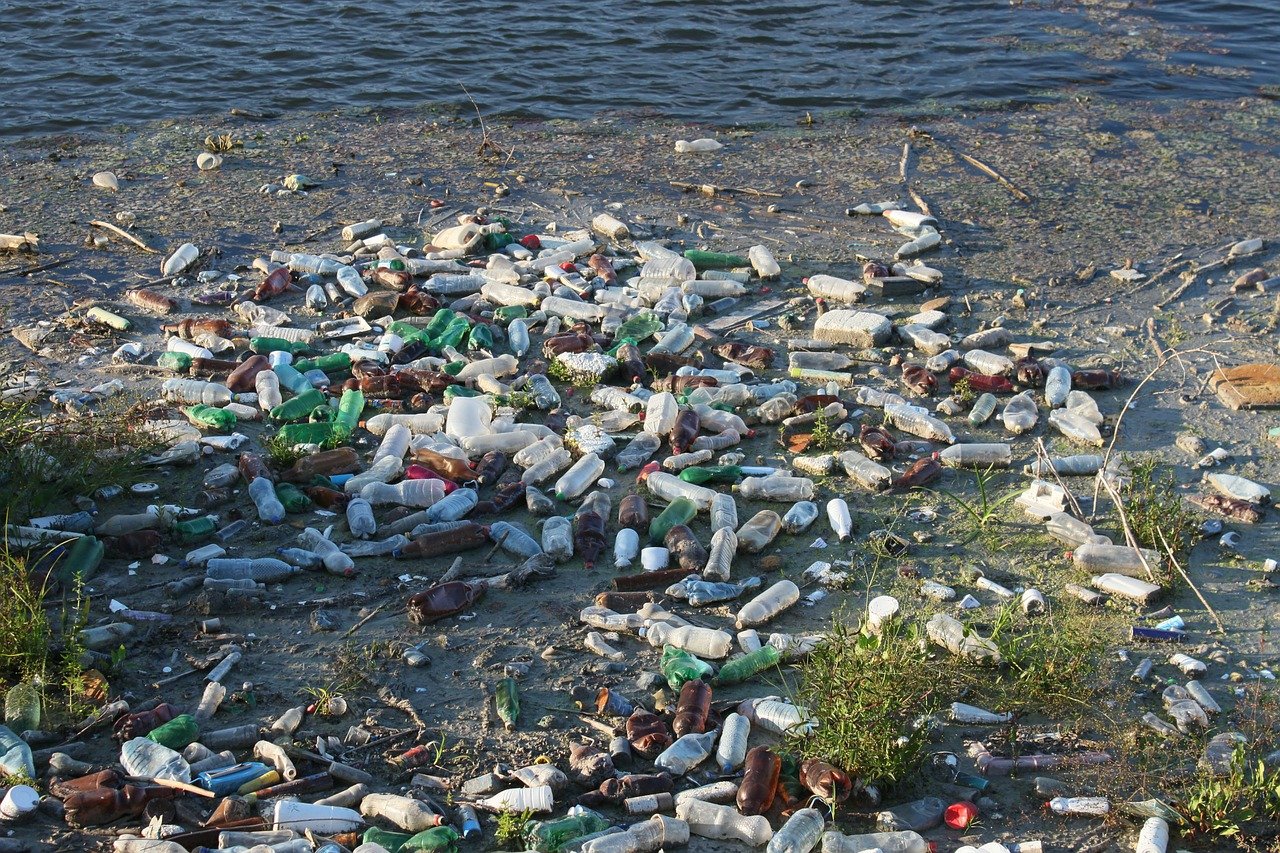
A recyclable plastic that is biodegradable and cheap to make has come closer to being feasible for widespread use.
Chemists at Colorado State University (CSU) have made a polymer called bacterial poly(3-hydroxybutyrate), more commonly known as P3HB, using chemicals in the laboratory.
 Biodegradable recyclable plastic is a sustainable alternative to petroleum plastic. Credit: pixabay-87342.
P3HB is a biomaterial that has already shown promise as a biodegradable, recyclable plastic alternative to that made from petroleum.
Indeed, it is already in use in specialized areas, for instance as a surgical material in medicine.
But because manufacturers currently use bacteria to make P3HB, the volumes are too low and the costs too high for more widespread industrial use.
The CSU researchers have developed a way to make P3HB using catalysts that they synthesized in the laboratory.
You can read how they did this in a scientific paper published in Nature Communications.
Chemical synthesis of P3HB
The CSU “chemical synthesis” process produces P3HB that has similar properties to the one made by bacteria.
The difference is that the CSU process is faster and lends itself more easily and cheaply for mass production of the polymer as a biodegradable, recyclable plastic.
For the starting material, the process uses “bio-sourced” succinate. The compound is a salt or ester form of succinic acid, which is made by fermenting glucose acid.
Succinic acid heads up the United States Department of Energy’s list of top 12 compounds made from biomass that are considered to be ideal replacements for chemicals traditionally made from petroleum.
The researchers say that their method “successfully addresses” the challenges that chemists who have been trying to solve the “chemical synthesis of bacterial P3HB” have faced for the last 50 years.
They have already applied for a provisional patent for their chemical synthesis technology.
‘Infinitely recyclable’
Chemical synthesis of P3HB is one of several recyclable plastic technologies that the CSU chemistry group, led by Prof. Eugene Chen, is working on.
Earlier this year, they reported in the journal Science how they developed “[a] synthetic polymer system with repeatable chemical recyclability.”
The team envisages a future in which plastic is simply “depolymerized” back to its starting material when the product has reached the end of its useful life as a commodity.
Thus, instead of ending up as landfill or littering the ocean, the recyclable plastic material enters a reactor that reduces it back to raw material. Not so much recyclable plastic as “infinitely recyclable plastic.”
