
Who would have thought that biofuels such as ethanol and biodiesel emit more greenhouse gas – specifically heat-trapping carbon dioxide – than gasoline? A team of scientists from the University of Michigan discovered this is the case. Their findings challenge the widely held assumption that ethanol, biodiesel and other biofuels are carbon neutral.
Contrary to what most people had assumed, the heat-trapping CO2 gas emitted when biofuels are burned isn’t fully balanced by the carbon dioxide uptake that occurs as the plants used to make them grow, Professor John DeCicco and colleagues from the University of Michigan’s Energy Institute wrote in the journal Climate Change.
People have commented over the years that although biofuels use crops, which are renewable, you still have to cook it down – an energy-consuming process – before you have a fuel that we can use.
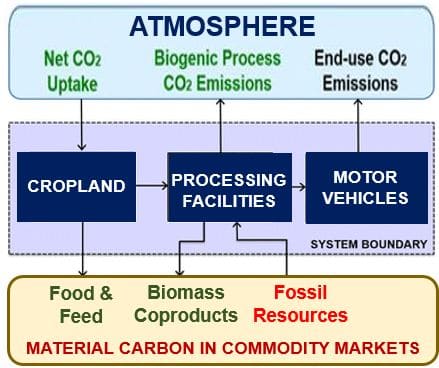 Material carbon flows relevant to the substitution of a biofuel for a fossil fuel. (Image: Journal Climate Change)
Biofuels aren’t carbon neutral!
The study, which was partly funded by the American Petroleum Institute, and was based on US Department of Agriculture crop-production data, shows that during the period when biofuel production in the US increased rapidly, the greater CO2 uptake by the crops only offset 37% of the carbon dioxide emissions due to biofuel combustion.
The authors conclude that rising biofuel usage has been linked to a net increase – and not a net decrease, as many people have claimed – in the CO2 emissions that cause climate change (global warming).
Prof. DeCicco said:
“This is the first study to carefully examine the carbon on farmland when biofuels are grown, instead of just making assumptions about it.”
“When you look at what’s actually happening on the land, you find that not enough carbon is being removed from the atmosphere to balance what’s coming out of the tailpipe.”
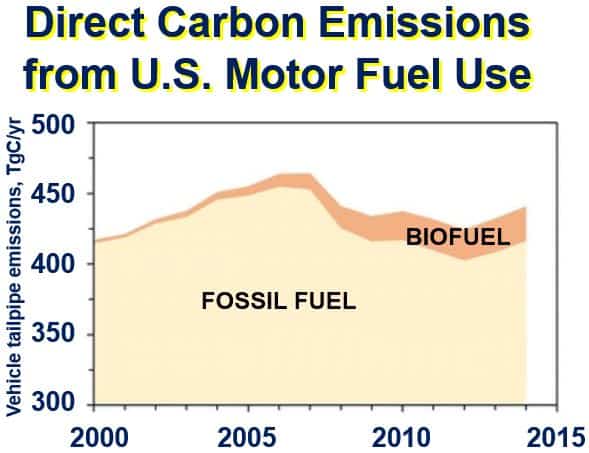 Direct carbon emissions from U.S. motor fuel use, 2000–2014. Source: derived from EIA. (Image: Journal Climate Change)
Replacing petroleum with biofuels has become increasingly popular over the past twenty years, especially in the larger nations such as Brazil and the United States. The US Renewable Fuel Standard is one of several policies that promote biofuel use for transportation.
Liquid biofuel consumption – mainly corn ethanol and biodiesel – has increased in the US from 4.2 billion gallons in 2005 to 14.5 billion in 2013. (A US gallon = 0.83 of a British gallon).
Biofuel carbon footprint assumptions were wrong
Environmentalists had assumed that renewable alternatives to fossil fuels were all inherently carbon neutral because their sources – plants – took out of the atmosphere the same amount of carbon dioxide that they emitted when burned, i.e. photosynthesis would consume whatever CO2 was produced when biofuels were used to make energy.
That assumption is embedded in the carbon footprint models used to administer and justify policies such as the California Low-carbon Fuel Standard and the Federal Renewable Fuel Standard.
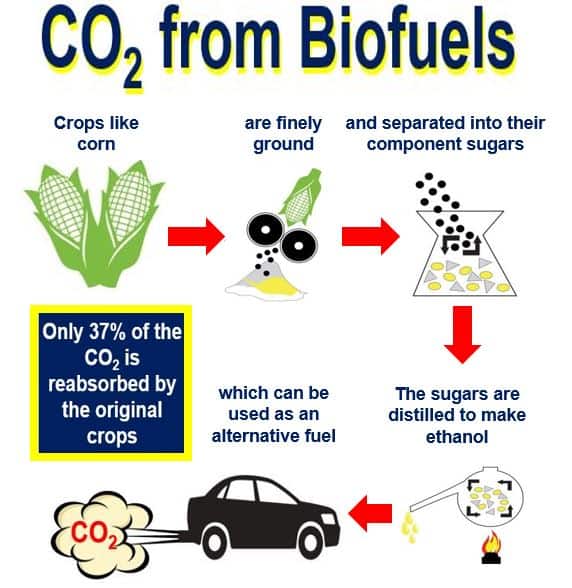 If further studies (preferably with no financial support from petroleum organizations) confirm that just 37% of carbon dioxide is reabsorbed by crops, then all that time and investment over the past two decades on biofuel R&D and production would have been pointless.
These models are based on a technique known as lifecycle analysis, and have often found that crop-based biofuels offer at least modest net greenhouse gas reductions relative to fossil fuels.
In this latest study, rather than modeling the emissions, Prof. DeCicco and colleagues analyzed real-world data on fossil fuel production, biofuel production, crop production and vehicle emissions. However, no assumptions were made regarding biofuels’ carbon neutrality. Their findings were striking.
Prof. DeCcicco said:
“When it comes to the emissions that cause global warming, it turns out that biofuels are worse than gasoline. So the underpinnings of policies used to promote biofuels for reasons of climate have now been proven to be scientifically incorrect.”
“Policymakers should reconsider their support for biofuels. This issue has been debated for many years. What’s new here is that hard data, straight from America’s croplands, now confirm the worst fears about the harm that biofuels do to the planet.”
In an Abstract preceding the main paper in the journal, the authors wrote:
“While U.S. biofuel use rose from 0.37 to 1.34 EJ/yr over this period, additional carbon uptake on cropland was enough to offset only 37 % of the biofuel-related biogenic CO2 emissions. This result falsifies the assumption of a full offset made by LCA and other GHG accounting methods that assume biofuel carbon neutrality.”
“Once estimates from the literature for process emissions and displacement effects including land-use change are considered, the conclusion is that U.S. biofuel use to date is associated with a net increase rather than a net decrease in CO2 emissions.”
Gasoline is a derivative product of petroleum or crude oil. Biofuels, which are derivatives of corn and other crops, are typically blended with gasoline.
Citation: “Carbon balance effects of U.S. biofuel production and use,” John M. DeCicco, Danielle Yuqiao Liu, Joonghyeok Heo, Rashmi Krishnan, Angelika Kurthen, and Louise Wang. Climate Change. 25 August, 2016. DOI: doi:10.1007/s10584-016-1764-4.

Comments are closed.