
Brexin refers to Britain remaining in the European Union. It is the opposite of Brexit. However, linguists say that the word Brexin makes no sense, while Brexit does.
BREXIT is the result of combining the first two letters of BRitain and adding the whole word EXIT.
However, BREXIN appears to have no proper origin. The BR comes from the beginning of BRitain, but where does EXIN come from? It cannot have anything to do with EXIT, because that would suggest leaving the EU. Even if the letters did refer to leaving, where do the letters IN at the end come from?
Perhaps the opposite of Brexit should be BRIN, which would be BRitain + the word IN.

Some words, however, do not originate from two or more root words but are the result of a change in the spelling of another word. So, Brexin, if it is to become a term that sticks, came from Brexit, where ‘it’ is replaced with ‘in’ to give it the opposite meaning.
BREXIN – a recent addition
The term Brexit became popular before Brexin. In fact, Brexin is a very recent addition to the English language. It is also an informal one.
Brexit became popular during the 2015 general election campaign. Conservative Party leader and Prime Minister David Cameron promised a referendum regarding the UK’s membership of the European Union. Mr. Cameron made this pledge if his party won.
The Conservatives party won. Subsequently, on 23rd June 2016, there was a referendum. The Brexin camp lost with just 48.1% of the votes, compared to 52.9% who opted for Brexit. In other words, a small majority voted to leave the European Union.
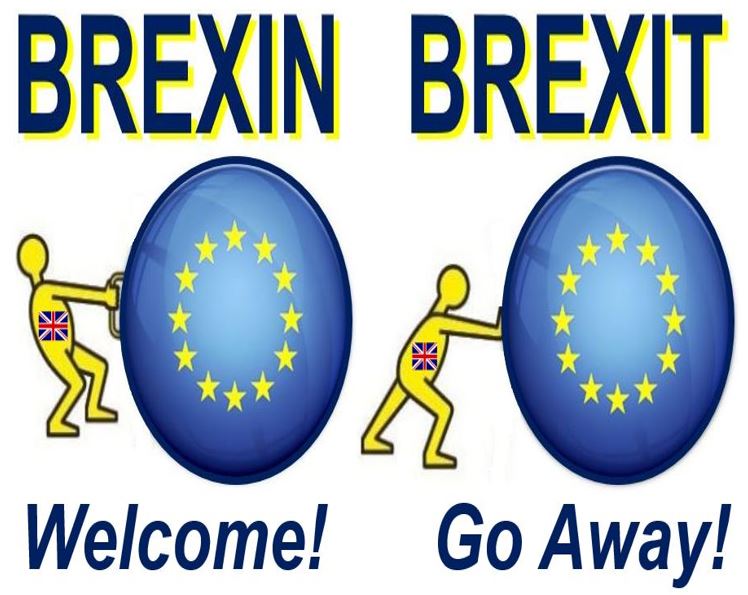
A Brexiteer is somebody who supports Brexit. In other words, a Brexiteer wants to leave the EU. There does not seem to be a word for a Brexin supporter. Could it be a Brexineer or Brineer (if the term BRIN takes hold)?
And then came BREGRET
Another word that emerged after the referendum was BREGRET. BREGRET is possibly the newest word in the English language regarding EU attitudes. It is a verb and means to regret voting for Brexit. The term BREGRET comes from BRExit + reGRET.
People voted on Thursday, 23rd June, and did not know what the result was until Friday morning.
Some voters woke up on Friday and were shocked to see Prime Minister David Cameron resigning. Then the pound took a nosedive and Brexit campaigners started breaking their pledges. For example, they turned on their promise to spend EU money on the NHS (National Health Service).
When the UK’s credit rating deteriorated to ‘negative’ and a declining stock market took hold, millions of people wondered whether they had made a mistake.
Furthermore, Financial Times informed that some banks were making plans to move people from London to an EU city.
Some of the people who voted to leave felt BREGRET – BRExit reGRET. In other words, they wished they had voted to remain.

Comments are closed.