
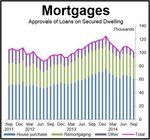
The number of mortgages approved by British financial institutions has fallen to a one-year low, the Bank of England announced on Wednesday, adding to evidence that the housing boom is cooling off.
According to the UK’s central bank, mortgage approvals for private dwellings fell from 64,054 in August to 61,267 in September, which was in line with a forecast by the British Bankers’ Association.
Mark Carney, Governor of the Bank of England (BoE), said earlier this year that the accelerating accumulation of debt linked to increasing house prices was the greatest threat to the country’s economic recovery.
After rising by 10% across the country and over 20% in London, house prices have recently started to grow more slowly, while mortgage approvals have yet to reach levels seen before the financial crisis.
After rising rapidly over the last year, the Centre for Economic and Buisness Research said earlier this month that house prices should decline by -0.8% in 2015. The slowdown will be even steeper in London, where forecasters see prices slumping by -2.6%.

(Source: Bank of England Statistical Release, Oct 29, 2014)
Since April, mortgage lenders have had to make more stringent checks on applicants. The BoE also placed a limit on the borrower’s income-to-mortgage ratio.
The central bank said mortgage lending increased by £1.8 billion in September, compared to a £2.2 billion growth in August. Mortgage lending tends to lag approval trends.
Unsecured consumer lending, at £915 million in September, was higher than analysts had expected.
The effective rate on outstanding mortgages declined 0.2 of a percentage point to 3.2% in September, the lowest since 1999 when the series began. The rate on new secured loans increased by 0.1 of a percentage point to 3.22%.
The broad measure of money supply, M4, dropped by -0.7% in September from August and fell by -2.5% compared to September 2013, the largest decline since November 2012.
On Friday, the BoE will announced its new leverage ratio for lenders, which limits how much can be lent in relation to their capital.
Corporate lending (to businesses) fell by £710 million in September, after rising in August. Lending to businesses fell by -3.1% compared to September 2013.
According to the Nationwide Building Society, house price growth is losing momentum.
