
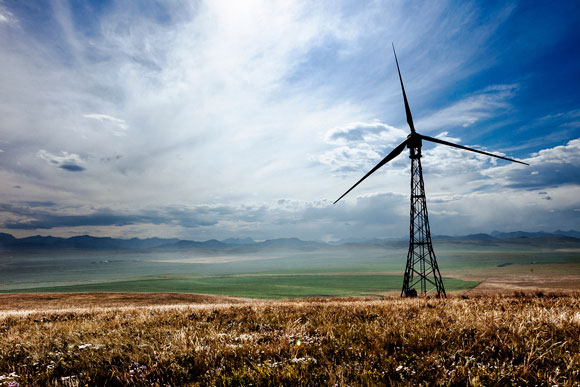
Canada’s power capacity from non-hydro renewables has grown significantly – from just 2 percent of the country’s total capacity in 2005 to 11 percent in 2015.
A new report from the National Energy Board (NEB) reveals that Canada generates nearly two-thirds of its electricity from renewable sources.
 Canada’s generation capacity from wind energy increased 20-fold over the past decade. Image: NEB
Hydro is the main source of electricity in Canada. The report shows it accounts for 55 per cent of total installed capacity and 58 percent of generation.
In British Columbia, Manitoba, Quebec, Newfoundland & Labrador and Yukon, over 85 percent of electricity comes from hydro.
In fact, in these hydro-rich provinces and territories, over 90 percent of electricity comes from renewables, say the NEB.
However, in the last decade, the biggest growth has been in non-hydro renewables.
Wind capacity increased 20 times (from 556 to 11,071 MW), while solar capacity multiplied 125 times (from 17 to 2,134 MW).
Shelley Milutinovic, chief economist at the NEB, says:
“Canada’s wind and solar power capacity has increased dramatically in the past decade due to the support of various policies and programs.”
But despite these steep rises, wind, solar and biomass combined represented only 11 percent of total Canadian capacity in 2015.
Also, these non-hydro renewables accounted for just 7 percent of total generation, because of the intermittent nature of wind and solar.
Canada second in the world in hydro, fourth in renewables
Canada is a world leader in renewable power, says the NEB report.
“The country now ranks second in the world in hydro power generation and fourth in the world in renewable generation,” notes Milutinovic.
In tandem with the dramatic growth of Canada’s non-hydro renewables, there has also been a fall in greenhouse gas emissions.
Around 11 percent of Canada’s greenhouse gas emissions emanate from electricity generation. During 2000-2014, these have dropped by 40 percent, mainly due to the phasing out of coal in Ontario, and programs to reduce emissions in Nova Scotia and New Brunswick.
Challenges to growth
The NEB report says the greatest challenges to further growth in renewable power in Canada are: local opposition, concerns about cost, slow growth in demand for electricity, and the long operating life of existing plants.
Meanwhile, 2015 was an extraordinary year for renewable energy. A report released earlier this year shows that in many markets, renewables are now competitive with fossil fuels and in many parts of the world are established as mainstream sources of power.
The REN21 Global Status Report 2016 notes the key to closing the energy access gap lies in distributed renewable energy that is decentralized and community-based, and adds:
“Cities, communities and companies are leading the rapidly expanding ‘100 percent renewable’ movement.”
Video – Renewable Energy
Renewable energy is energy that comes from a source that never runs out, i.e., it lasts forever.
