

Canadian top CEOs are happy, their average pay is back to pre-crisis levels. The average top CEO will earn more by lunchtime on the first work day of 2015 than the average Canadian does in a whole year, says the Canadian Centre for Policy Alternatives (CCPA).
The CCPA annual CEO pay review, written by Hugh Mackenzie, a CCPA Research Associate, looked at compensation levels among Canada’s 100 highest paid CEOs in 2013. He found they earned an average of $9.2 million, which was 195 times greater than the $47,358 the average Canadian received annually. Their pay was 237 times that of the average working woman in Canada.
The last time the richest 100 CEOs’ pay exceeded 2013’s level was in 2007, when they averaged $10 million.
“By 11:41 a.m. today, just as most Canadians are getting ready for their lunch break on the first official work day of the year, the average of the 100 highest paid CEOs will have already pocketed what it takes the average Canadian an entire year, working full-time to earn.”

Mr. Mackenzie believes a new tax system should be considered to address Canada’s growing pay gap.
Gerald W. Schwarz, whose total compensation package in 2013 reached $87.9 million, was the highest paid CEO in Canada in 2013.
The pay gap among the top 100 CEOs has narrowed. In 2008, the lowest paid among the top 100 earned $3.18 million, compared to $4.14 million in 2013, an increase of 30%.
Forty-three percent of Canada’s top 100 CEOs belong to a defined pension plan worth (average) $1.39 annually. In contrast, just 11% of workers in the private sector have a defined benefit pension plan.
Three-quarters of Canada’s 100 best-paid CEOs received stock options in 2013 as part of their pay package, worth (average) $3.16 million.
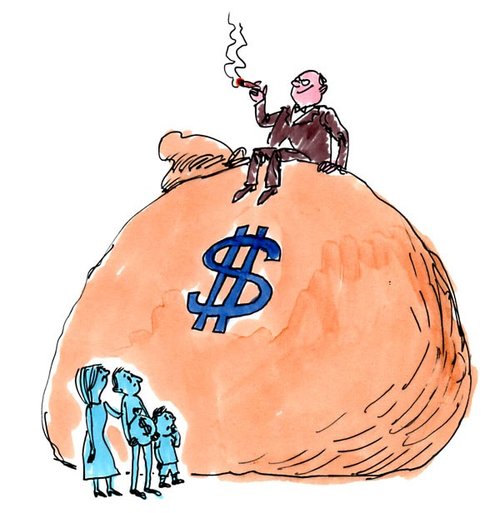
Canada’s top 100 CEOs earn 195 times more than the average Canadian worker.
Should top earners be taxed more?
Mr. Mackenzie points out that voluntary restraint and shareholder activism to rein in CEO compensation has been poor. He suggests the government should consider simple tax measures to close the widening income gap in Canada.
Mr. Mackenzie said:
“Canada would benefit from closing the tax loophole that allows executives to pay half the income tax rate on proceeds from cashing in stock options by claiming that revenue as capital gains.”
“The stock options held by the highest paid 100 CEOs in 2013 represent a tax break worth more than a billion dollars – money that would go a long way toward addressing Canada’s 1989 commitment to end child poverty, for example.”
