
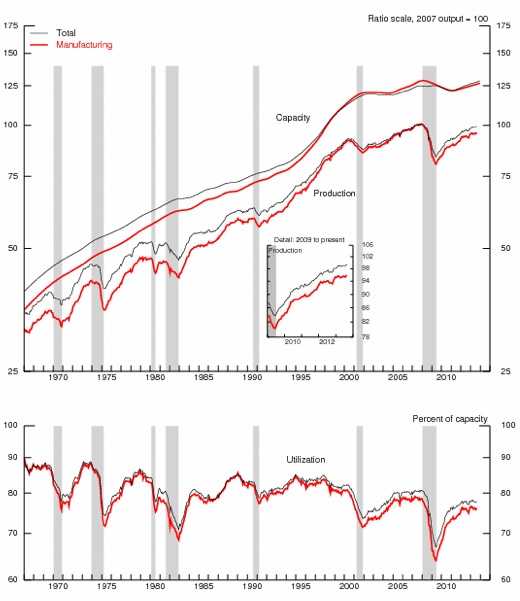
Capacity utilization is a term used to describe how a company or country uses its installed productive capacity.
It analyzes the rate of output that is actually being produced compared to the potential output if an entity were to use full capacity.
It helps reveal how efficiently the factors of production are being used. There is statistical evidence that shows many industries in the developed world experience significant excess capacity.
Economists use capacity utilization as a tool to measure inflation pressures. If demand in an economy weakens, then capacity utilization will fall, however, if demand increases then capacity utilization increases.
Excess capacity in the market is also an indicator that there is not enough demand to meet the growing output. In such a scenario it is believed that if utilization rises above 85% then price inflation will rise.
Bondholders are also affected by changes in capacity utilization, as a strong capacity utilization is an indicator of higher inflation in the future. A predicted high inflation rate decreases the price of bonds and typically results in a higher yield to male up for the expected increase in inflation.
In economic statistics capacity utilization is typically used for industries producing goods at plant level. Capacity utilization is presented as an average percentage rate by industry and economy-wide, where 100% means that there is full capacity.
If the capacity utilization rate is high then there is “under-capacity”, whereas if the capacity utilization is low then there is an “excess capacity” or “surplus capacity”.
The US Federal Reserve Board’s survey of plant capacity is recognized in the FRB capacity utilization index. This involves asking firms about “the maximum level of production that this establishment could reasonably expect to attain under normal and realistic operating conditions, fully utilizing the machinery and equipment in place.”
According to the Federal Reserve update on Industrial Production and Capacity Utilization:
“Capacity utilization for total industry has risen in each year from 2010 to 2013. In 2013, capacity utilization for total industry was 78.4 percent, a rate 1.7 percentage points below its long-run (1972–2013) average of 80.1 percent. Compared with earlier estimates, capacity utilization for total industry is now reported to have been slightly lower in each year from 2010 to 2013.”
Utilization refers to how well or badly we are making use of available resources or hours. For example, if a machine is operating for 84 of 168 available hours in one week, it has a utilization of 50%.
