
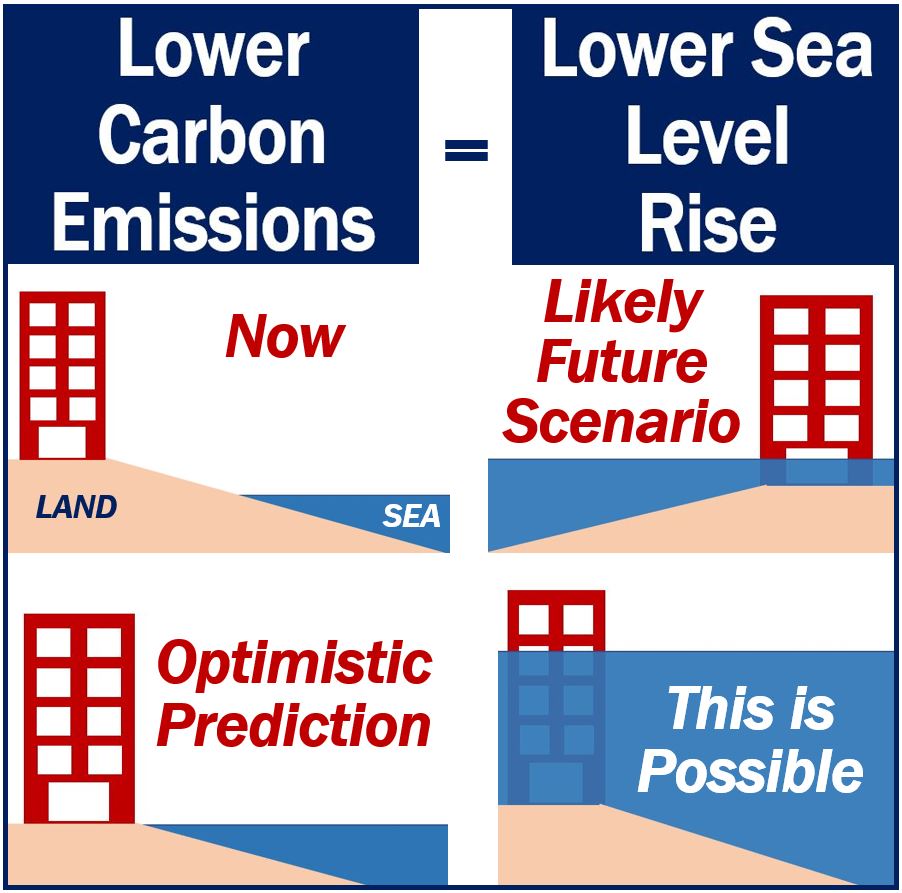
Reducing carbon emissions will help limit sea level rise, say researchers at Oregon State University in the United States. Researchers, in recent years, have been able to correlate global warming rates to cumulative carbon emissions. In other words, the more carbon we emit, the warmer our planet gets. Specifically, carbon emissions from burning fossil fuels.
This relationship became the basis of the 2016 Paris Agreement on climate change. The Agreement directs the majority of countries in the world to limit their carbon emissions.
Fossil fuels are fuels that formed in the geological past from the remains of living organisms. Natural gas, oil, and coal, for example, are fossil fuels.
This new study shows that there is also a correlation between future sea level rises and cumulative carbon emissions. In other words, the more carbon we emit, the faster sea levels rise.
According to the researchers: “The news isn’t good!”
Lead author, Peter Clark, and colleagues wrote about their study and findings in the prestigious journal Nature Climate Change. The citation for this article is at the bottom of this page.
Clark is a Distinguished Professor of Earth, Ocean, and Atmospheric Sciences at Oregon State University (OSU).
Sea level rise warning
Over the next few thousand years, sea levels will continue to rise by several meters. This will happen even under the most optimistic scenarios that the Paris Agreement outlines.
By ‘optimistic,’ in this context, we mean limiting the overall warming of our planet to 1.5°C.
If overall temperatures rise by 2°C, the sea level rise may be more than nine meters. Nine meters is almost thirty feet. When we talk about rising temperatures of our oceans and atmosphere, we use the term ‘global warming.’
In other words, no matter how much we reduce our carbon emissions by, sea level rises will happen regardless.
Prof. Clark said:
“When we pump more carbon into the atmosphere, the effect on temperature is almost immediate. But sea level rise takes a lot longer to respond to that warming.”
“If you take an ice cube out of the freezer and put it on the sidewalk, it doesn’t melt immediately.”
“The same is true for ice sheets. It takes time for them to melt so that the resulting sea level rise will continue for hundreds to thousands of years after we’re done emitting carbon.”
Carbon emissions – past and present
We have emitted approximated 600 billion tons of carbon into the atmosphere since 1750. In other words, since the beginning of the Industrial Revolution.
As a result, the overall global temperature has risen by about 1°C.
We are currently emitting 10 billion tons of carbon each year. We are, therefore, on track to hit the 2°C Paris Agreement threshold in sixty years.
Prof. Clark added:
“We now know how much more carbon we can emit to keep below a certain temperature.”
An additional guide
The researchers make a case for using carbon emissions and the subsequent sea level rise as an additional guide. Specifically, an additional guide for future policy decisions regarding reducing or limiting carbon emissions.
Regarding how much sea level rise we can withstand, Prof. Clark said:
“One way to begin looking at it from a policy standpoint is to ask the question, ‘how much sea level rise can we tolerate?'”
“It becomes a fairly simple exercise from there. The more carbon we emit, the more sea level rise we are committed to. We need to ask if there is a target for sea level rise – much like the 2-degree threshold that was established for global warming.”
The authors believe that limiting sea level rise to 3-to-9 meters over several thousand years is unlikely. It is overly optimistic, they say, unless we reach zero emissions immediately.
The future – a catastrophic sea level rise?
If cumulative carbon dioxide emissions increased to 3,000 billion tons, the sea level rise would be catastrophic.
We would be looking at a sea level rise of thirty or even forty meters, this latest study shows. Thirty and forty meters are equivalent to 98 and 131 feet respectively.
Co-author, Professor Alan Mix, also Distinguished Professor of Earth, Ocean, and Atmospheric Sciences at OSU, said:
“The sea level rise we’ve seen thus far is just the tip of a very large iceberg. The big question is whether we can stabilize the system and find new energy sources.”
“If not, we’re on the way to a slow-motion catastrophe. The question becomes: What do we owe our grandchildren and their grandchildren?”
Sea level rise – economic toll
Coastal flooding in 2015 cost the world’s biggest coastal cities about $6 billion in 2005. By 2050, this figure will soar to about $1 trillion.
If we build strong coastal defenses, we could reduce the economic toll to $60 billion. However, in their paper, the authors write: “Such well-intended short-term efforts neglect the long-term horizon of sea level rise.”
Sea level rise response time
Sea level response time is considerably longer than temperature. In other words, when the overall global temperature rises, the rise in sea levels takes a long time to happen.
Regarding this response time, Prof. Clark said:
“You can build a one-meter seawall. But what do you do when sea levels rise by two, or five, or 10 meters?”
“Rising sea levels haven’t really alarmed people yet because their response time is much longer than temperature. Smart countries will use that to their advantage and begin adaptation strategies over time.”
Co-author, David Wrathall said that poorer countries will suffer significantly more than the advanced economies when sea levels rise.
Wrathall is Assistant Professor of Geography, Environmental Sciences, and Marine Resource Management at OSU.
A billion people will be affected
About one billion people live in coastal zones globally.
Regarding people who live on the coast, Prof. Wrathall said:
“Many of those people depend directly or indirectly on the oceans for their livelihood – and we don’t know all the ways they will be affected.”
“But you don’t have to look far away to see the devastating impact of extreme events – like the hurricanes in Puerto Rico and Texas – that will take decades to recover from.”
Citation:
“Sea-level commitment as a gauge for climate policy,” Peter U. Clark, Alan C. Mix, Michael Eby, Anders Levermann, Joeri Rogelj, Alexander Nauels & David J. Wrathall. Nature, 16 July 2018. https://doi.org/10.1038/s41558-018-0226-6.
