
China has overtaken the United States and France to become Germany’s biggest trading partner for the first time.
Preliminary figures from the German Federal Statistical Office show that trading volume (exports plus imports) between Germany and China rose to 170 billion euros ($180 billion) in 2016.
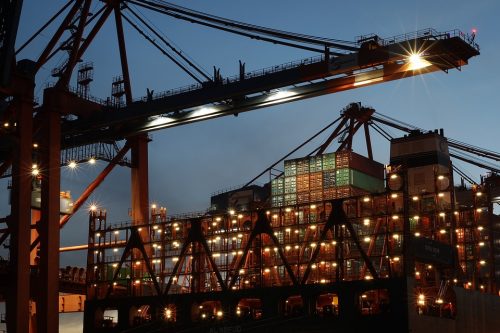 China is now Germany’s biggest trading partner. Image: Hamburg port pixabay-2103261
The figures also show that Germany’s exports rose 1.2 percent to 1,207.5 billion euros and imports rose 0.6 percent to 954.6 billion euros in 2016 to reach record highs, as they had in the previous year.
Trade between the European Union (EU) and China has increased dramatically in recent years, reflecting the desire on the part of both to pursue open trading relations.
Since 2013, the two powers have held 12 rounds of negotiations toward a comprehensive EU-China investment agreement.
China’s exports to the EU are dominated by industrial and consumer goods such as: machinery and equipment, footwear and clothing, furniture, and toys.
EU exports to China consist mostly of machinery and equipment, motor vehicles, aircraft, and chemicals.
Services do not feature highly in EU and China trade: they amount to only one tenth of total trade between the two powers.
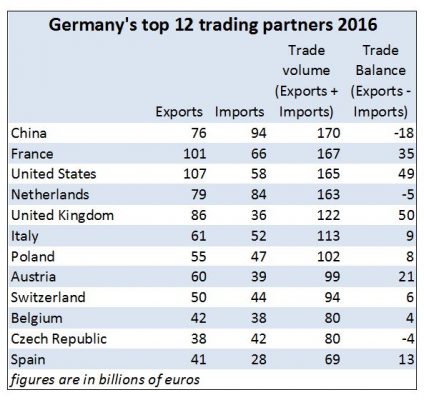 Data from: destatis
However, the EU is treading cautiously amid concerns that China’s view of fair trade might be less tight than it should be – especially when it comes to respecting intellectual property rights and meeting World Trade Organization (WTO) obligations.
Nevertheless, China overtaking the US to become Germany’s biggest trading partner may well help Germany in two ways.
First, it sends a strong signal to Washington that Germany can and will seek deals without the US, as the new White House regime pushes a more nationalistic economic agenda.
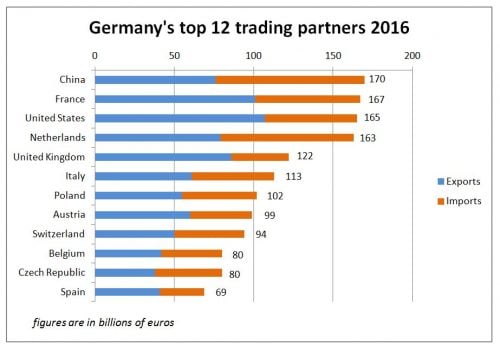 Data from: destatis
Secondly, in view of the fact that President Trump seems bent on pursuing a trade war with China, it gives Berlin an opportunity to put pressure on Beijing to further loosen market restrictions for German investors.
Anton F. Börner, head of Germany’s Federal Association of Wholesale, Foreign Trade and Services (BGA), was recently quoted by Reuters as saying:
“Given the protectionist plans of the new US president one would expect that the trade ties between Germany and China will be further strengthened.”
Meanwhile, China is also pushing ahead with developing ways of opening up trade routes, such as the recent launch of a direct rail freight service that runs west across Europe to London and back.
