
Is China overtaking the US economy soon? According to the World Bank Group, it is going to happen either in 2014 or 2015. However, its calculations are based on purchasing power parity, which many economists argue are simply not realistic.
The World Bank says China’s GDP (gross domestic product) was 87% that of the United States’ in 2011, with calculations adjusted by purchasing power parity (PPP). On this basis China will overtake the US within the next couple of years.
Most economists had forecast that the “great sorpasso” (when China passes America into Number 1 spot) would occur in 2019. However, after updating the costs of services and goods, the date has been brought forward, suggesting America’s era of global dominance which started in the last quarter of the 19th century is about to end.
China rejects World Bank report – according to the Huffington Post, China’s National Bureau of Statistics rejected the World Bank’s report. The Bureau, which took part in the study, “expressed reservations” about the methodology of the study and “did not agree to publish the headline results for China. The NBS of China does not endorse these results as official statistics.”
PPP to compare GDP sizes makes no sense
The problem is that using PPP-adjustments to compare one country’s GDP with another and claim one is bigger than the other makes absolutely no sense.
As the term indicates, PPP is about purchasing power and not economic size. Goods and services in Sudan are much cheaper than in Switzerland, but to extrapolate from PPP information and say the Swiss economy is smaller is simply wrong.
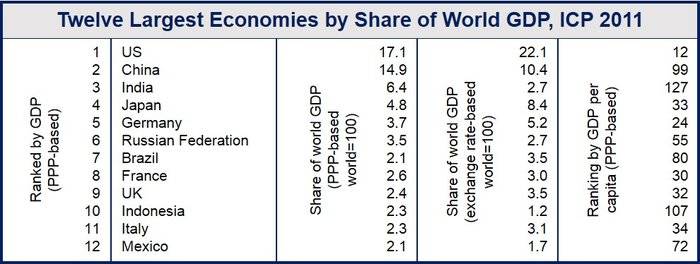
Exchange-rate based calculations give different results to PPP-based ones. (Source: World Bank)
When gauging a country’s economic size one has to measure what it has, i.e. its national wealth, and not what transactions occurred over a 12-month period. National wealth is a much more reliable measurement of a country’s economic size.
The Wall Street Journal quotes Credit Suisse, which placed Chinese private wealth at approximately $22 trillion in mid-2013, much more than the country’s standard GDP of $9 trillion in 2013. The bank placed US private wealth during that same period at $72 trillion, more than triple that of China’s.
Admittedly, private wealth is not the only calculation for economic size. However, saying that a country with $50 trillion less in private wealth has a larger economy is massively inaccurate.
Converting GDP into one currency not accurate either
Comparing economic output of nations is not easy. The simplest way is to convert a country’s GDP into one currency, for example dollars, at market exchange rates. It is a useful way of measuring a country’s international might. If one measures economic output in this way, China’s GDP is 43% of the USA’s.
However, using just market exchange rates can be misleading when comparing growth rates or living standards. If the British pound drops 5% in one month against the US dollar, does that necessarily mean British living standards or growth rates have fallen by 5%? No, it does not.
Exchange rates are changing all the time, yielding diverging GDP values from day to day.
US still a long way ahead
Before becoming too disheartened, Americans should bear the following in mind:
- China is still a developing nation, the US is a developed country.
- The US is five times richer that China in per capita terms.
- US services, such as health, education, etc. are light-years ahead of China’s.
- According to the United Nations Human Development Index, China is in 101st place while the US is in 3rd, out of 186 nations.
Several benchmarks needed to gauge a country’s success
A country’s economic might needs to be gauged against a number of different benchmarks. Investment and productivity are important, as are how many global companies a nation has headquartered within its borders. Its science base and universities should also be included in the mix.
When taking these benchmarks into account, the US and other developed nations are a very long way ahead of China.
The United States controls the world’s reserve currency – the dollar. It can print dollars, and most of China’s foreign debt is held in dollars.
Military might
One should not just look at economics when devising a league table of country rankings. A nation’s military might is an important factor when measuring its power.
China’s investments in its armed forces have increased significantly over the last 15 years, but annual expenditure barely reaches one third of what the United States spends.
While China may have more foot-soldiers, the US’ stock of hardware and technological competence is far superior.
Overall, the US is the most powerful country in the world, and will be for many years to come.
