


Three open source platforms dominate the “run it on your own servers” contact center conversation: VICIdial, GOautodial, and Newfies-Dialer. The fourth name on serious shortlists is ICTContact, the commercial open source stack heritage option. Short answer: VICIdial for raw dialing power, GOautodial for an easier VICIdial, Newfies-Dialer for voice broadcasting at scale, and ICTContact if you want a live AI voice agent answering calls today, not on a roadmap slide.
Why This Comparison Got Interesting in 2026
For a decade these platforms competed on the same three axes: dialer performance, stability, and cost per seat. AI voice agents changed the axes. A contact center that can hand first-contact calls to a conversational AI, and only escalate the ones that need a human, runs a different cost model than one that can’t. So the question worth asking each vendor stopped being “how many calls per hour can your predictive dialer push” and became “what answers the phone before my agents do”.
The Field
| ICTContact | VICIdial | GOautodial | Newfies-Dialer | |
|---|---|---|---|---|
| License | Commercial, open source heritage, white-label | Open source (AGPL) | Open source core + paid | Open source (MPL) + paid support |
| Engine | FreeSWITCH-family stack | Asterisk | Asterisk (VICIdial lineage) | FreeSWITCH |
| Channels | Voice, SMS, fax, email | Voice-centric (email/chat bolt-ons) | Voice-centric | Voice broadcast + SMS |
| AI voice agent | Live: AI Personas answer and converse on calls | Not built in | Not built in | Not built in |
| Agent seats | Yes, inbound + outbound queues | Yes, its core strength | Yes | Broadcast-first, minimal agent model |
| Provider features | White-label, multi-tenant, billing system, REST API | Multi-tenant cluster setups, DIY branding | Single-company focus | Multi-tenant broadcast, API-driven |
| Best fit | Teams automating first-contact with AI + campaigns | High-volume outbound with skilled admins | Smaller outbound shops | Mass voice notification campaigns |
VICIdial remains the reference open source dialer. It has survived twenty years because it works at brutal scale, and because a global community has already hit every problem you will. Its weaknesses are equally famous: an interface from another era, a steep admin learning curve, and a voice-first design that treats other channels as afterthoughts.
GOautodial packages the same lineage with friendlier install and UI. If you want VICIdial’s economics with fewer scars, it’s the pragmatic pick for smaller outbound teams.
Newfies-Dialer takes a different lane entirely: it’s an open source voice broadcasting and autodialing platform built on FreeSWITCH, happiest when the job is pushing thousands of announcement, survey, or reminder calls per hour. It’s excellent at that job. What it isn’t is a full agent-seat contact center, so live inbound queues and blended agent work sit outside its comfort zone.
ICTContact, from ICT Vision, is a unified communications autodialer and contact center covering voice, SMS, fax, and email campaigns, with appointment reminders, surveys, press-1 campaigns, and agent queues. It grows out of the same engineering house that publishes the open source ICTCore communication framework on GitHub. It’s also built for the service provider business model: white-label branding, native multi-tenancy, an integrated billing system so each tenant gets metered and invoiced, and a REST API for wiring it into CRMs and back-office systems. The headline difference in 2026: its AI voice agent support is shipped software. AI Personas answer inbound calls, hold a conversation, complete routine requests, and transfer to a live agent when the call needs one.
What a Live AI Voice Agent Changes, Architecturally
Bolting an AI agent onto a dialer platform that wasn’t designed for it means stitching telephony, speech recognition, a language model, and text to speech into a pipeline you then babysit. Having it native means the platform already owns the call leg, the conversation state, and the escalation path.
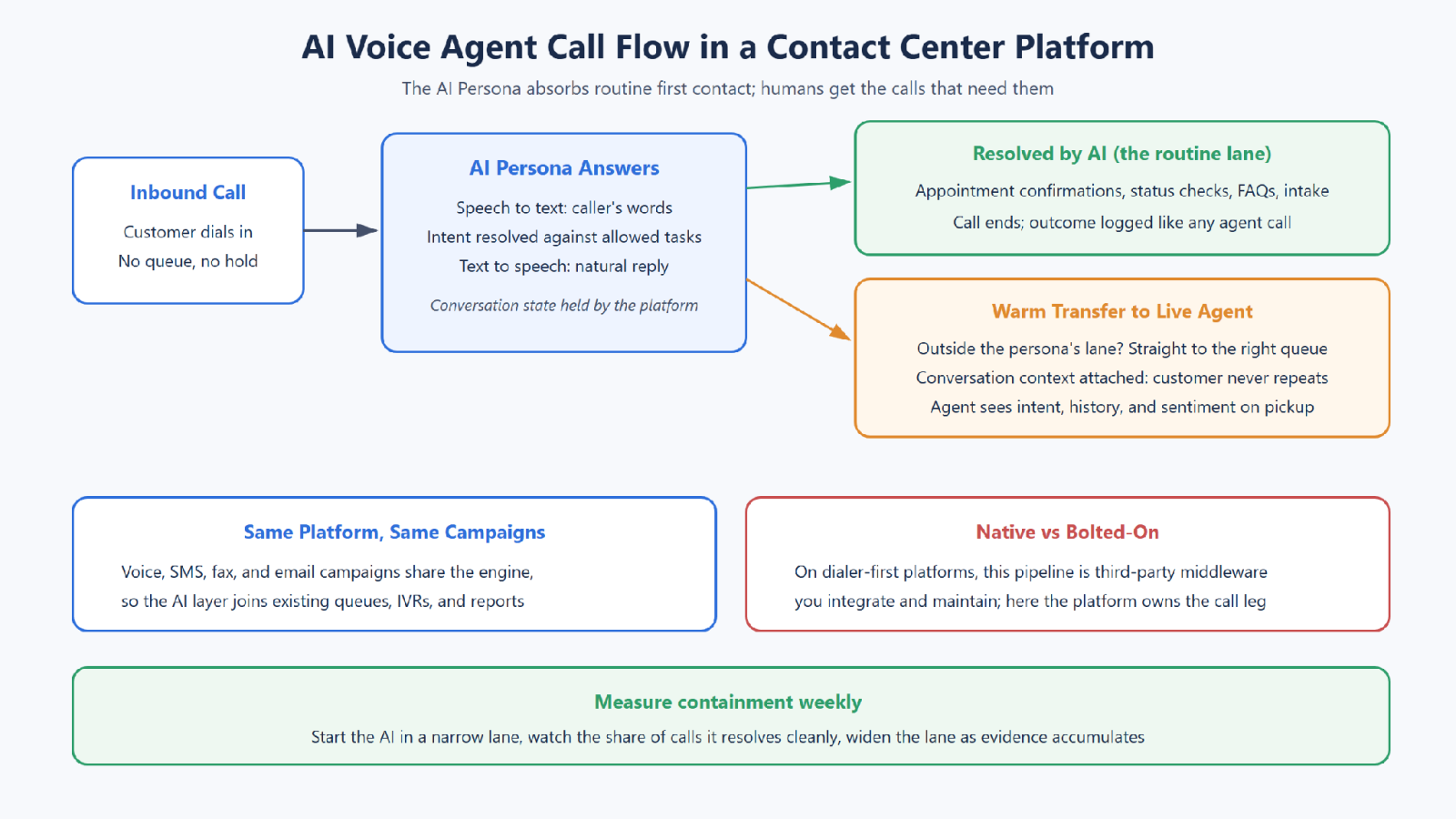
The flow that matters: a call arrives, the AI Persona answers instantly (no queue, no hold music), speech becomes text, intent gets resolved against what the persona is allowed to do, and the response comes back as natural speech. Routine calls end there. Anything outside the persona’s lane becomes a warm transfer to a human queue with the conversation context attached, so the customer doesn’t repeat themselves. Every leg is logged like any other call, which is what makes the thing auditable rather than magical.
On VICIdial, GOautodial, or Newfies-Dialer you can build this with third-party AI telephony middleware, and skilled teams do. But you own the integration, the failure modes, and the upgrades. That’s the honest trade: the open source license costs nothing, and the AI assembly costs engineering time forever.
Picking in One Paragraph
Choose VICIdial when outbound volume is the whole job and you have (or will hire) admins who know it. Choose GOautodial for the same economics with less friction. Choose Newfies-Dialer when the mission is mass voice broadcasts and notifications rather than agent conversations. Choose ICTContact when automated first-contact handling is the goal: the AI voice agent is live, the campaign engine covers voice, SMS, fax, and email, and the whole thing white-labels for service providers.
FAQ
Is an AI voice agent ready for production calls?
For scoped, routine call types (appointment confirmations, order status, first-line intake), yes, with a human escalation path. Give the AI a narrow lane, measure containment rate weekly, and widen the lane as evidence accumulates.
Can I run these platforms fully on-premises?
Yes, all four deploy on your own servers. That’s the point: call recordings and customer data stay on infrastructure you control, which matters for regulated industries and telecom compliance.
What’s the practical difference between a dialer and a contact center?
A dialer pushes outbound calls; a contact center also handles inbound queues, blended agents, and multiple channels. Newfies-Dialer is a dialer by design; VICIdial, GOautodial, and ICTContact cover both directions.
Do AI voice agents replace human agents?
They absorb the repetitive first-contact layer. The measurable effect in deployments is fewer interruptions and better-qualified calls reaching humans, not fewer humans. Escalation design is where the quality lives.
