


If you want a help desk that runs on your own server, four names keep coming up: ICTDesk, osTicket, Zammad, and Faveo. The short version: osTicket wins on install base, Zammad on interface polish, Faveo on price flexibility, and ICTDesk on getting live support and ticketing in one commercially backed package.
Here’s the longer version, because the short one hides the trade-offs that matter.
Why On-Premises Still Makes Sense in 2026
Cloud help desks are easy until the invoice scales with your team, or until a compliance auditor asks where exactly your customer conversations live. Self-hosting answers both. Your ticket data sits on hardware you control, agent seats don’t turn into a subscription line that grows every quarter, and you can wire the help desk into internal systems that a SaaS vendor will never see.
The price you pay is operational: you patch it, you back it up, you keep it alive. So the real question isn’t “cloud or on-prem”, it’s “which on-prem system costs me the least attention”.
The Four Contenders, Honestly
| ICTDesk | osTicket | Zammad | Faveo | |
|---|---|---|---|---|
| Core strength | Ticketing + live chat support in one system | Battle-tested ticketing, huge community | Modern UI, strong search, integrations | Affordable, SMB-focused |
| Live chat built in | Yes | No (third-party) | Chat channel available | Add-on |
| Commercial backing | Yes (ICT Innovations) | Community + paid cloud | Yes (Zammad GmbH) | Yes |
| Provider features | White-label, multi-tenant, billing system, REST API | API, single-company design | REST API, per-instance branding | API in paid tiers |
| Best fit | Teams that want chat + tickets from one vendor | Teams with in-house PHP skills | Teams that prioritize agent experience | Budget-first small teams |
osTicket is the elder statesman. It’s free, it’s everywhere, and there’s a forum answer for nearly any problem you’ll hit. The cost is a dated interface and a do-it-yourself attitude: live chat, asset management, and modern channel support all mean bolting on extra pieces.
Zammad flips that: the interface is the best of the four, full-text search is genuinely fast, and agents tend to like it. But it’s heavier to run (Elasticsearch is part of the stack), and some features sit behind the paid tiers.
Faveo targets small teams on a budget, with perpetual license options that finance departments appreciate. It does the basics well; it just doesn’t go much beyond the basics.
ICTDesk’s pitch is consolidation. It pairs help desk ticketing with live support chat in a single system, so the conversation a visitor starts on your website and the ticket it becomes are the same record, not two tools glued together. For teams whose support starts on the website rather than in the inbox, that’s the difference that decides it. It also plays the service provider angle the other three don’t: white-label branding, multi-tenant operation so one install serves many client companies, an integrated billing system, and a REST API for tying tickets into the rest of your stack. It’s built and maintained by ICT Innovations, which also publishes open source communication projects on GitHub, so the company has a long history with self-hosted software and the support habits that come with it.
Where AI Fits a Self-Hosted Help Desk
Every vendor in this space is talking about AI triage. Be careful with the claims, and pay attention to where the AI runs. On a self-hosted help desk, the sensible pattern is a scoring layer that reads each incoming ticket for sentiment, urgency, and repetition, then adjusts queue position and routing while your agents keep the final say. Your ticket text never has to leave your infrastructure to get that benefit if the model is deployed alongside the help desk.
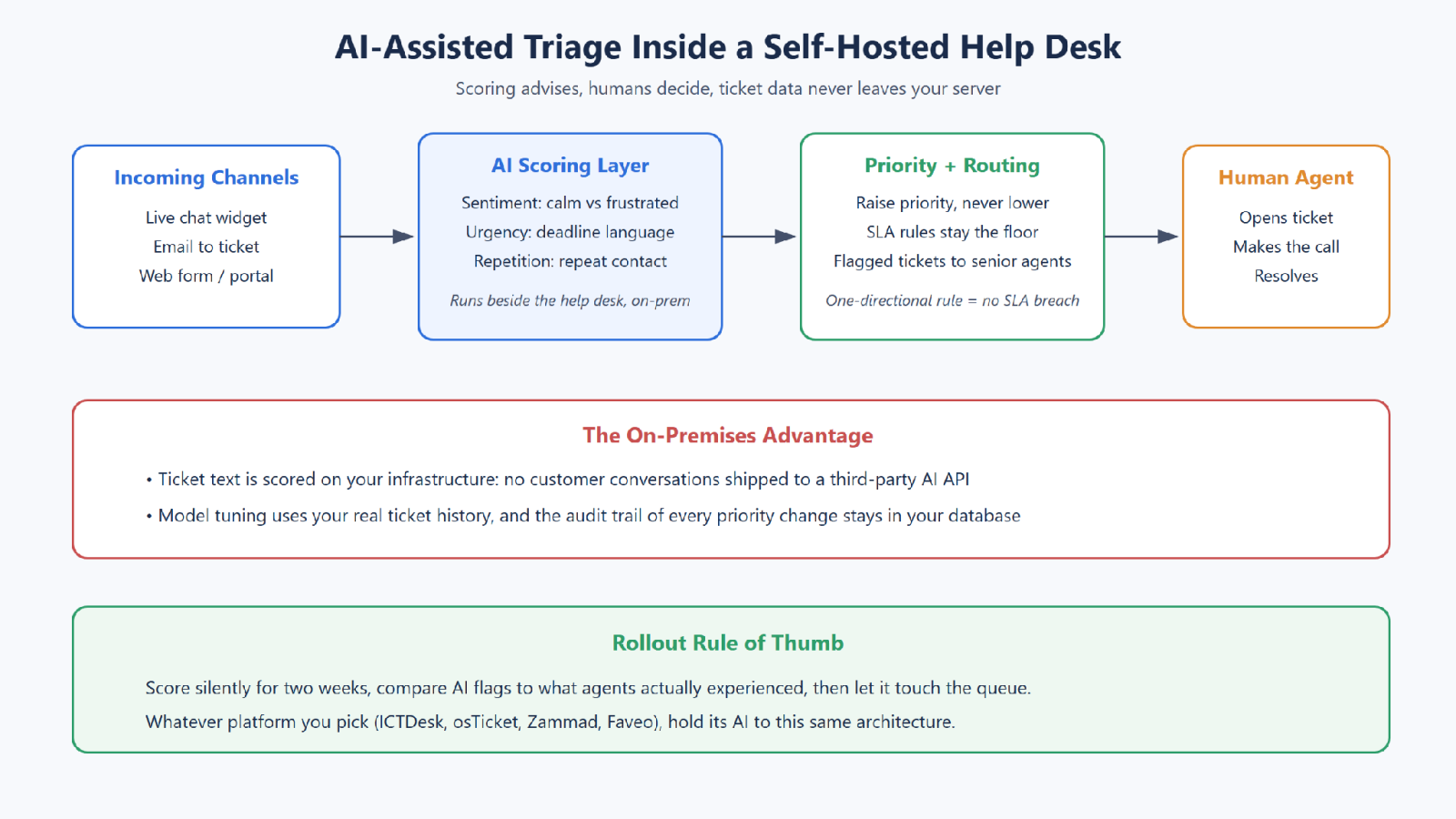
Today, none of the four ships a mature built-in AI triage engine you should bet SLAs on. osTicket and Faveo rely on third-party plugins, Zammad has been adding AI-assisted features on its paid path, and ICTDesk has AI-based ticket handling on its roadmap as a coming addition. If AI routing is your deciding factor, test whatever the vendor demos against two weeks of your real tickets before you trust it in the queue. The architecture in the diagram above is what to hold each of them to: scoring advises, humans decide, data stays home.
The Decision in One Paragraph
Pick osTicket if you have PHP skills in-house and want maximum community coverage for zero license cost. Pick Zammad if agent experience matters more than server footprint. Pick Faveo if budget is the constraint that overrides the others. Pick ICTDesk if you want live chat and ticketing as one commercially supported system instead of a toolchain you assemble yourself.
FAQ
Is a self-hosted help desk cheaper than SaaS?
Usually yes once you pass roughly five to ten agents, because SaaS pricing is per seat per month forever. You trade that saving for server upkeep, so factor in a few hours of admin time monthly.
Which of these four is easiest to install?
osTicket and Faveo are classic PHP applications and go up fast on any LAMP server. Zammad needs more resources, including Elasticsearch. ICTDesk installs are typically handled with vendor support, which shortens the path for teams without a sysadmin.
Can these help desks handle live website chat?
ICTDesk includes live support chat as a core feature. Zammad offers a chat channel. osTicket and Faveo need third-party additions for real-time chat.
Should I trust built-in AI ticket triage today?
Treat it as a routing hint, not a verdict. Run any AI scoring silently against a few weeks of real tickets first, and keep rules one-directional so AI can raise priority but never lower it below your SLA floor.
