
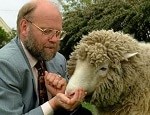
Dolly the Sheep will be one of 10 “unsung heroes” of science across the UK to have a blue plaque in her memory. Dolly was the first mammal to be cloned from an adult sheep’s somatic cell. A somatic cell is any cell in a living organism that is not a reproductive cell.
The plaque ceremony will take place on February 26th, where Dolly was born and lived till she died, at the Roslin Institute, part of the University of Edinburgh, Scotland.
In her short almost 7-year life, she was bred with a Welsh Mountain ram and produced six offspring.
Dolly project leader, embryologist Sir Ian Wilmut, Chair of the Scottish Centre for Regenerative Medicine at the University of Edinburgh, will be making a short speech.
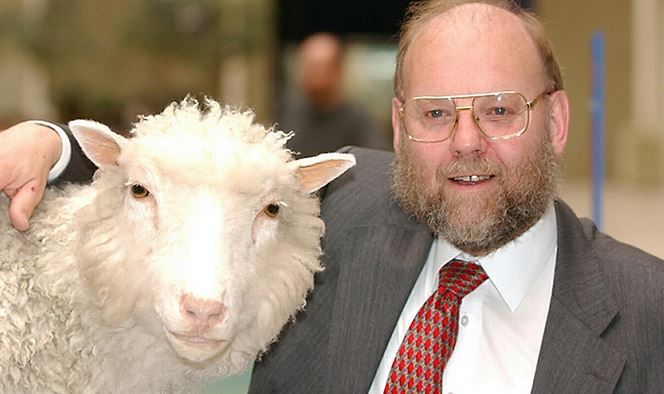
Sir Ian Wilmut with Dolly, the first mammal in the world to be cloned.
The following will be engraved on the plaque: “Dolly the Sheep, 1996-2003. First mammal to be cloned from an adult cell.”
As part of the Biology: Changing the World project, developed by the BBSRC (Biotechnology and Biological Sciences Research Council) and the Society of Biology, blue plaques are being placed across the country. It has been funded by the Heritage Lottery.
All the ten ceremonies are free to attend and last between 30 and 45 minutes each. Unfortunately, the Dolly ceremony is fully booked. If you are interested in attending one of the others, contact Anita Sedgewick (anitasedgewick@societyofbiology.org).
At the age of four Dolly (1996-2003) developed arthritis and started to walk stiffly. Vets treated her with anti-inflammatory drugs. She later developed progressive lung disease and died aged 6yrs and 7mths.
She was cited by both Scientific American and the BBC as the “world’s most famous sheep”.
Dolly – the daughter of three mums
Dolly is a clone from a mammary gland cell. Sir Ian and colleagues proved that one could recreate a whole individual, in this case a sheep, from a cell taken from a specific part of the body of an adult.
Dolly had three mothers: 1. The egg provider. 2. The genetic material (DNA) provider. 3. And the surrogate, i.e. the ewe that carried the cloned embryo to term.
She was created using a technique called SCNT (somatic cell nuclear transfer). An adult cell’s nucleus is transferred into an unfertilized oocyte (a developing egg) whose nucleus has been removed. Electric shock is applied to get the hybrid cell to divide.
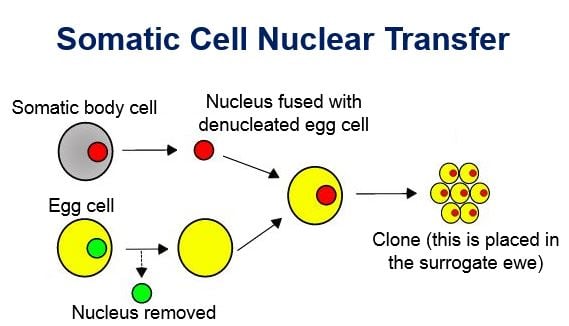
Dolly was cloned using SCNT. (Image source: Wikipedia)
When it has divided enough times to form a cluster of cells, known as a blastocysts or an early embryo, it is implanted into the surrogate mother.
SCNT overcomes many of the hurdles involving cloning, as occurs with embryonic stem cells (ESC) and the destruction of viable embryos in research. Many people, for ethical and/or religious reasons are against using embryos for research.
Dolly is not the only animal to be immortalized. Nipper, the dog that appeared in the HMV logo, has a plaque in his memory in Piccadilly, London.
Reference: “Blue Plaque Unveilings,” The Society of Biology.
