
British scientists have managed to double the distance optical fiber communications can travel error free by eliminating the interactions between optical channels. This could significantly reduce long-distance optical fibre communications costs, say University College London (UCL) researchers.
With the new technique, signals would not need to be boosted electronically along their way, which would significantly reduce costs for transatlantic sub-marine cables, as well as cables which are buried underground.
The scientists wrote in the academic journal Scientific Reports (citation below) that their technique can also correct the transmitted data if they are distorted or corrupted on the journey, which means the capacity of fibres could increase.
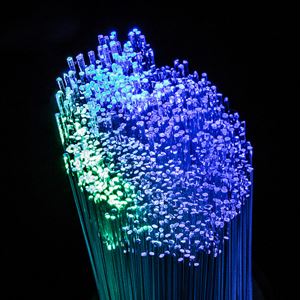
A strand of optical fibres (Courtesy of Groman123. Image: UCL)
The correction is done at the end of the link, at the receiver, so no new components need to be placed within the link itself.
As optical fibres carry 99% of all data and demand is increasing with growing Internet usage, enhancing capacity in this way is important.
If the network’s capacity can be increased by simply changing the receivers at the end of the link, rather than re-laying cables, increasing capacity this way would be much cheaper and faster.
The authors wrote:
“To cope with this increased demand, more information is being sent using the existing fibre infrastructure with different frequencies of light creating the data signals. The large number of light signals being sent can interact with each other and distort, causing the data to be received with errors.”
The study, sponsored by the EPSRC (Engineering and Physical Sciences Research Council), improves the transmission distance by undoing the interactions taking place between different optical channels as they travel over an optical cable side-by-side.
Author Dr Robert Maher, UCL Electronic & Electrical Engineering,, said:
“By eliminating the interactions between the optical channels, we are able to double the distance signals can be transmitted error-free, from 3190km to 5890km, which is the largest increase ever reported for this system architecture.”
“The challenge is to devise a technique to simultaneously capture a group of optical channels, known as a super-channel, with a single receiver. This allows us to undo the distortion by sending the data channels back on a virtual digital journey at the same time.”
Transmission was free of errors
Dr. Maher and colleagues used a ‘16QAM (quadrature amplitude modulation) super-channel made of a set of frequencies which could be coded using phase, amplitude and frequency to create a high-capacity optical signal.
The super-channel was subsequently detected with a high-speed super-receiver and new signal processing techniques the team had developed, which enabled the reception of all the channels together and error-free.
The team says it now plans to test the new method on denser super-channels commonly used in cable modems (256QAM), Ethernet connections (1024QAM) and digital cable TV (64QUAM).
Author Professor Polina Bayvel, who is Professor of Optical Communications and Networks and Director of UNLOC (UNLocking the capacity of Optical Communications), said:
“We’re excited to report such an important finding that will improve fibre optic communications. Our method greatly improves the efficiency of transmission of data – almost doubling the transmission distances that can be achieved, with the potential to make significant savings over current state-of-the art commercial systems.”
“One of the biggest global challenges we face is how to maintain communications with demand for the Internet booming – overcoming the capacity limits of optical fibres cables is a large part of solving that problem.”
What are fibre optics and optical fibres?
Fibre (US English: Fiber) optics is a way of transmitting information through thin fibres (threads). The data may be computer codes, pictures or sound. The information travels through the fibres in the form of light.
The fibres, called optical fibres, can be made of plastic or glass. They are about as thick as a human hair. Many of them are bundled together to form a fibre-optic cable.
Today, fibre-optic cables link most computers and telephones. Health care professionals also use fibre-optic medical devices to look inside the human body.
Citation: “Spectrally Shaped DP-16QAM Super-Channel Transmission with Multi-Channel Digital Back-Propagation,” Robert Maher, Tianhua Xu, Lidia Galdino, Masaki Sato, Alex Alvarado, Kai Shi, Seb J. Savory, Benn C. Thomsen, Robert I. Killey & Polina Bayvel. Scientific Reports. Published Feb 3, 2015. DOI:10.1038/srep08214.
