

New driverless car technology may make speeding tickets and traffic lights obsolete, say two researchers. They foresee cars one day talking to each other to coordinate traffic patterns.
Jackeline Rios-Torres and Andreas Malikopoulos wrote about their work and achievements in IEEE Transactions on Intelligent Transportation Systems (citation below).
Malikopoulos is Terri Connor Kelly and John Kelly Career Development Associate Professor at the University of Delaware’s College of Engineering. Rios-Torres is a Eugene P. Wigner Fellow in the Energy and Transportation Sciences Division at Oak Ridge National Laboratory, Tennessee.
Imagine an orderly daily commute
Imagine a daily commute by road that is orderly instead of total traffic chaos. Driverless car technology could provide that relief by adjusting to traffic conditions. Cars would adjust with the minimum of input from drivers. They might even adjust with no input at all from humans traveling inside them.
The new driverless technology would control your car’s speed so that its movements were in harmony with nearby vehicles. When the vehicle in front speeds up, yours will accelerate too, and when it suddenly stops, so will yours.
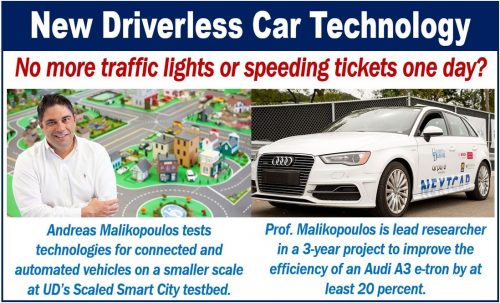
Driverless car technology – using control theory
Prof. Malikopoulos uses control theory to develop algorithms. The algorithms will enable this type of driverless car technology.
In two recent publications, Prof. Malikopoulos described innovations in connected and automated vehicle technology. Researchers tested the driverless car technology at a driving simulator facility and the UD Scaled Mart City (UDSSC). UD stands for the University of Delaware.
Prof. Malikopoulos said:
“We are developing solutions that could enable the future of energy efficient mobility systems. “We hope that our technologies will help people reach their destinations more quickly and safely while conserving fuel at the same time.”
Driverless car technology – no more traffic lights
New driverless car technology will probably make traffic lights obsolete one day. Imagine cars talking to each other to coordinate traffic patterns.
Prof. Malikopoulos and colleagues from Boston University recently developed a solution to minimize and control energy consumption. The solution focused on connected driverless vehicles crossing an urban intersection with no traffic lights.
They then used software to simulate their results. The researchers found that their framework allowed connected and automated cars to conserve fuel and momentum. At the same time, they also improved travel time.
Saving fuel – no more speeding tickets
Imagine a driverless car that automatically slows down when the speed limit goes from 65 to 45 mph.
Prof. Malikopoulos and colleagues from the University of Virginia developed a solution that yielded the optimal deceleration and acceleration in a speed reduction zone. The vehicles avoided rear-end crashes.
The simulations suggested that the cars used 19% to 22% less fuel. They also got to their destinations 26% to 30% faster than vehicles with human drivers.
In a different project, researchers described a new camera that mimicked mantis shrimp vision to help driverless cars see better.
Citation
“Impact of Partial Penetrations of Connected and Automated Vehicles on Fuel Consumption and Traffic Flow,” Jackeline Rios-Torres and Andreas Malikopoulos. IEEE Transactions on Intelligent Transportation Systems, October 2018. DOI: 10.1109/TIV.2018.2873899. Electronic ISSN: 2379-8904, Print ISSN: 2379-8858.
