
Droughts and floods in California will at least double in frequency and become more severe by the end of this century, due mainly to weather patterns known as La Niña and El Niño, say researchers from the Department of Energy’s Pacific Northwest National Laboratory, who published their findings in Nature Communications.
According to their study, extreme events are likely to occur more frequently. Previous studies have suggested that California’s average precipitation (rainfall) will gradually increase, but nowhere near enough to make up for the recent droughts.
A better understanding of El Niño-Southern Oscillation (ENSO), the phenomenon that gives rise to El Niño and La Niña cycles, might help the state predict and prepare for more frequent floods and droughts as the century progresses.
Jin-Ho Yoon, an atmospheric scientist who works at the Department of Energy’s Pacific Northwest National Laboratory, said:
“Wet and dry years in California are linked to El Niño and La Niña. That relationship is getting stronger. Our study shows that ENSO will be exhibiting increasing control over California weather.”
Rain’s range
California is currently suffering one of the most severe droughts in recorded history. Whether warmer world temperatures will make droughts worse or more frequent is unclear. We know that warm air can hold more water.
Some studies have indicated that California’s average rainfall (and snowfall) would increase if global temperatures rose.
However, other studies suggest that Californian rains in future will come down more as heavy deluges or light drizzles, rather than moderate rainfall.
Yoon and team from PNNL and Utah State University wonder whether droughts might follow a similar pattern.
The scientists looked at what happens to California in global climate models in order to find out. They simulated two periods in history, 1920 to 2005 using historical measurements, and 2006 to 2080, in conditions where not much effort is made to reduce greenhouse gas emissions
They studied this future scenario to examine the most extreme case.
They used two tactics to demonstrate reproducibility to understand how well the simulations worked. In one tactic, a compilation of thirty-eight different models were used. In the other, they ran a single model thirty times.
The more similar the results, the more sure they could be about their findings.
Weather pendulum
The models suggest that in future, if emissions continue to increase, Californian seasons will exhibit more excessively dry and wet events.
The frequency of droughts is likely to double, while floods may triple between the early 20th century and late 21st century.
Yoon said:
“By 2100, we see more – and more extreme – events. Flooding and droughts will be more severe than they are currently.”
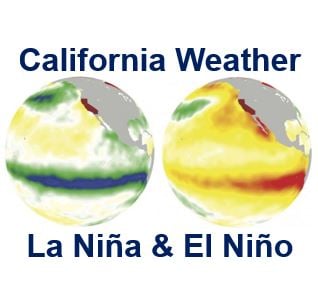
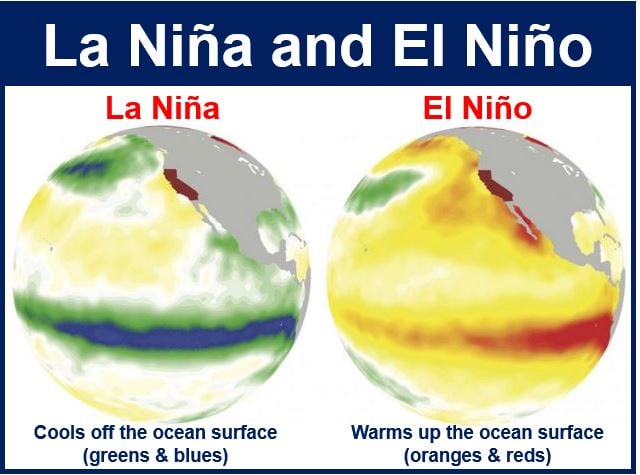
What is the reason for this? Yoon and colleagues suspected the El Niño-Southern Oscillation. El Niño comes in and warms up the tropical Pacific Ocean every two to seven years by a few degrees, which raises California’s winter rainfall and snowfall.
Over a similar time schedule, La Niña cools things down. Both of them disrupt regular weather in several regions across the planet.
In this latest study, the scientists ran a climate model with and without El Niño to explore its connection to California precipitation. In both simulations, they raised CO2 concentrations by 1% every year for 150 years.
In just one of the runs, they removed the contribution made by El Niño by programming the sea surface temperature to reflect just steady warming.
El Niño & La Niña influence California’s rainfall
For the entire 150-year period, the frequency of extreme precipitation in the Golden State remained constant without El Niño and La Niña. With ENSO, simulated California underwent wide swings in rainfall by the end of the period.
Their findings suggest that even though scientists expect rainfall and snowfall to increase as the climate warms, how this water hits California could be highly variable.
The El Niño-Southern Oscillation is still a bit of an enigma, Yoon explained. Researchers only know that El Niño and La Niña years – which in Spanish mean ‘the boy’ and ‘the girl – are coming by sea surface temperature and other weather hints. Research to determine what controls these unruly kids could help scientists forecast unruly weather in the future.
The study was funded by the Department of Energy’s Office of Science.
Citation: “Increasing water cycle extremes in California and in relation to ENSO cycle under global warming,” Jin-Ho Yoon, S-Y Simon Wang, Robert R. Gillies, Ben Kravitz, Lawrence Hipps & Philip J. Rasch. Nature Communications. Article number: 8657. October 21, 2015. DOI:10.1038/ncomms9657.
