
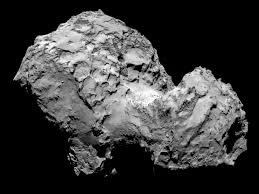
According to a recent study published in the journal Science, results from the European Space Agency’s Rosetta mission (which landed on Comet 67P in November) reveals that water on the icy mass is different to that on our planet.
This is somewhat of a surprise considering that previous theories said that the majority of Earth’s water came from comets.
The authors say that it is more likely that the water came from asteroids instead. However, other scientists say that there needs to be more concrete data collected and analyzed before the theory that water came from comets can be ruled out.
The Rosetta probe has been in orbit around Comet 67P/Churyumov-Gerasimenko since August. On November its lander, Philae, reached the object’s surface – a major historic event in science.
The robot’s batteries quickly died out after landing, however it managed to retrieve a large amount of scientific data. In addition, the Rosetta probe is still analyzing the wandering “ice mountain”.
For years scientists have wondered whether these primitive bodies brought water to Earth billions of years ago. This close-up look is helping scientists determine whether they actually played a role in bringing water to our planet.
The study used data that Rosetta’s Rosina instrument gathered. It used two mass spectrometers to detect the gas that comes off the surface of Comet 67P.
Water on our planet has a unique signature, with the majority of liquid on earth being composed of hydrogen and oxygen atoms. It’s very rare that a hydrogen atom is replaced with a deuterium atom.
Out of every 10,000 water molecules on earth only three deuterium atoms can be found. This type of water (with deuterium atoms) has very similar properties to H20, but is heavier in mass.
Prof Kathrin Altwegg, from the University of Bern in Switzerland, who is Rosina’s principal investigator, said: “This ratio between heavy and light water is very characteristic. You cannot easily change it and it stays for a long time.
“If we compare the water in comets with the water we have on Earth, we can definitely say if the water on Earth is compatible with the water on comets.”
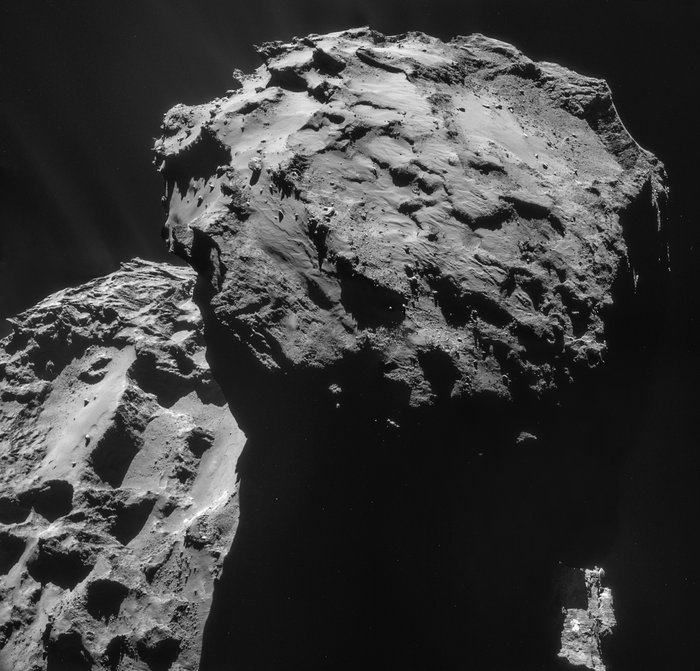
This four-image mosaic comprises images taken by Rosetta’s navigation camera on 7 December from a distance of 19.7 km from the centre of Comet 67P/Churyumov-Gerasimenko. Photo Credit: ‘European Space Agency – ESA’
The water on Comet 67P is far heavier than the water on earth, according to the research team.
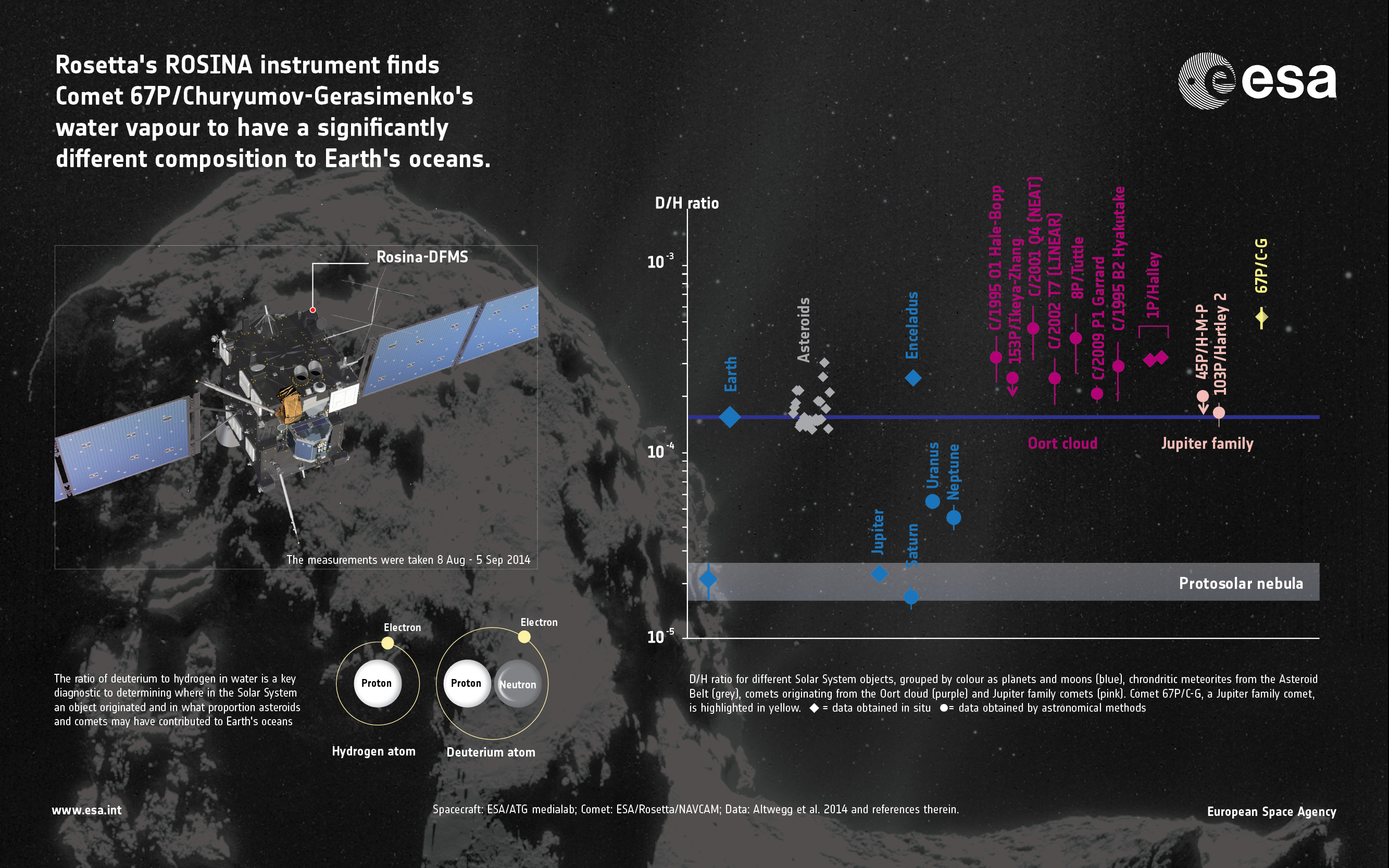
Photo Credit: Spacecraft: ESA/ATG medialab; Comet: ESA/Rosetta/NavCam; Data: Altwegg et al. 2014
Prof Altwegg told BBC Radio 4’s Inside Science programme: “It is the highest-ever measured ratio of heavy water relative to light water in the Solar System.
“It is more than three times higher than on the Earth, which means that this kind of comet could not have brought water to the Earth.”
Previous studies have suggested that water originating from the Oort Cloud – a region of space on the outer reaches of our solar system – also has a distinct signature, different to that of Earth’s.
Only two comets from the Kuiper-belt (a region of space near Neptune) have been analyzed so far; the Comet 79P and a comet known as Hartley 2.
Research conducted using the Herschel Space telescope found that the water on Hartley 2 is almost identical to the water in Earth’s oceans.
However, Prof Altwegg says that Kuiper Belt comets did not bring water to Earth. She said:
“The conclusion here is that in the reservoir of the Kuiper Belt, we have very diverse comets that probably came from different regions of the early Solar System.
“We have light water in some comets and very heavy water in other comets. We have to assume the mixture of all these comets is something that is heavier than what we have on Earth, so this probably rules out Kuiper Belt comets as the source of terrestrial water.”
She believes that water was brought by asteroids, which are dense rocky objects formed nearer the Sun than comets.
“We know already something about the characteristic of asteroids by studying meteorites, which are pieces of asteroids – and the characteristics of asteroids are very much like our water.
“They are also much closer to the Earth, so it is more likely that they hit the Earth than the very distant comets, which are beyond Neptune.”
Hartley 2
In another analysis Hartley 2 was found to have similar water to Earth’s and therefore some scientists believe it’s too soon to rule out the comet theory, stating that more evidence is necessary.
Prof Alan Fitzsimmons, from the Astrophysics Research Centre at Queen’s University Belfast, said:
“There is no arguing with this exquisite measurement; it shows the true value of going to a comet and doing your science there.
“The problem is that if you take the few Kuiper Belt comets now measured and average them, you don’t get Earth’s water.
“We don’t know how you’d just hit Earth with high deuterium-to-hydrogen comets and not low deuterium-hydrogen comets. So more data are important, and specifically we now need to take a really close look at the icy asteroids and main-belt comets between Mars and Jupiter.”
Prof Monica Grady said that the team’s conclusions could be “jumping the gun a bit”.
She said:
“The measurements that have been made by Rosina are of the gas that has come from the surface of the comet. The amount of hydrogen relative to deuterium changes as the gas escapes from the surface.
“This is why other instruments on the lander were going to make complementary measurements of the ice on the surface. We are going to have to wait to see what comes from the COSAC and Ptolemy [Philae lander instruments] before we can say any more.”
In an interview with the BBC, Dr Conel Alexander, from the Carnegie Institution of Washington in the US said:
“From meteorites, spectroscopic measurements of asteroids and even the fairly recent discovery of a few ‘asteroidal comets’, some types of asteroid contain quite a bit of water in clay minerals and possibly in ice.”
The Rosetta probe will be tracking and analyzing Comet 67P for the next year.
References:
- “Rosetta fuels debate on origin of Earth’s oceans” 10 December 2014 – European Space Agency
- “Rosetta results: Comets ‘did not bring water to Earth” 10 December 2014 – By Rebecca Morelle – BBC News
