
The European Space Agency’s Intermediate Experimental Vehicle (IXV), Europe’s first re-entry spacecraft, will undergo a crucial test on Wednesday when it will be launched into space for the first time on a Vega rocket from Kourou, French Guiana, and then re-enter Earth’s atmosphere.
The IXV spaceplane is an experimental re-entry vehicle. The wingless spaceplane’s flight is of huge importance in Europe because it has no atmospheric re-entry system of its own.
After separating from the Vega rocket, eighteen minutes into flight and at an altitude of about 340 kilometers (211 miles), it will coast up to a height of 420 km (261 miles). The IXV will then start re-entry, recording data from several conventional and advanced sensors.
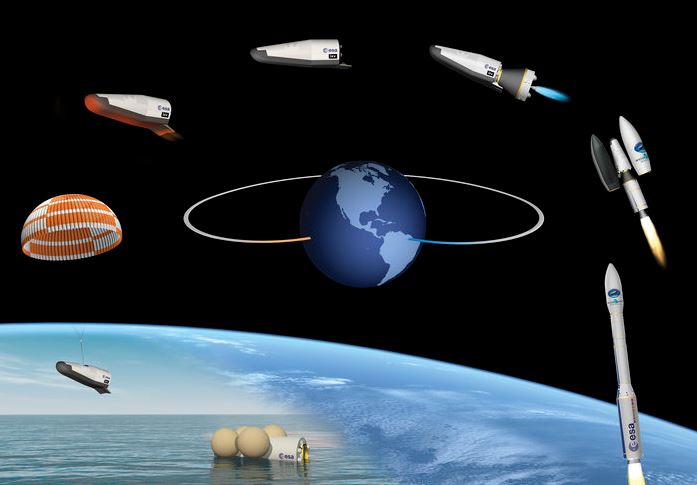
The IXV will be launched into space, it will then re-enter the atmosphere and splash down on the Pacific Ocean. (Image: European Space Agency)
IXV will re-enter the atmosphere at a speed of 27,000 km/h (16,777 mph), or 7.5 km/s (4.66 m/s), thus creating the same conditions as those for a spacecraft return from low orbit. During its descent a multistage parachute will open to slow it down. Splashdown in the Pacific Ocean, if all goes according to plan, will occur 100 minutes after liftoff.
During re-entry its steering flaps and nose cone will reach 1,800 degrees Celsius, which would melt iron (iron’s melting point is 1,538 °C).
According to the European Space Agency (ESA):
“The spacecraft will fly fully autonomously, and will be closely monitored from its Mission Control Centre located at the Advanced Logistics Technology Engineering Centre in Turin, Italy. Signals from the spacecraft will be tracked by two ground stations in Africa and by an antenna on the recovery ship, Nos Aries.”
You can watch the mission live via Arianespace TV and ESA TV on February 11th, starting at 12:30 GMT (13:30 CET).
The test will determine how the two-tonne, five-meter long spaceplane re-enters the Earth’s atmosphere and lands in a targeted spot.
Scientists will be testing its guidance, navigation and control technology, its unique shape (no wings), and how well its heat-resistant materials developed for the outer shell coped.
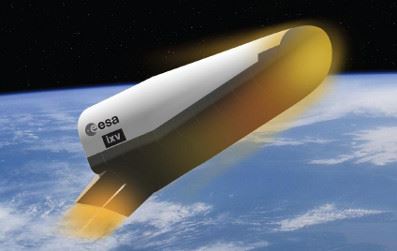
ESA’s wingless spaceplane, the IXV. (Image: Wikimedia)
Scientists say the most dangerous band in our atmosphere during re-entry is between 80 and 70 km altitude. This is where materials tend to break up due to the extreme forces involved.
While Russia has its own Soyuz capsule and NASA is developing the Orion capsule, Europe currently has no vehicle for returning from space. Even private company SpaceX has the Dragon. India, Japan and China have their own re-entry capsules.
ESA Video – The IXV Mission
