
With EU energy security at the fore of most European leaders’ minds, especially after the scares of 2006 and 2009 caused by a Russia-Ukraine standoff, the European Commission has put forward what it calls a new European Energy Security Strategy.
According to the Commission, the EU needs to upgrade its energy infrastructure, diversify external energy supplies, complete the EU internal energy market, and save energy.
Regarding its energy requirements, the EU needs to be able to speak with one voice when negotiating with external suppliers.
EU energy security better than in 2009
The current proposal builds on the progress achieved so far since the 2009 gas crisis. The Commission’s proposals, including suggested measures to make sure supplies go uninterrupted this winter, will be discussed by Members’ heads of state or government at the European Council on June 26th and 27th.
José Manuel Barroso, European Commission President, says that the EU energy security has come a long way since the 2009 gas crisis, but it is still vulnerable, he warns.
Mr. Barroso said:
“The tensions over Ukraine again drove home this message. In the light of an overall energy import dependency of more than 50% we have to make further steps. The Commission has tabled a comprehensive strategy today which will be discussed by EU leaders in June. I count on their strong support, since increasing energy security is in all our interest. On energy security, Europe must speak and act as one.”
The EU needs strong and stable contracts with major suppliers, Günther Oettinger, the European Energy Commissioner emphasized. It is crucial that the EU never falls victim to commercial and political blackmail. There is a lot of work to be done to achieve real energy security, he added.
Mr. Oettinger said:
“Collectively, we need to reinforce our solidarity with more vulnerable Member States. We also need to complete the internal energy market, improve our infrastructure, become more energy efficient and better exploit our own energy resources. Moreover, we need to accelerate the diversification of external energy suppliers, especially for gas. Only concrete actions will help.”
EU energy security stress tests
The Commission proposes a series of comprehensive stress tests to determine how prepared the trading block is for the coming winter. The risk assessments should be carried out on both regional and EU levels, by for example, simulating a disruption of the supply of natural gas.
The aim of the simulations is to determine how the energy system would cope with security of supply risks, and based on the results, develop contingency plans and create back-up mechanisms.
Examples of mechanisms may include reducing natural gas demand by switching to other fuels (especially for heating), raising gas stocks, and developing emergency infrastructure such as pooling parts of the existing energy security stocks and completing reverse-flow possibilities.
A breakdown of the Commission’s proposals:
The Internal energy market
The internal energy market needs to be completed, as do the missing infrastructure links so that nations can respond rapidly to supply problems by directing energy flows across the EU wherever and whenever they are needed.
According to the Commission, there are 33 infrastructure projects which are vital for the region’s energy security.
It also proposes extending the target regarding interconnection of installed electricity capacity to 15% by 2030. EU members have already pledged to ensure connectivity of 10% by the end of this decade.
Diversifying supply sources
Thirty-nine percent of all natural gas imports into the EU come from Russia, 33% from Norway and 22% from Algeria/Libya (North Africa).
The EU should maintain its relationship with reliable suppliers. However, it should also seek out new partner nations as well as supply routes.
For example:
- The Southern Gas Corridor could be further expanded into the Caspian Basin region.
- LNG supplies should be increased.
- The development of the Mediterranean Gas Hub.
Strengthening emergency and solidarity mechanisms
This includes protecting critical infrastructure. The Commission says it will review the provisions and implementations of the Security of Gas Supply Regulation.
Raising domestic production
This includes sustainable production of fossil fuels and greater use of renewable energy, such as wind power, solar power, hydro-power, biomass, biofuel and geothermal energy.
Speaking with one voice
The EU’s energy security would be greatly enhanced if it could speak with one voice in external energy policy.
According to the Commission, it will become “involved at an early stage in envisaged intergovernmental agreements with third countries that could have a possible impact on security of supply. Moreover, the Commission will ensure that all such agreements and all infrastructure projects on EU territory fully comply with the relevant EU legislation.”
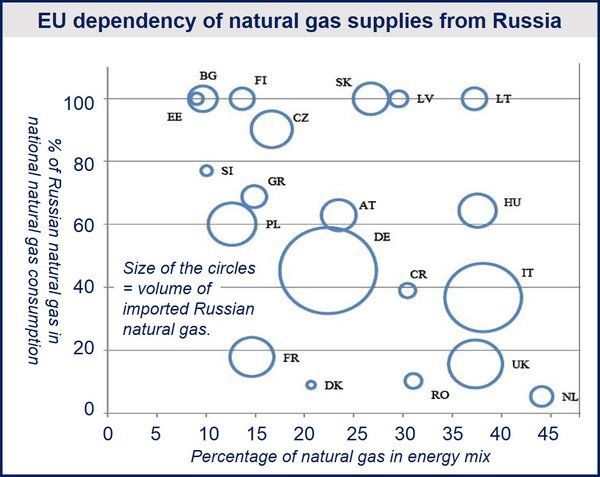
After spending the last 20 years producing less and less energy, the EU now says it needs to produce more and diversify its sources of imports.
EU energy production has been falling
While energy demand worldwide races ahead and is expected to grow 27% by 2030, the EU’s domestic energy production declined by nearly one-fifth between 1995 and 2012.
The EU depends on external suppliers for over 50% of its energy requirements. The EU nations’ reliance on foreign suppliers are as follows for different energy products:
- Oil: 90%
- Natural gas: 66%
- Solid fuels: 42%
The European Union pays out more than €1 billion each day on energy imports.
Earlier in May, Joseph Braml, a foreign affairs specialist who works at the German Society for Foreign Policy, says it is high time that a start is made for the EU to lower its dependence on energy imports.
