
If you really want the euro to work, you will need to share decisions on spending and taxes, the Governor of the Bank of England Mark Carney said on Wednesday in a stark message to European leaders.
During a lecture at Iveagh House in Dublin, Ireland, to honour the memory of The Honourable James Michael Flaherty, P.C., Canada’s former federal Minister of Finance who died in April 2014, Mr. Carney said:
“For complete solutions to current and potential future problems the sharing of fiscal risks is required … Without this risk sharing, the euro area finds itself in an odd position. As the Presidents of the European Council, European Commission, Eurogroup and European Central Bank argued in their report, European Monetary Union will not be complete until it builds mechanisms to share fiscal sovereignty.”
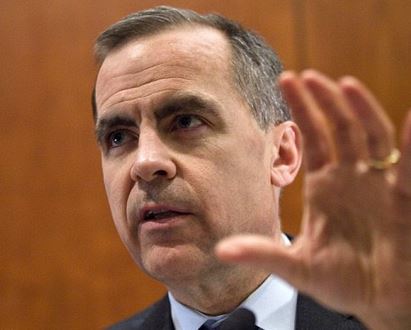
Without fiscal and political union, Mr. Carney doubts the European common currency will succeed.
Mr. Carney doubts the currency will succeed if all the members do is share the euro but make spending decisions on a national level.
For the euro to have a chance of success he believes mechanisms will need to be introduced so that fiscal sovereignty is shared.
The big difference between the current Eurozone and federal nations such as Germany, Canada and the United States, is their central government’s ability to transfer considerable sums of money to constituent states that run into serious difficulties as and when those problems occur.
Mr. Carney said:
“The euro area also stands out from federal systems like the US, Canada and Germany. In those systems, the impact of localised shocks to income is reduced by between one tenth and one fifth by centralised fiscal transfers.”
Mr. Carney is not the first to say this
Mr. Carney’s argument is not a new one. Economists, politicians and central bankers across the globe have been saying the same ever since the Eurozone was born.
They have all insisted that monetary union will not endure over the long term unless there is total political and fiscal union – or at least if the spending and national taxation powers are not transferred to a central decision-making authority.
However, Mr. Carney’s comments stand out now because they coincide with the European Central Bank launching a massive €1.1 trillion of debt purchases (quantitative easing or QE), and Germany’s and other rich Eurozone members’ reluctance to continue helping Greece financially.
Regarding the ECB’s action, Mr. Carney said they were “timely and welcome,” but also added:
“However, the ECB alone cannot eliminate the risks of a prolonged stagnation. These exist primarily because, in most respects, the current construction of the euro area is unfinished.”
“With limited cross-border banking in the euro area, savings don’t flow to potential investments. Euro-area corporates’ cash balances have risen to the tune of €420 billion, or 3% of GDP, since the crisis, for example. Modest cross-border equity flows mean inadequate risk sharing. Moreover, by design, there are virtually no cross-border fiscal flows so fiscal space is separated from fiscal needs.”
Alan Greenspan, who was chairman of the Federal Reserve (US central bank) from 1987 to 2006, said three years ago that without political union the euro won’t work.
In May 2012, The Financial Post quoted Mr. Greenspan in an interview, who said:
“At the moment, northern Europe finances southern Europe. There is tax evasion and illegal commerce in Greece, Italy, Portugal and Spain. The European Central Bank is printing money to finance all the shortfalls in fiscal deficits of southern Europe.”
“This has to stop at some point and when it stops, you are going to have a major confrontation of the euro and all countries will have to make a fundamental choice. The only resolution is political union of the Eurozone countries.”
