

The economies of countries with declining income inequality on average grow at a faster rate than those where the income gap is growing, says a new report published by the Organization for Economic Co-operation and Development (OECD).
If countries worldwide made a greater effort to reduce income inequality, global GDP would be boosted, the authors claim.
According to the report – “Trends in income inequality and its impact on economic growth” – the single biggest obstacle to economic growth is the growing income gap between the lower-middle class plus poor households versus the rest of the population.
Poorer people’s lack of investment in education is the main factor behind inequality undermining growth, hence “Education is the key.”
OECD Secretary-General, Angel Gurría, said:
“This compelling evidence proves that addressing high and growing inequality is critical to promote strong and sustained growth and needs to be at the center of the policy debate. Countries that promote equal opportunity for all from an early age are those that will grow and prosper.”
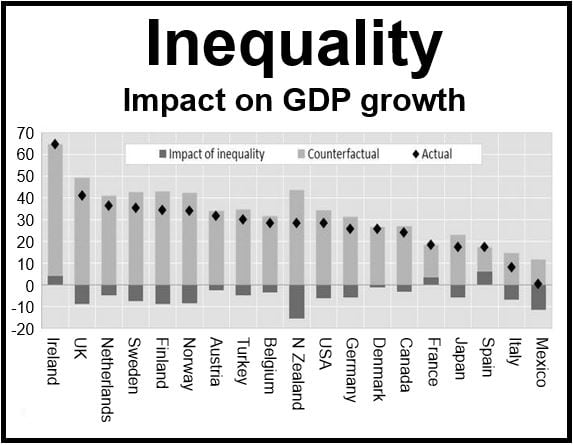
The chart reports the estimated consequences of changes in inequality (1985-2005) on the cumulative growth rate of GDP per capita.
Over a 20-year period leading up to the Great Recession, growing inequality in New Zealand and Mexico has cost their economies 10 percentage points in lost growth, the authors write. The economies of the US and UK would have grown 6 percentage points more over the same period.
Even countries perceived to have better equality levels, such as Norway, Finland, and Sweden saw their widening wealth gaps hurt GDP growth.
In Spain, France and Ireland, whose income gaps narrowed, GDP per capita grew faster. GDP per capita is GDP divided by the country’s whole population.
Why choose those dates?
One wonders why the OECD chose to pick just the years before the Great Recession, because Ireland and Spain suffered more than the UK or US post-crisis, and France today is in the middle of an economic crisis with very high unemployment and zero percent GDP growth. Shouldn’t a country’s ability to withstand economic shocks and its consequences on income factors plus recovery rates be included in the study?
According to the study’s findings, lower education opportunities for children from low-income households undermine economic growth, reduce social mobility and hamper skills development.
In countries where income inequality is rising, individuals whose parents have low academic levels see their educational outcomes worsen. For those whose parents have medium or high levels of education, there is little or no effect.
The greatest impact of inequality on economic growth comes from the gap between the 40% poorest with the rest of the population. Many people mistakenly think it is the gap between the poorest 10% and the richest 10%.
The OECD wrote in a statement:
“Anti-poverty programs will not be enough, says the OECD. Cash transfers and increasing access to public services, such as high-quality education, training and healthcare, are an essential social investment to create greater equality of opportunities in the long run.”
The authors say they found no evidence that redistributive policies, including social benefits and taxes, undermine economic growth, as long as they are well targeted and implemented.
After WWII, the advanced economies grew rapidly without inequality getting any larger. This all changed towards the end of the 1970s.
