
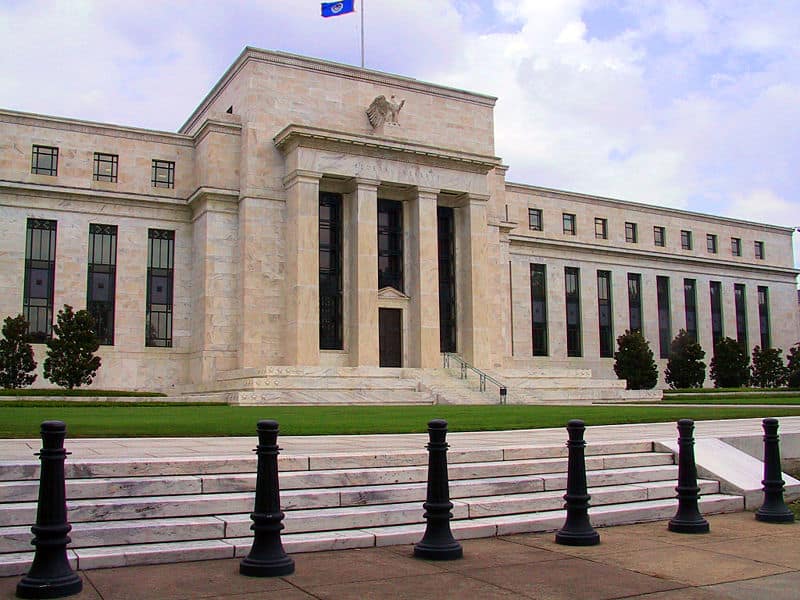
The U.S. Federal Reserve’s latest Beige Book revealed that 11 of the Fed’s 12 regional banks reported at least modest expansion in the economy in July through mid-August.
The Beige Book provides information on the condition of the U.S. economy in each of the Fed’s 12 districts.
Six of the 12 Districts reported moderate growth, while New York, Philadelphia, Atlanta, Kansas City, and Dallas reported modest growth.The Cleveland District said that there has only been “slight growth” since the last report.
Manufacturing
District reports on manufacturing activity were mostly positive, with only the New York and Kansas City Districts reporting a drop in manufacturing.
The boost in manufacturing was primarily driven by strong auto sales, with Cleveland, Richmond, and Chicago all reporting robust growth in auto-related manufacturing.
However, low energy prices has caused a reduction in demand for machinery, and cheap steel imports resulted in “low capacity utilization” in that industry.
According to the Beige Book, reports from three Districts “explicitly mentioned the Chinese slowdown as a factor, noting reduced demand for wood products (San Francisco), chemicals (Boston), and high-tech goods (Dallas).”
Consumer Spending
Philadelphia, Chicago, Kansas City, and San Francisco said that consumer spending increased at a moderate pace, while Boston and Atlanta reported mixed results and New York characterizing retail sales as generally sluggish and below plan in July.
Labor and wages
There were reports of higher wages, particularly in New York, Cleveland, St Louis and San Francisco. Wages were pushed up in some industries because of a tighter jobs market. “Most districts reported modest to moderate growth in labor demand,” the Beige Book said.
Will the report influence the Fed’s decision on when to hike rates when it next meets on September 16-17?
According to a Bloomberg report, David Ader, head of government bond strategy at CRT Capital Group LLC in Stamford, Connecticut, told the newspaper that “from the Fed’s perspective, this shouldn’t change things one iota,”
He added: “The labor markets continue to do a little bit better, inflation continues to look a little bit weaker.”
Source: Beige Book – September 2, 2015 – Prepared at the Federal Reserve Bank of Boston based on information collected on or before August 24, 2015.
