
An agent bank is a bank appointed to carry out specified tasks for another party or a group of parties. In a syndicated loan, it commonly administers the facility and coordinates payments and communications between the borrower and the lenders.
A syndicated loan is financed by several lenders under a shared agreement. Agent describes a role under that agreement, rather than a universal category of bank with identical powers in every transaction.
What does a loan agent do?
The agreement sets the responsibilities. They may include receiving borrowing or repayment notices, processing funds, calculating amounts due, distributing payments and circulating reports. Different facilities assign different duties and decision procedures.
ICBC Asia distinguishes arranging a syndicated loan from its continuing administration. Associated Bank describes its agency service as a central point of contact, funding conduit and source of coordinated reporting.
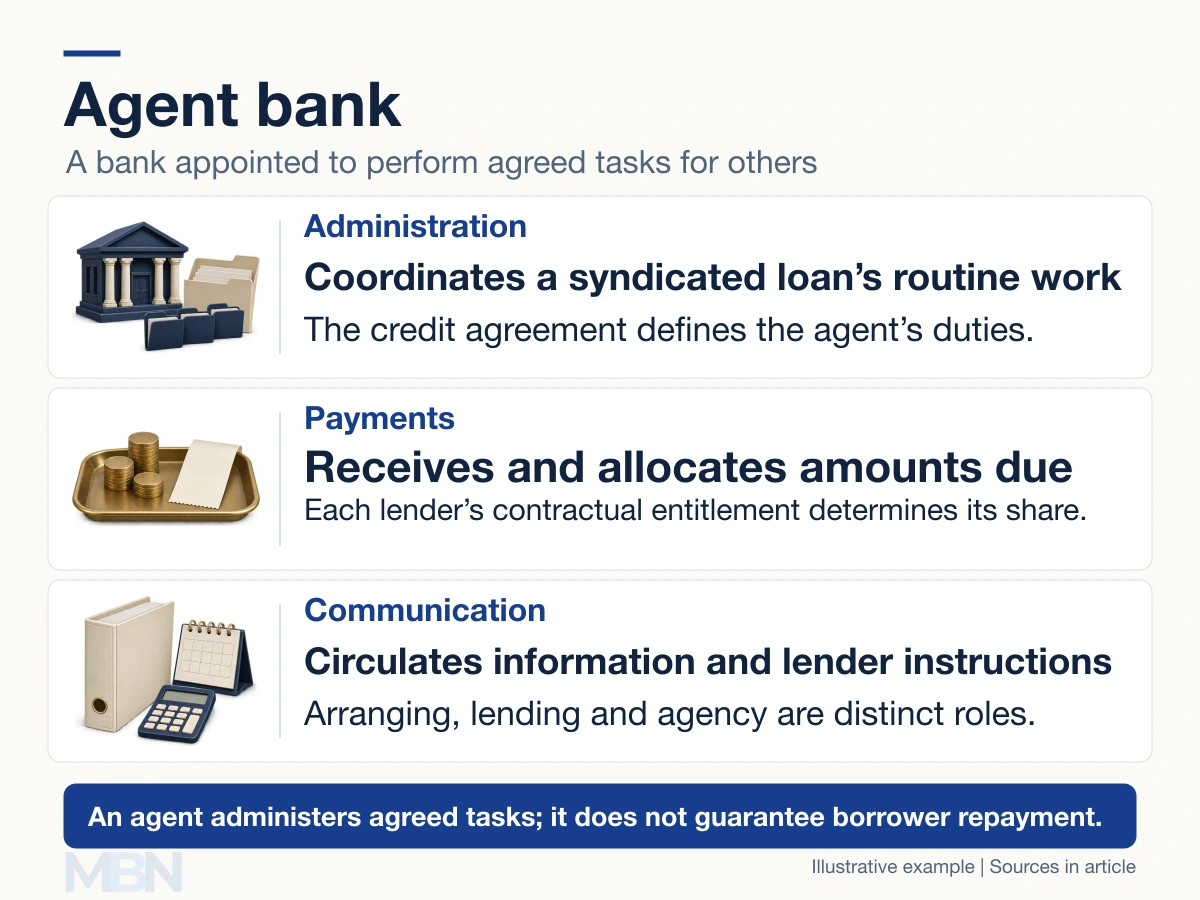
This coordination can reduce the need for separate routine communications between the borrower and every lender. It does not remove the need for accurate records, contractual compliance or each lender’s assessment of its exposure.
Agent, arranger and lender are different roles
The arranger helps structure the financing and assemble lenders. The agent administers the loan after it is established. A lender commits funds and takes the associated credit exposure.
One bank can perform more than one role. However, an agent does not necessarily arrange the deal or provide the largest loan share. The Congressional Research Service explains that the arranger or another company may act as agent after closing, collecting payments and passing the appropriate amounts to loan holders.
A security agent or trustee may separately hold or administer collateral rights for the lenders. Collateral means assets supporting repayment. The precise legal role and enforcement rights depend on the documents and jurisdiction.
A payment-allocation example
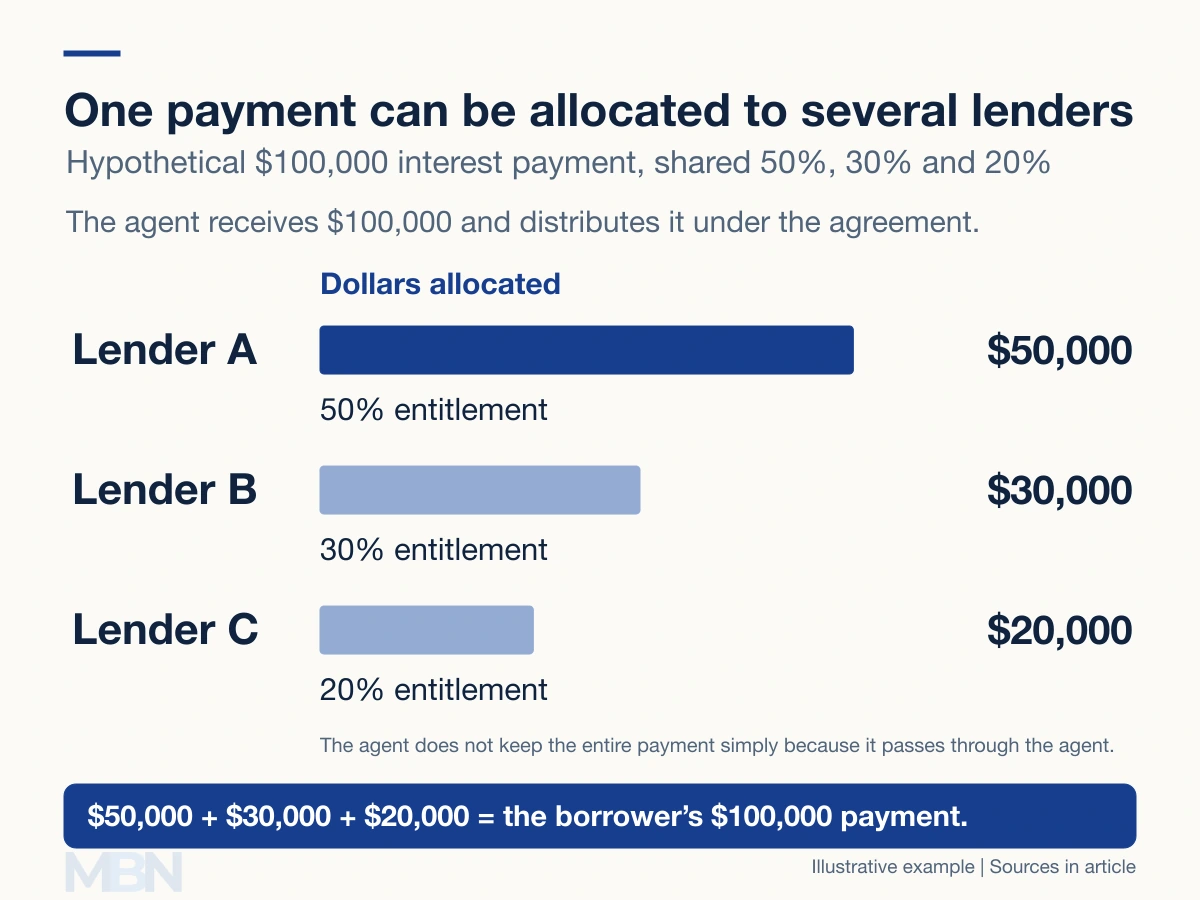
Suppose three lenders are entitled to 50%, 30% and 20% of an interest payment. The borrower pays $100,000 to the agent. Assuming identical interest terms and no deductions or special priorities, the agent allocates $50,000, $30,000 and $20,000 respectively.
The money passing through the agent is not all the agent’s income. Its service fee is a separate contractual amount. If the agent is also a lender, its lending return belongs to that separate role.
Who bears the risk and makes decisions?
Sharing a loan can spread exposure among lenders, but it does not eliminate borrower default risk. An agent’s administrative appointment is not a promise to reimburse every lender if the borrower fails to pay.
Changes to terms, waivers and enforcement may require instructions or votes from specified lenders. Some decisions may require broader consent than others. The agreement determines how the agent acts, rather than giving it unrestricted authority to change the loan on its own.
Operational errors, delayed information and conflicting roles can also matter. The documents allocate duties, limitations, fees, replacement procedures and any liability, so the title agent alone does not establish the full legal relationship.
Is a foreign bank agency the same thing?
No. A foreign bank agency is a separately regulated type of banking office. Its permitted activities depend on its license and applicable law; it should not be treated as simply another name for a syndicated-loan agent.
For example, New York’s Department of Financial Services distinguishes foreign agencies from branches and describes specific deposit restrictions and permitted activities. It is inaccurate to say that every foreign bank operating for its parent abroad is forbidden from accepting any deposits.
Last checked and updated on November 10, 2026 by the MBN editorial team.