
A cryptocurrency exchange is a service or trading protocol through which participants buy, sell or swap supported crypto assets. Some support trading against government-issued currencies, such as dollars or euros; others primarily support crypto-to-crypto transactions.
Supported assets, payment methods and legal availability vary. A platform does not necessarily accept every digital asset, bank card or payment instrument. “Digital currency exchange” is another term sometimes used for such a service.
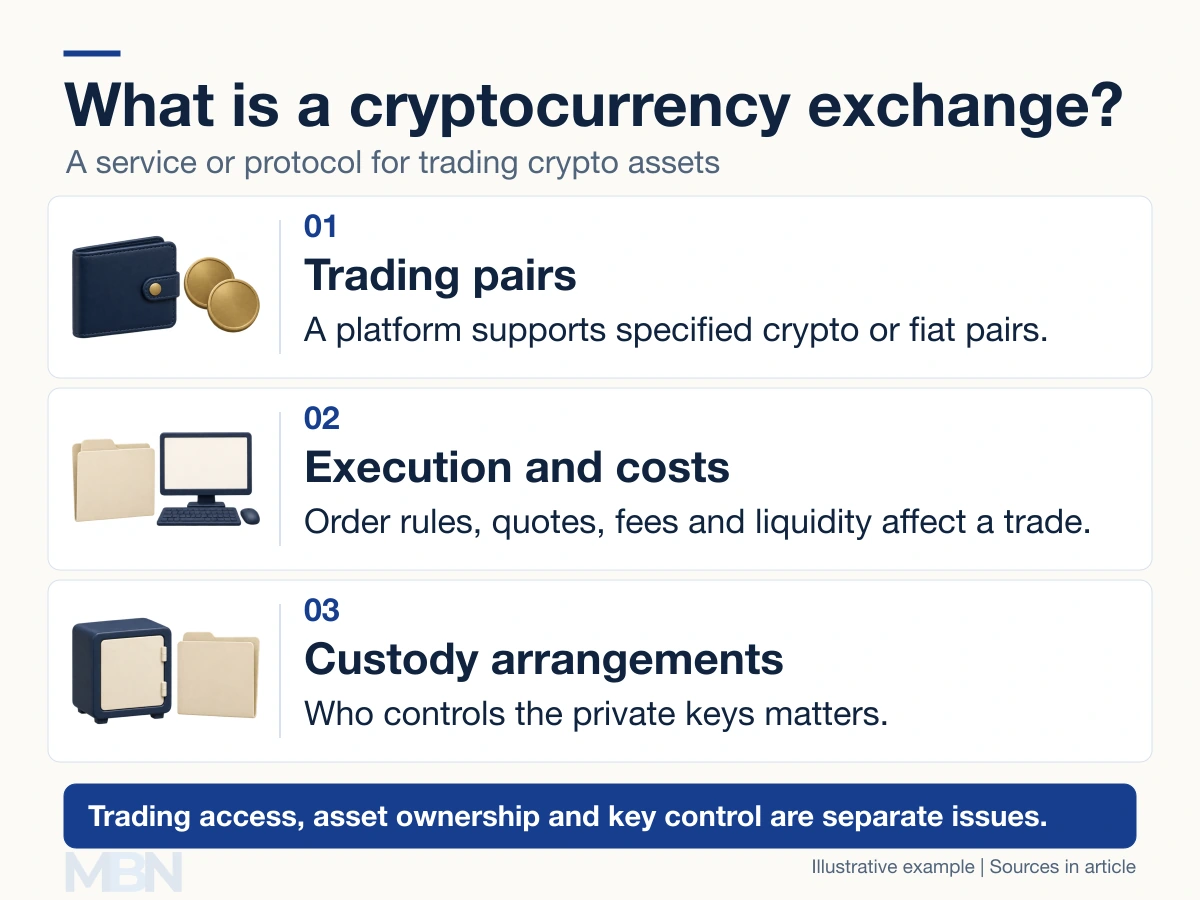
How a trade works
A trading pair states what is being exchanged. A centralized order book can match buyers’ bids and sellers’ offers. A broker-style service may instead provide a quoted price. Prices and fees can differ across venues.
Suppose a fictional platform quotes bitcoin at $40,000. A $100 purchase would equal 0.0025 bitcoin before fees. If a separate 0.5% fee applies, that fee is $0.50. Actual execution also depends on available liquidity and the order’s terms. These are illustrative figures, not a current quote.
Platforms, protocols and investment funds
A centralized platform is operated by a business. Decentralized trading protocols use smart contracts, programs on a blockchain, to facilitate trades. Designs differ, including order books and pools of assets used to provide liquidity.
Peer-to-peer services can connect counterparties and may provide escrow or dispute processes. Calling a trade P2P does not mean no platform is involved. A crypto investment fund is a pooled investment vehicle, rather than another name for an exchange.
Custody and private keys
A private key is secret cryptographic information used to authorize transactions. A wallet generally manages keys and access to blockchain records; it does not hold coins as physical objects.
The SEC’s custody bulletin distinguishes self-custody from third-party custody. With a custodial account, the provider typically controls the keys. With self-custody, the user controls them and bears responsibility for their security.
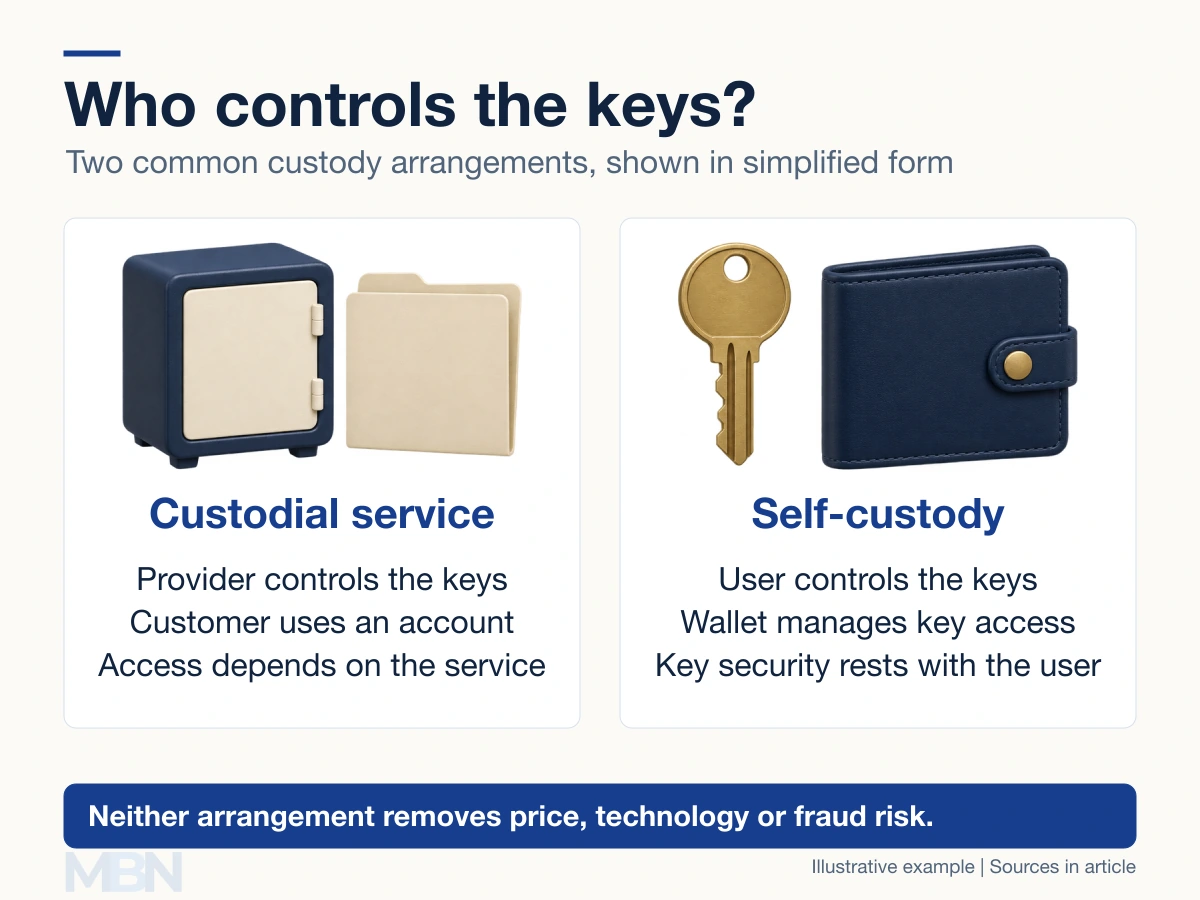
Account access, withdrawal rights and treatment if a provider fails depend on the actual arrangements. Cryptography alone does not protect against every stolen key, software weakness, fraud or business failure.
Identity checks and regulation
It is wrong to promise that nobody knows the buyers’ or sellers’ identities. Many providers conduct identity checks under applicable anti-money-laundering rules. The FATF’s virtual-asset work addresses these obligations and gaps in implementation. Public blockchain addresses are not a universal guarantee of anonymity.
In the EU, MiCA, the Markets in Crypto-Assets Regulation, creates a framework for crypto-asset services. ESMA confirmed the final transitional period ended on July 1, 2026. Provider status, permitted services and asset coverage still matter; authorization does not eliminate investment risk.
In the United States, FDIC insurance does not cover crypto assets. Holding a crypto account is not equivalent to holding an insured bank deposit. Trading can also be interrupted by outages, restrictions or maintenance despite typical round-the-clock availability.
What is a cryptocurrency?
A cryptocurrency is a digital representation of value using cryptography and network rules. Many use blockchains, distributed ledgers organized into linked blocks.
NIST explains that each block is cryptographically linked to the preceding block. That does not mean every block stores every transaction. A theft from an exchange does not require attacking every block simultaneously. Governance, technical design and control differ across assets and networks.
Last checked and updated on November 6, 2026 by the MBN editorial team.