
A dark pool is a securities trading venue that does not publicly display its buy and sell orders before execution. It can help investors seek a trade without advertising their full intentions. The word “dark” refers to limited pre-trade visibility, not permission to leave completed trades unreported.
In US stock trading, the term commonly refers to a non-displayed alternative trading system, or ATS. FINRA explains how these venues differ from exchanges and other off-exchange arrangements.
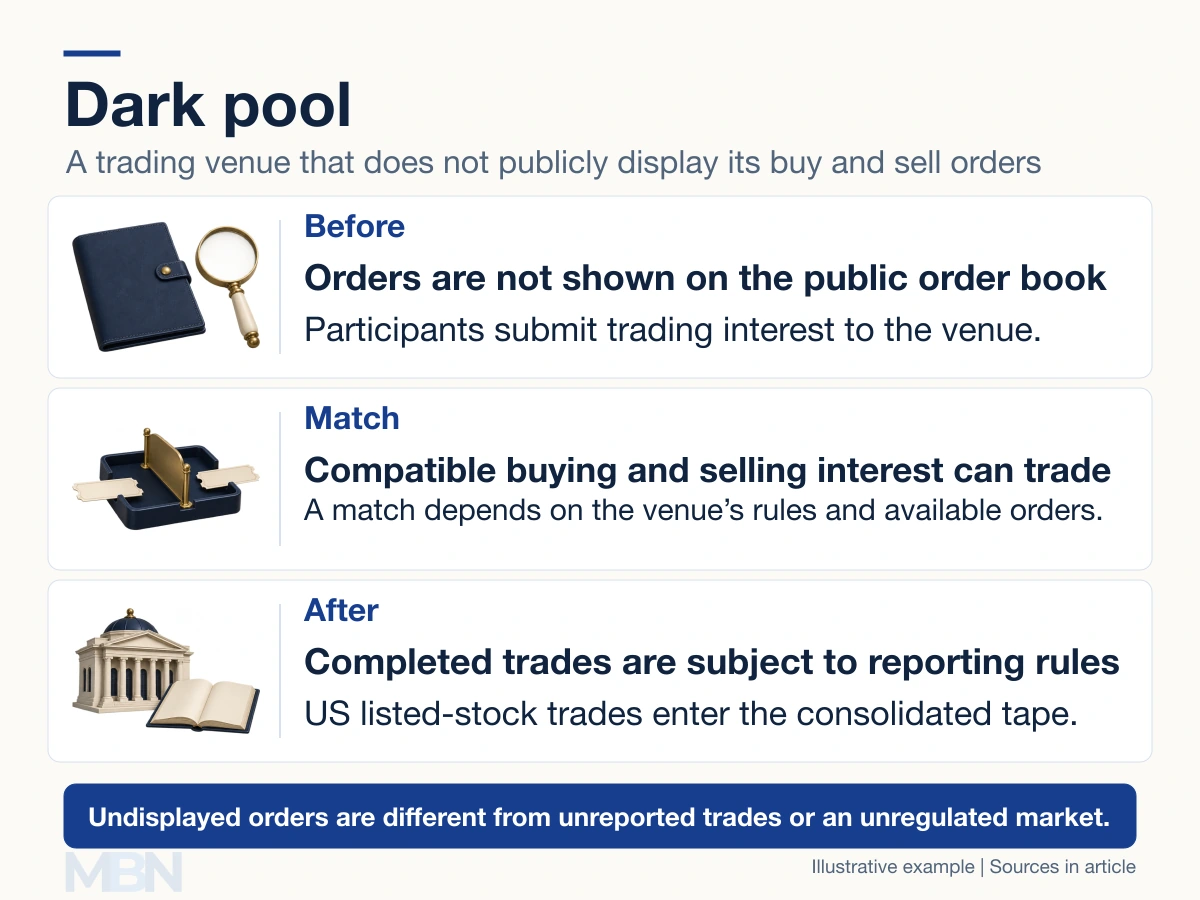
How a dark pool works
An investor’s broker sends an order to the venue. Its systems look for compatible trading interest according to its rules. An order might execute fully, execute partly or remain unfilled because there is no suitable counterparty.
A pension fund seeking to sell a large holding may prefer not to display the whole order. Revealing substantial selling interest could lead other traders to change their prices. A dark pool aims to limit that information exposure while searching for buyers.
This does not guarantee zero market impact. Information can leak, other orders can move prices, and the fund may eventually need to trade elsewhere. Privacy of an order is also different from anonymity from the venue operator or regulators.
What happens after a trade?
US listed-stock trades on ATSs must be reported through the relevant FINRA facility and are published on the consolidated tape, which collects trade data across venues. They are not invisible forever.
A public trade record does not show an investor’s entire uncompleted strategy. Seeing a completed transaction therefore does not reveal everything that was hidden before it.
A simple midpoint example
Suppose a share has a displayed bid of $49.90 and an ask of $50.10. The bid is the price offered by buyers; the ask is the price requested by sellers. Their midpoint is $50.00.
In a hypothetical venue that matches at that midpoint, a buyer and seller agree to exchange 10,000 shares for $500,000. Buying the same quantity at $50.10 would cost $501,000, assuming sufficient shares were available at that ask.
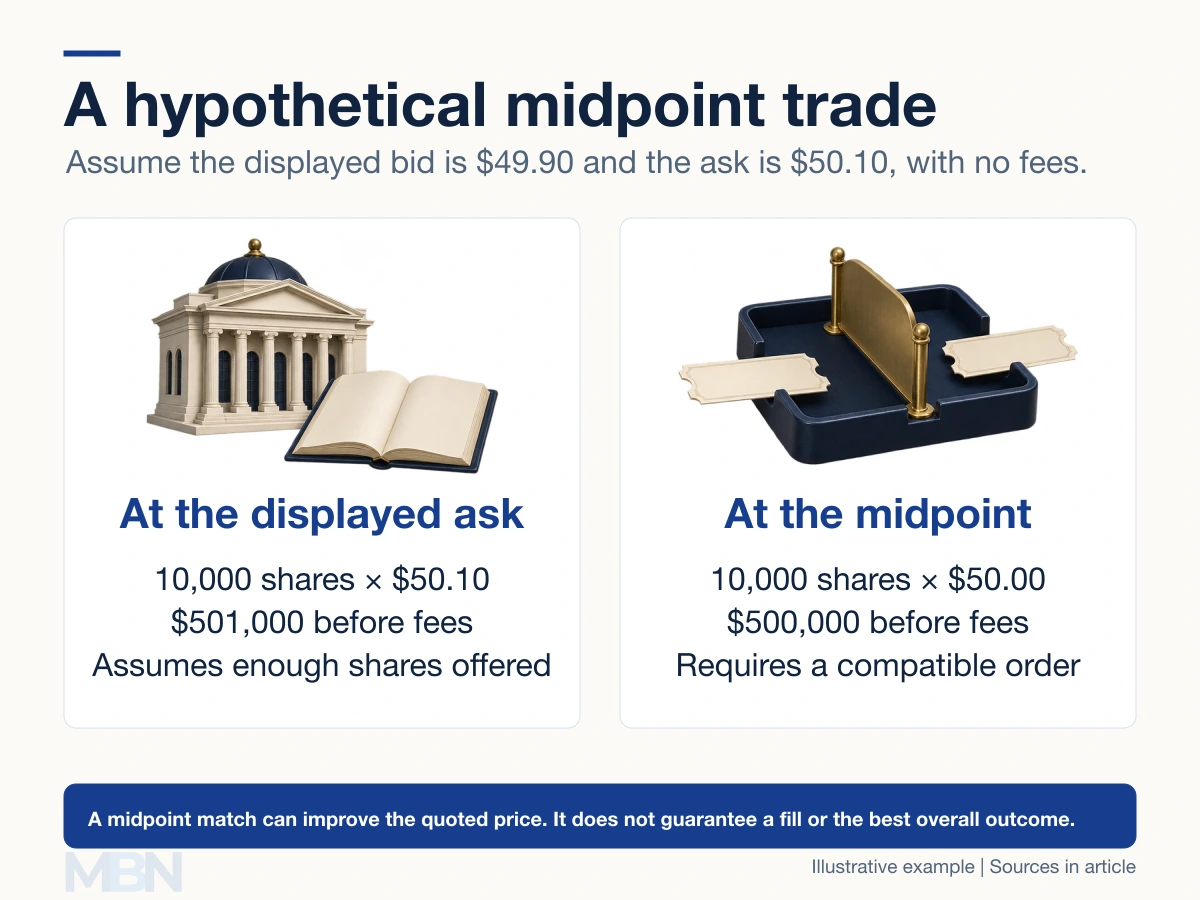
The $1,000 difference excludes fees and assumes the quotes remain unchanged. It does not prove that waiting for a dark-pool match is better: the buyer could receive only part of the order, miss the trade or face a later price change.
Benefits and trade-offs
Lower exposure of trading intentions and possible price improvement can make a dark venue attractive. However, less visible trading interest can also make it harder to assess available liquidity or understand how the market forms prices.
FCA-published research using UK equity transaction data found an association between less transparent venue choices and lower execution costs in its sample. That result is not a guarantee for every investor, venue or market condition.
Venue rules matter. Different participants may have different access, and an operator’s own activities can create conflicts. The SEC’s ATS framework requires operational disclosures and safeguards for confidential trading information. Public Form ATS-N filings help explain how covered US stock ATSs operate.
Dark pools are not all off-exchange trading
A broker trading against a customer as principal is a different arrangement from an ATS matching multiple subscribers. Treating every off-exchange transaction as a dark-pool trade overstates the category.
FINRA publishes separate ATS and non-ATS activity data. Any market-share figure needs a named period, market and denominator. An old percentage from a research article should not be presented as today’s share of stock trading.
A share can be listed on an exchange while a particular transaction occurs elsewhere. Listing identifies where the company’s securities are admitted to trading; execution identifies where an individual trade takes place.
Last checked and updated on November 11, 2026 by the MBN editorial team.