
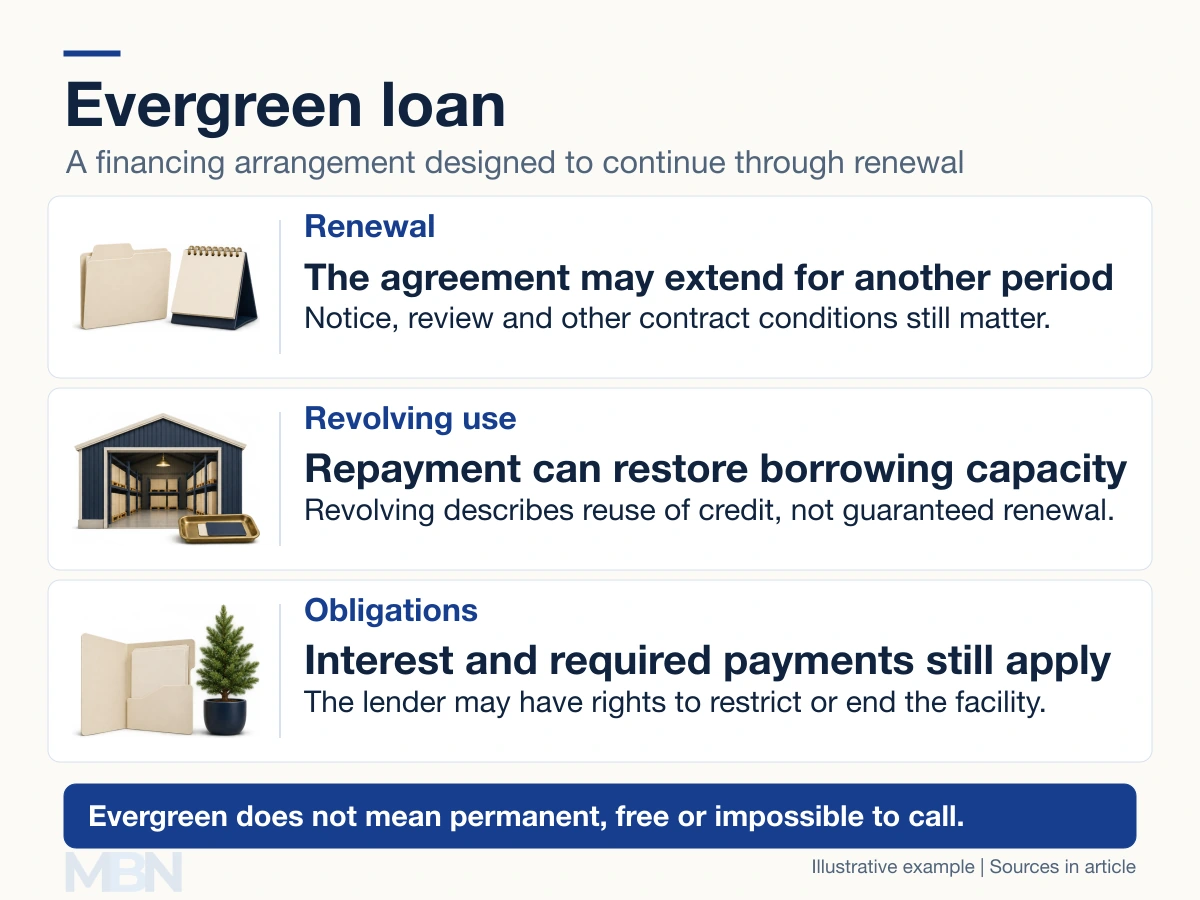
An evergreen loan is a borrowing arrangement intended to continue through renewal or extension rather than finish after one fixed borrowing cycle. The agreement determines how renewal works and when either party can stop it.
The term is also used loosely for continuing revolving credit. It does not mean the borrower can keep the money forever, make no payments or demand unlimited funding. Evergreen is not a standardized description of every loan’s legal rights.
Renewal and revolving credit are different
An evergreen clause commonly extends a contract automatically unless the required notice of nonrenewal is given. Practical Law’s glossary describes this automatic-extension feature. Other facilities require a lender’s review and fresh approval to continue.
Revolving credit describes the ability to borrow, repay and borrow again within a limit while a facility remains available. A revolving facility can have a fixed expiration date. Conversely, renewing a loan does not necessarily give the borrower permission to redraw amounts already repaid.
The CFPB’s official interpretation of open-end consumer credit specifically recognizes that a reusable credit line can have a fixed expiration date. This distinction also helps explain why revolving and perpetual should not be treated as synonyms.
How can a business use continuing credit?
A wholesaler might draw funds to buy inventory, sell the goods on credit and repay its borrowing when customers pay. If the facility allows further draws, it can then finance the next inventory cycle without arranging a completely new loan each time.
Its agreement may require interest payments, financial reporting, collateral and compliance with covenants, meaning contractual financial requirements or restrictions. Some facilities require the balance to be reduced periodically. Renewal dates, commitment fees and cancellation rights vary.
A revolving credit example
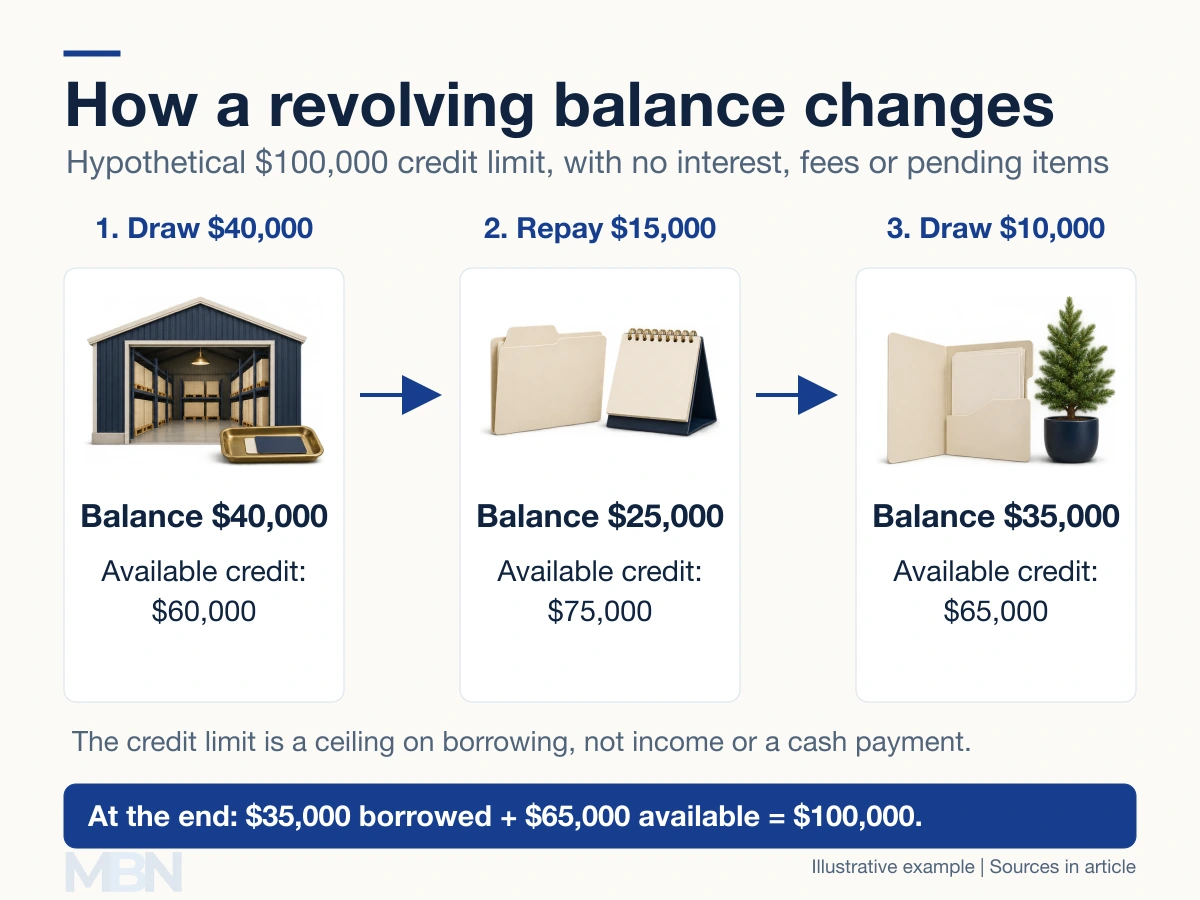
Suppose a business has a $100,000 limit and draws $40,000. It has $60,000 of unused capacity. Repaying $15,000 reduces the balance to $25,000 and restores available capacity to $75,000, assuming the lender has made no other changes.
A new $10,000 draw then raises the balance to $35,000 and leaves $65,000 available. The limit has not increased, and the repayments have not eliminated interest or future repayment obligations.
Does paying on time guarantee renewal?
No. Renewal may depend on contract conditions, the lender’s decision and applicable law. A lender might reassess cash flow, other debt, collateral or sector exposure. A loan payable on demand can also be called according to its terms.
There is no universal rule that income must exceed total debt, or that a balance near its limit for two years proves inability to repay. Income is measured over a period, whereas a debt balance is measured at a date. Repayment capacity requires a broader assessment of cash flows and obligations.
Continuing credit can provide flexibility, but a business that relies on repeated renewals faces refinancing risk: replacement funding may be costly or unavailable when the existing arrangement ends.
What does evergreening a troubled loan mean?
In banking supervision, evergreening can mean providing new credit or rolling over debt to disguise an existing borrower’s repayment difficulties. This is distinct from an ordinary renewable facility that is properly assessed and reported.
For example, the Reserve Bank of India’s 2023 to 2024 annual report discusses alleged arrangements that routed fund investments back to stressed borrowers to repay loans. A legitimate renewal does not by itself establish such concealment. The borrower’s condition and the transaction’s substance matter.
Last checked and updated on November 10, 2026 by the MBN editorial team.