
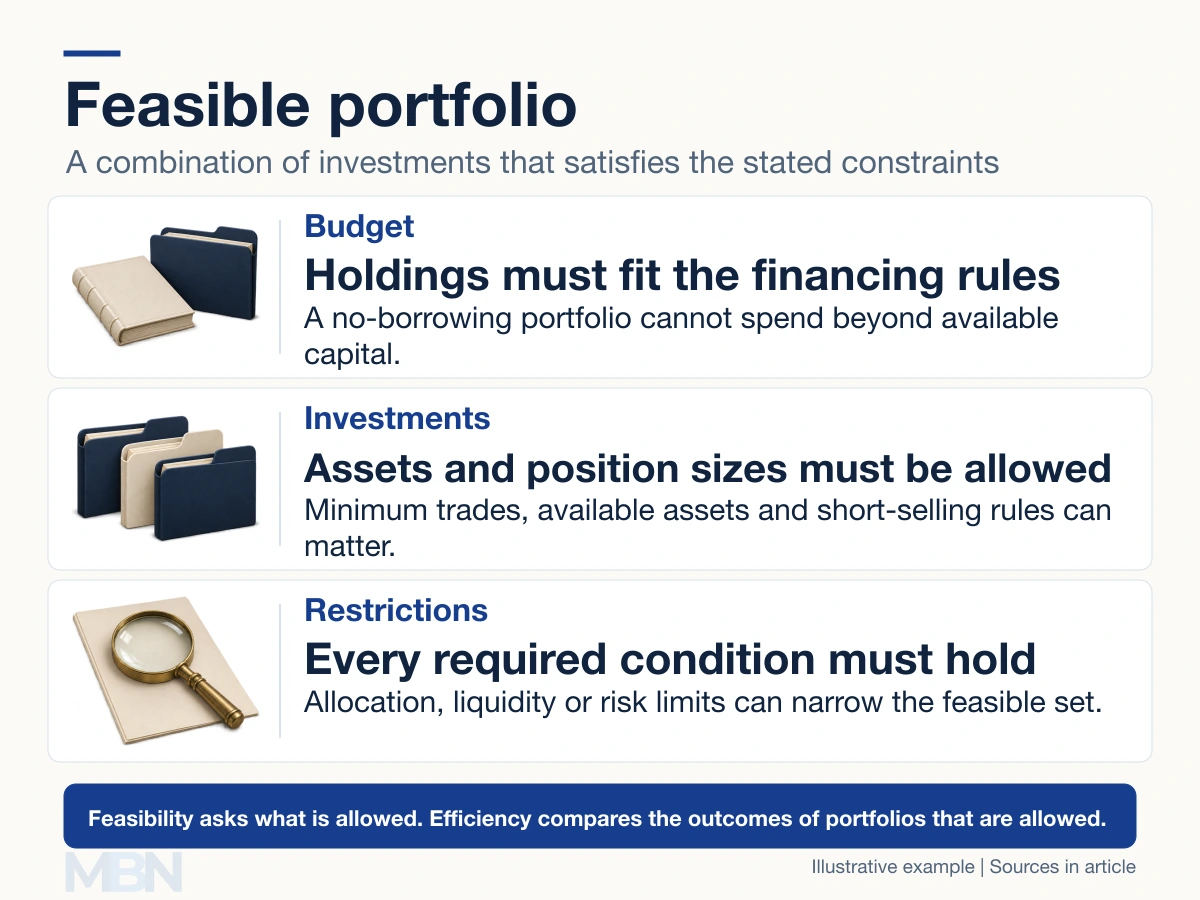
A feasible portfolio is a combination of investments that satisfies the constraints of a portfolio problem. Those constraints can include the available budget, permitted assets, borrowing rules and limits on particular holdings. The feasible set is the collection of all portfolios that satisfy them.
A portfolio is a collection of investments. Calling one feasible means it is allowed under the specified rules; it does not establish that it is the best choice, low risk or likely to earn a profit.
What determines feasibility?
In a simple fully invested portfolio, the investment weights add to 100%. A long-only constraint requires nonnegative weights, so the model does not allow short positions. Borrowing or leverage can change the financing rules and must be stated explicitly.
Other constraints can include a maximum equity allocation, minimum cash reserve, prohibited assets, minimum trade sizes or restrictions on selling. A formal risk limit can also be a constraint. Stanford portfolio research describes these allocation and budget conditions.
An investment objective is different from a hard restriction. Wanting a higher return does not automatically make every lower-return portfolio infeasible. The model must specify whether a minimum expected return is required or whether return is an objective to optimize.
A budget and allocation example
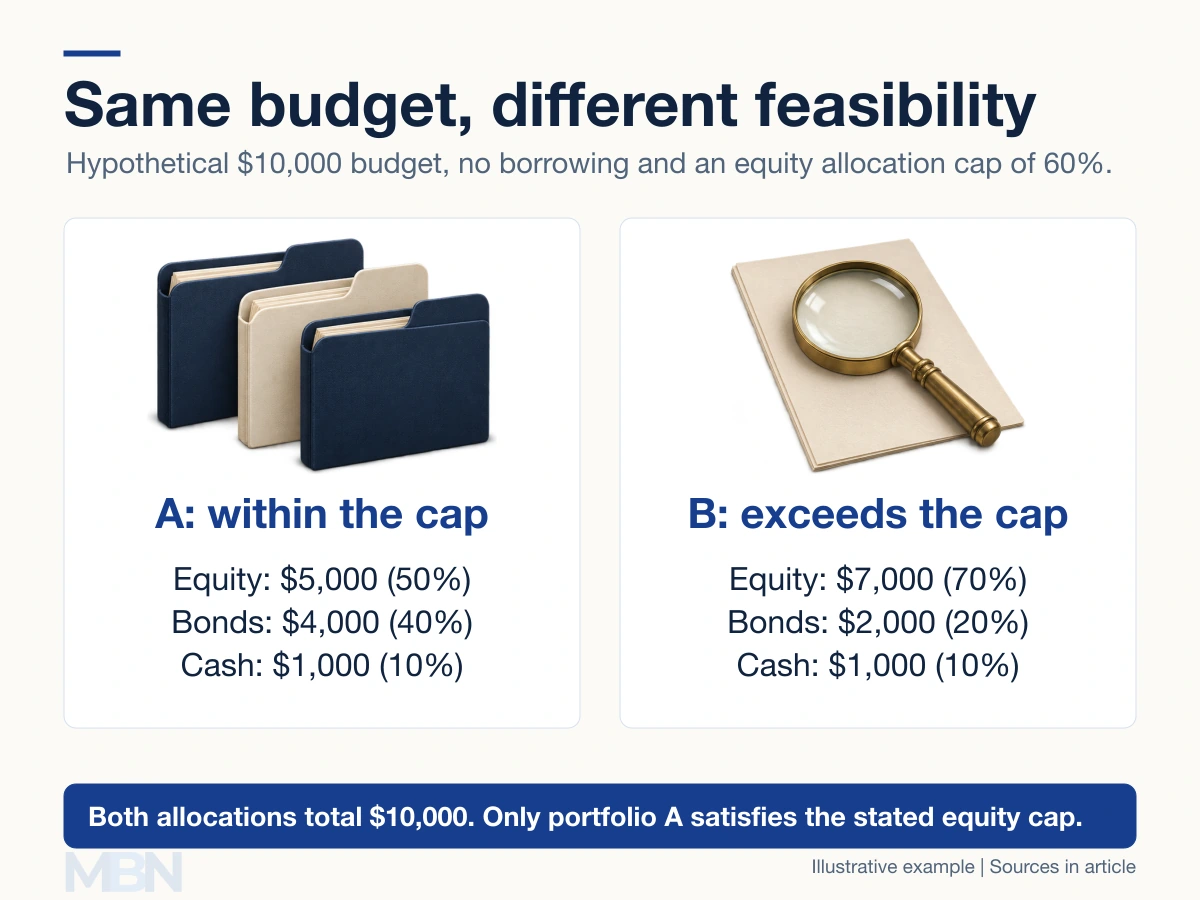
Suppose an investor has $10,000, cannot borrow and sets an equity cap of 60%. The only available categories are equity, bonds and cash. An allocation of $5,000, $4,000 and $1,000 respectively uses the budget and meets the cap.
An allocation of $7,000 to equity, $2,000 to bonds and $1,000 to cash also totals $10,000, but violates the equity restriction. It is infeasible under these stated rules even if the investor expects it to earn more.
William Sharpe’s optimization instructions illustrate the same principle: candidate holdings must respect their bounds and the portfolio’s funding constraint. Changing a constraint changes which portfolios are available for comparison.
Feasible and efficient portfolios
In mean-variance analysis, expected return is compared with risk measured by the variance or standard deviation of returns. An efficient feasible portfolio cannot be improved to give more expected return at the same risk, or less risk at the same expected return, within the model.
For example, if two feasible portfolios both have modeled volatility of 8%, but expected returns of 5% and 6%, the first is dominated on those two measures. The higher-return portfolio is preferable on that comparison, although another portfolio could still improve on both.
The efficient frontier describes the best available risk-return trade-offs under the specified assumptions. Stanford’s Markowitz review explains this optimization framework.
Why model assumptions matter
Portfolio risk depends on how asset returns move together, not simply an average of individual risks. Estimated returns, volatilities and relationships can change. An apparently efficient portfolio is not guaranteed to perform efficiently in future realized results.
Transaction-cost research also shows why implementation affects portfolio choice. Fees, taxes, trading restrictions and liquidity can make an abstract allocation impractical. Feasibility should be assessed against the rules and conditions that actually apply.
Last checked and updated on November 11, 2026 by the MBN editorial team.