
A fill-or-kill order, abbreviated FOK, instructs a broker or trading venue to execute the entire order immediately or cancel it in full. Under the standard definition, no partial execution is allowed.
The instruction combines a quantity requirement with an immediate-execution requirement. It is different from a guarantee that the trade will happen or that a particular market price will remain available.
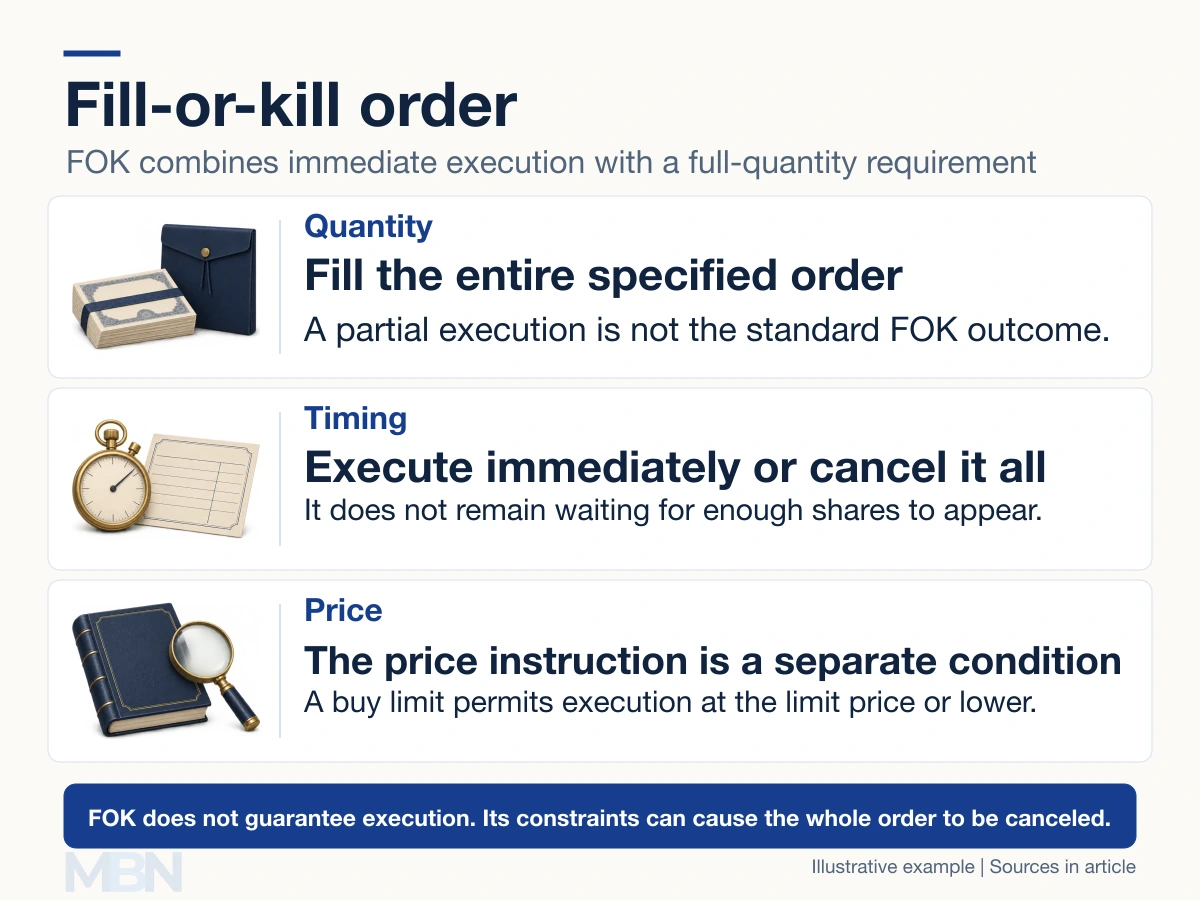
How quantity, time and price interact
Suppose an investor enters a FOK order to buy 1,000 shares with a $50 limit. The complete quantity must be executable immediately at $50 per share or better. If only 600 qualifying shares are available, the whole order is canceled.
A limit specifies the maximum purchase price or minimum sale price. FOK specifies how the quantity and timing must be handled. Depending on the venue’s rules, a complete fill can involve multiple counterparties or price levels within the limit, rather than one trade at exactly one price.
Nasdaq MRX’s rules, for example, describe FOK as a limit order requiring immediate execution in its entirety. Other venues have their own supported instructions and execution scope.
FOK, IOC and AON are different
The SEC’s order-type bulletin distinguishes three instructions. FOK requires immediate execution of the whole order. Immediate-or-cancel, or IOC, allows the immediately available portion to execute and cancels the remainder.
All-or-none, or AON, requires the full quantity but does not itself require immediate execution. It can remain active under its applicable duration conditions. FINRA’s explanation makes the same distinction.
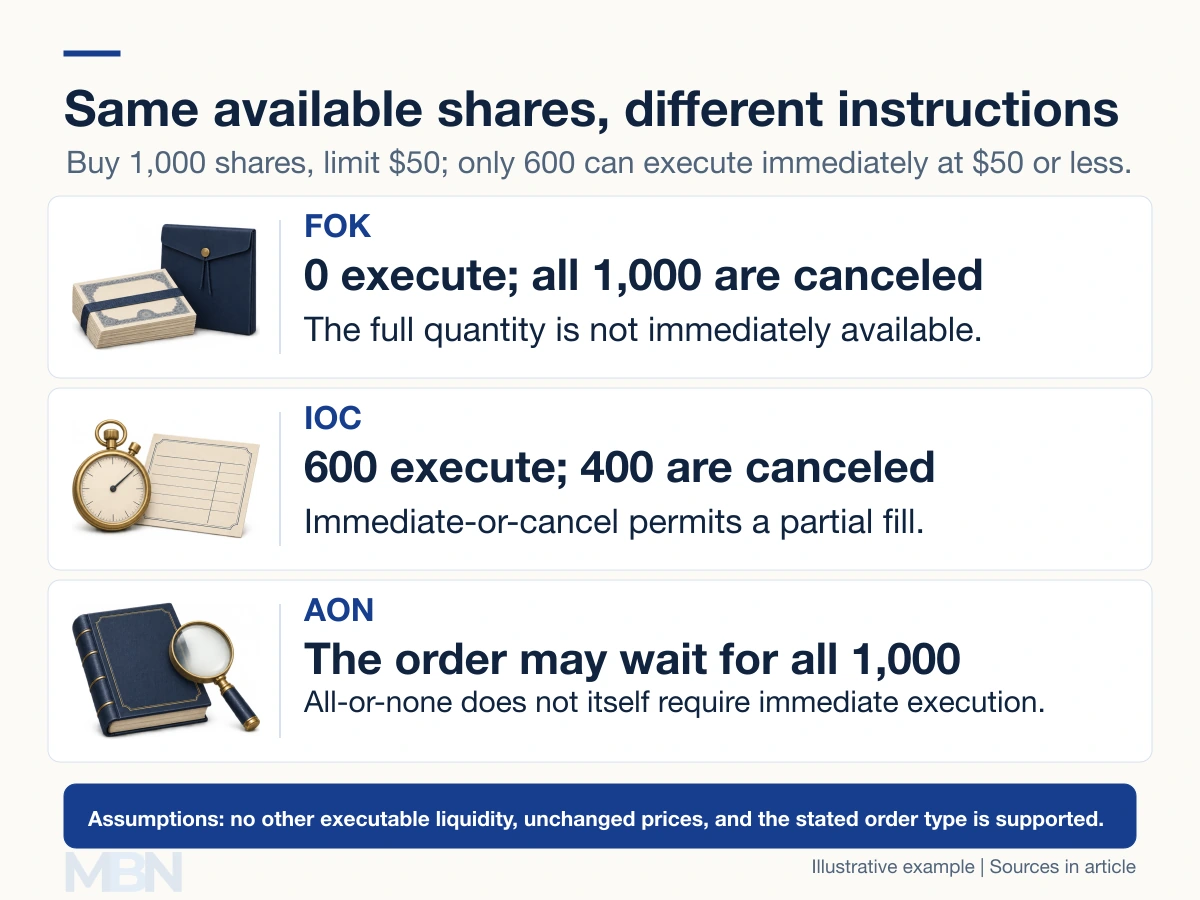
In the example, IOC can fill 600 shares and cancel 400. FOK fills none and cancels all 1,000. AON may wait for a complete fill, subject to its duration and the venue’s rules.
What the instruction is used for
FOK can be useful when a partial position would not meet a transaction’s purpose, or when an investor wants an immediate full-quantity result. It is often discussed with large orders, but “large” is not part of the core definition.
There is a trade-off: insisting on both immediacy and completeness can increase the chance of no execution. A displayed quote alone may not provide the required quantity by the time the order reaches the market.
Where the protection ends
FOK applies to the order under the broker’s and venue’s implementation. It does not automatically make separate orders across different markets execute as one guaranteed package. One leg of a wider strategy can still have different execution conditions from another.
The Nasdaq Canada order description, for instance, specifies execution within its own order book. Availability, routing and eligible instruments therefore matter alongside the label. FOK is an execution instruction, not protection against later price movements or investment losses.
Last checked and updated on November 11, 2026 by the MBN editorial team.