
FF&E stands for furniture, fixtures and equipment. It is a practical grouping of items used to furnish and operate spaces such as offices, hotels, shops and other facilities.
Desks, seating, display units and office equipment are common examples. Many items are movable, but the precise treatment of fittings, connected equipment and other components depends on the project, contract or asset definition.
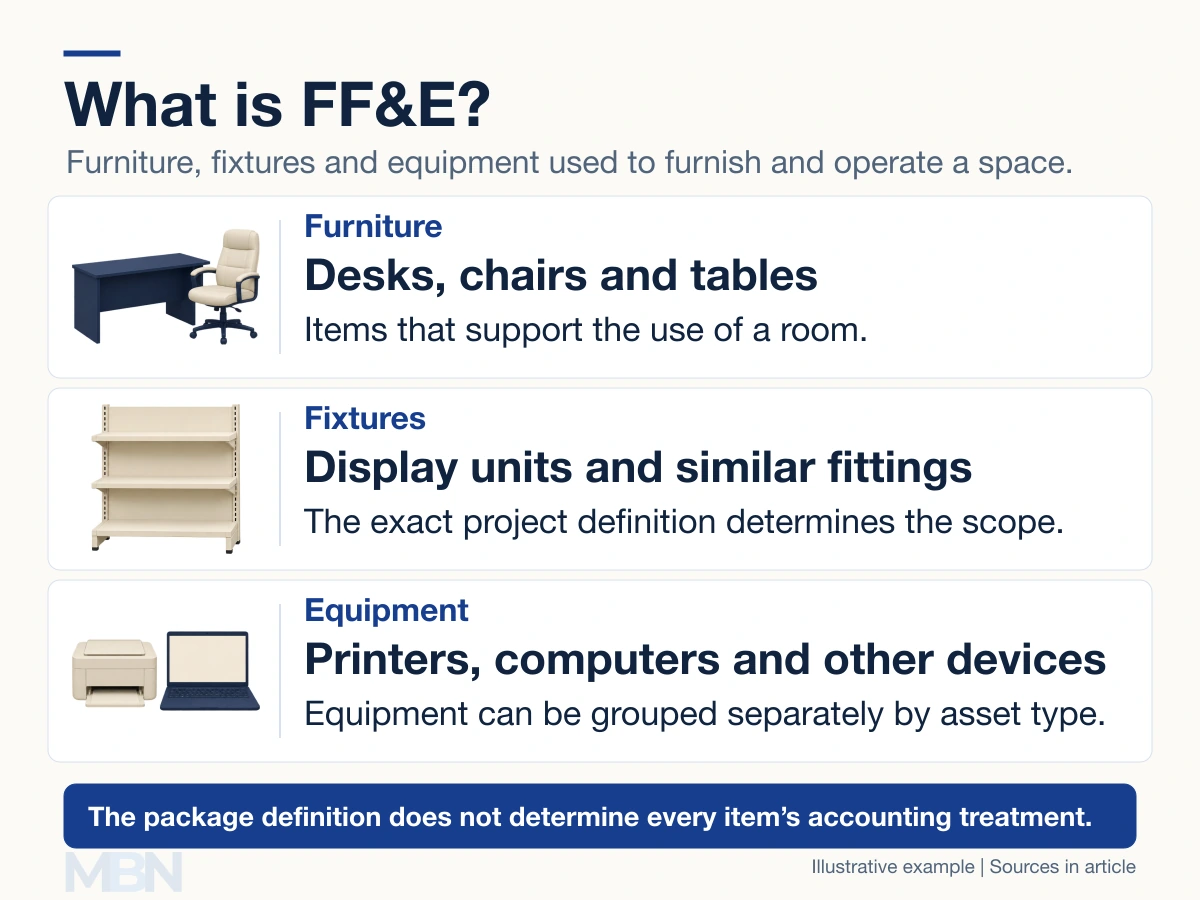
What belongs in an FF&E package?
A package can cover selection, specification, procurement and installation. The US Army Corps of Engineers’ furnishings program describes work spanning interior design, procurement, installation and quality assurance.
A US federal guide specification includes a broad FF&E package and provisions for contractor procurement and installation. This illustrates why it is incorrect to say that FF&E is always outside the contractor’s scope or absent from design documentation.
Responsibility is established by the actual project arrangements. Building fabric, structural work and finishes such as paint or floor surfaces are often budgeted separately. Boundaries can differ, especially for fitted or specialized equipment.
Is everything used by a business FF&E?
No. Inventory held for sale, consumable supplies, land and the building itself are different categories. A box of paper used by an office does not become long-term equipment merely because the business uses it every day.
The meaning of a project package is also different from the recognition rules for an accounting asset. FF&E is not necessarily one compulsory line on every company’s financial statements.
How is it treated in financial accounts?
The IFRS Foundation’s IAS 16 overview describes property, plant and equipment as tangible items held for use over more than one period. Recognition also depends on the relevant criteria, including probable future economic benefits and reliable measurement of cost.
Applicable standards, materiality and accounting policies determine whether expenditure is capitalized as an asset or recognized as an expense. There is no universal rule that every FF&E item must last at least three years.
Cost is different from resale value
Suppose a fictional qualifying asset costs $6,000 and has a five-year useful life and $1,000 residual value. With straight-line depreciation and unchanged estimates, annual depreciation is ($6,000 − $1,000) divided by five, or $1,000.
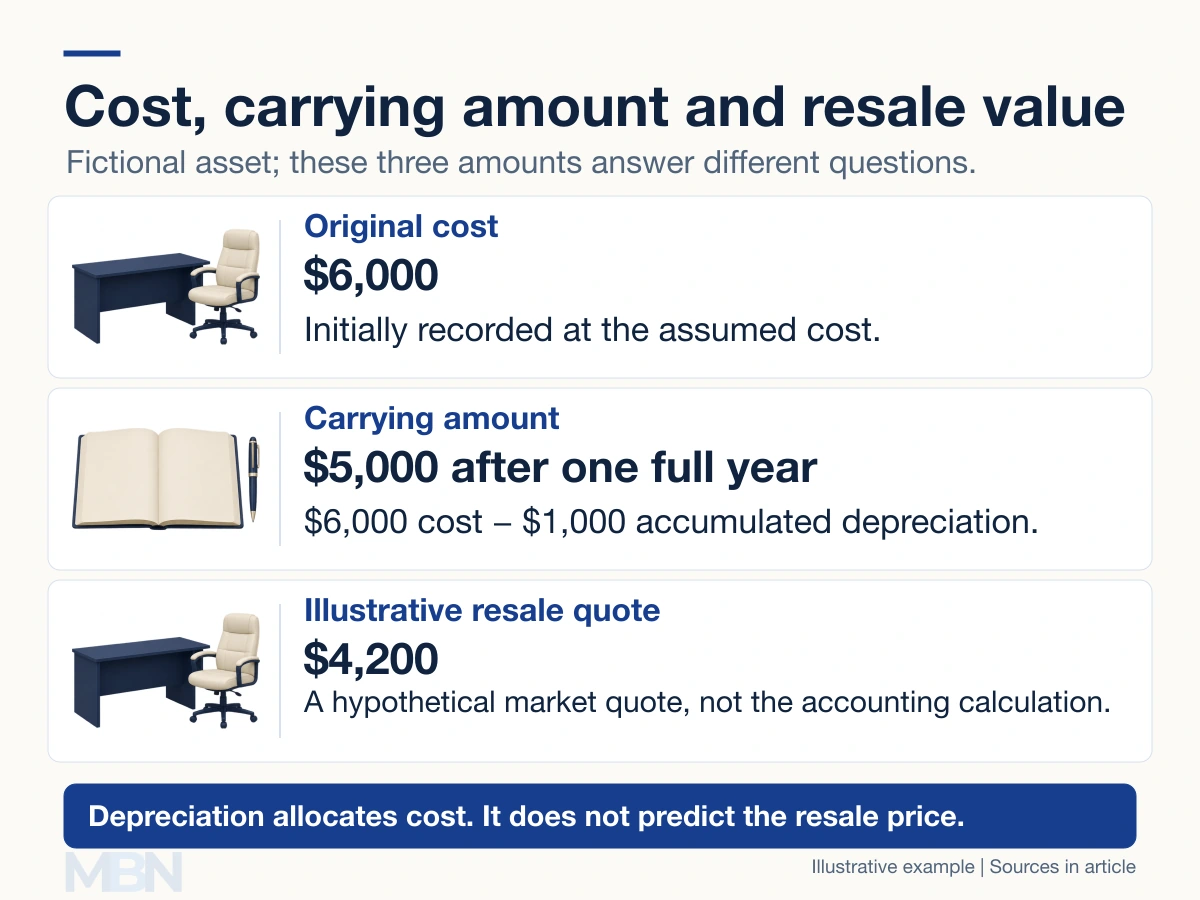
After one full year, its carrying amount under a simple cost model is $5,000, before other adjustments. A hypothetical buyer might quote $4,200 for it. The original cost, carrying amount and resale quote are different figures.
Depreciation systematically allocates the depreciable amount over the asset’s useful life. It is not automatically a measure of falling market prices or a new cash payment. The example excludes impairment, revaluation and other adjustments.
Do tax rules use the same useful life?
Not necessarily. The IRS’s 2025 Publication 946 distinguishes US tax recovery periods for office furniture and computers. Tax classifications and available deductions are specific to the jurisdiction, asset and applicable year.
A prescribed tax recovery period is different from a business’s estimated useful life for financial reporting. The label FF&E alone does not determine a depreciation rate, tax deduction or resale value.
Last checked and updated on November 3, 2026 by the MBN editorial team.