
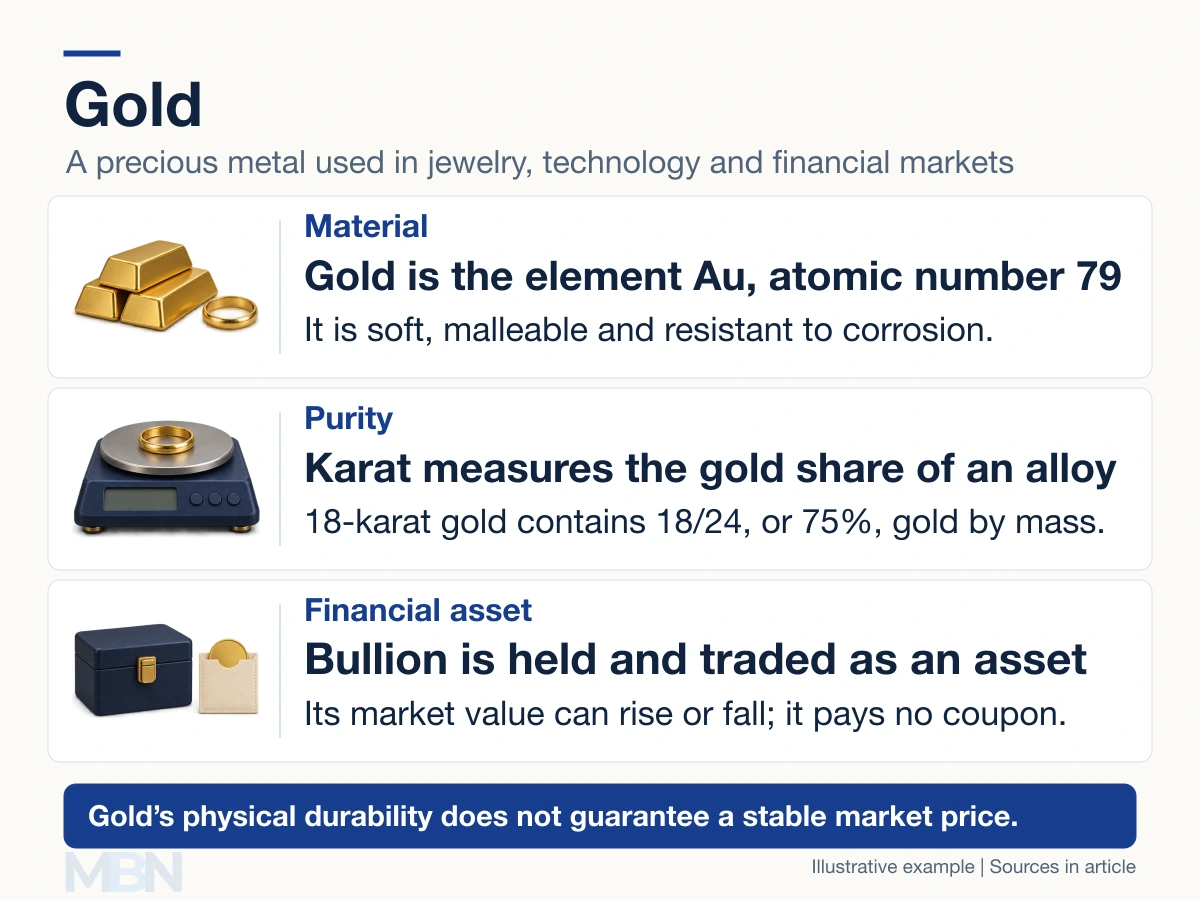
Gold is a precious metal used in jewelry, electronic components, coins and bullion. It is also a financial asset held by investors and central banks. Its chemical symbol is Au and its atomic number is 79.
The Royal Society of Chemistry describes gold as a soft, highly malleable metal. Malleable means it can be hammered into thin sheets. Its resistance to corrosion helps explain why it has been used for ornaments and stores of wealth for thousands of years.
What do karat and fine gold mean?
Pure gold is described as 24-karat gold. Jewelers often mix it with other metals to increase hardness or change its color. An 18-karat alloy contains 18 parts gold out of 24, or 75% gold by mass. Fineness expresses purity in parts per thousand, so 750 fineness also means 75% gold.
“Fine gold” refers to the pure gold content. A jewelry item’s total weight can include alloy metals, stones and other components, so it is not necessarily its gold weight.
A simple gold-content calculation
Suppose a 10-gram item consists entirely of 18-karat gold alloy. Its fine gold content is 10 × 18/24 = 7.5 grams. At a hypothetical fine-gold price of $80 per gram, that content has a metal value of $600.
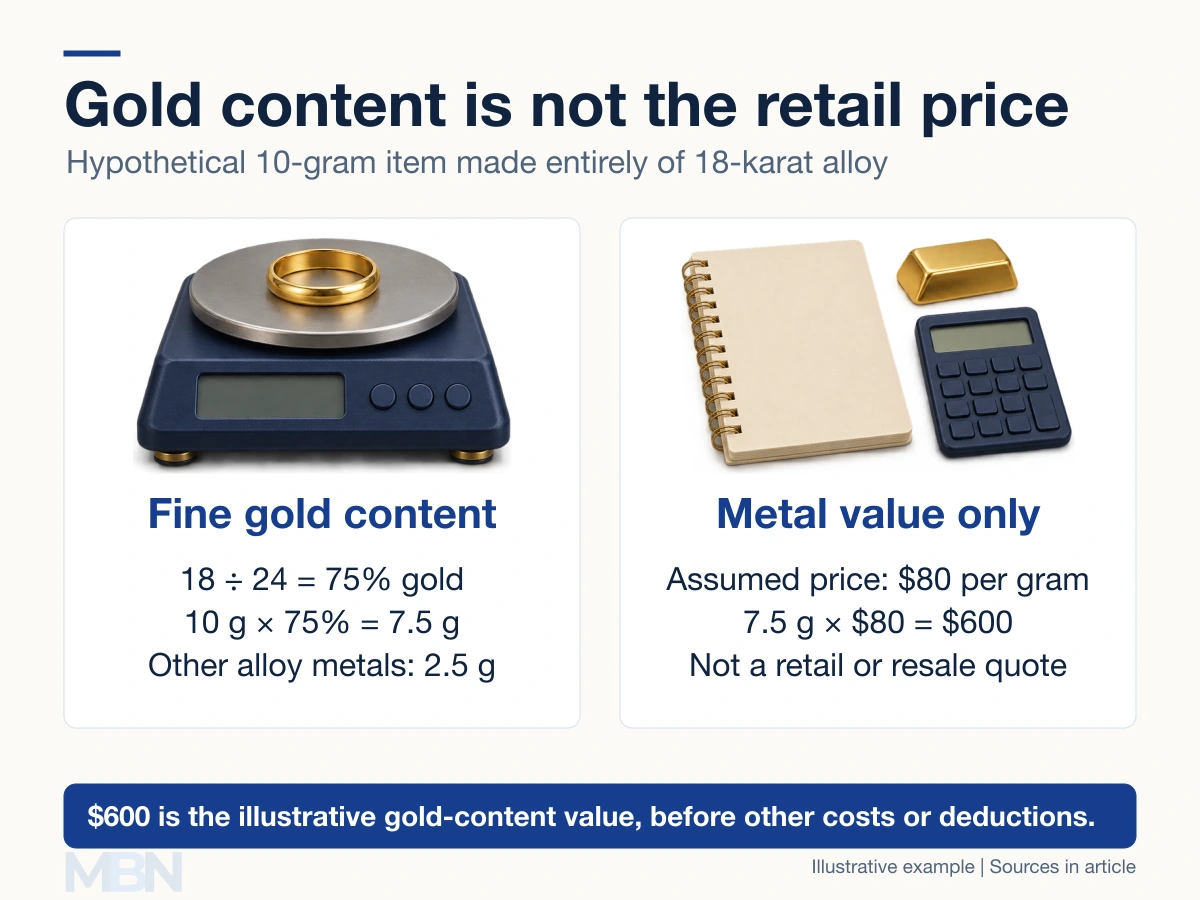
That calculation does not establish a shop price or a dealer’s purchase offer. Workmanship, brand premiums, taxes, testing and refining costs, and dealer margins can make those prices differ substantially.
How is gold priced?
Gold trades in several markets, including over-the-counter bullion markets and exchange-traded futures. A spot price concerns near-term delivery; a futures price concerns a specified contract and delivery or settlement period.
The LBMA Gold Price is a London benchmark set through auctions administered by ICE Benchmark Administration. Gold auctions commence at 10:30 and 15:00 London time on publication days. This benchmark is one market reference, rather than a rule that gold can trade only twice a day.
Wholesale quotations commonly use US dollars per troy ounce. A troy ounce is about 31.1035 grams, distinct from the ordinary ounce used for many household goods. A retail bar or coin can trade above the underlying metal quotation because of fabrication and distribution costs.
What changes gold’s market value?
Investment flows, jewelry and technology demand, central-bank transactions, mining and recycling all affect supply and demand. Existing above-ground stocks can be sold or held, so newly mined supply is only part of the picture.
Interest rates do not produce an automatic one-way price movement. Gold itself pays no coupon, so higher expected real interest rates, meaning rates after expected inflation, can raise the opportunity cost of holding it. Chicago Fed research examines real rates, inflation expectations and economic pessimism as price influences. Exchange rates and changing demand can offset or reinforce those influences.
Why do investors and central banks hold gold?
Some investors use gold for diversification or protection against particular monetary and financial risks. That does not make it a reliable short-term inflation hedge or guarantee that it rises in every crisis. The CFTC warns that precious-metal prices can be volatile and ownership can involve significant costs.
Physical bullion involves storage, insurance and buying-and-selling spreads. Exchange-traded products may hold bullion, derivatives or other assets, with their own fees and structures. Mining-company shares represent a business, adding operating and management risks. Leveraged futures create different risks again.
Official gold reserves are assets held by monetary authorities. Holding reserves does not by itself create a gold standard, under which money is linked to a defined gold quantity. For example, the UK Treasury describes gold as part of its diversified official reserve portfolio, rather than a promise to convert every pound into gold.
Last checked and updated on November 10, 2026 by the MBN editorial team.