
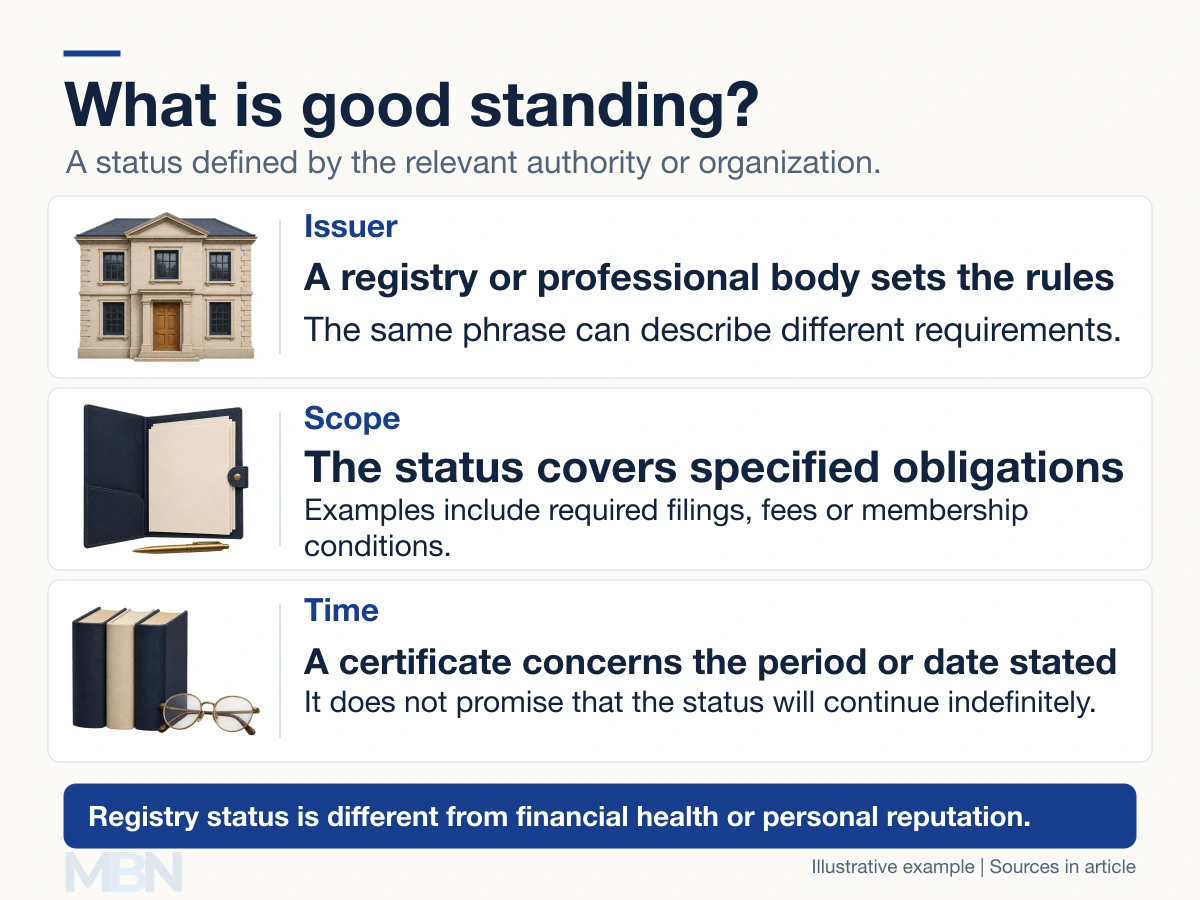
Good standing means that a company, member or other entity meets specified requirements of the relevant authority or organization. What it confirms depends on who grants the status, the rules involved and the date or period covered.
The phrase is not a universal guarantee of honesty, financial health or compliance with every law. A company registry’s certificate and a professional body’s membership record can cover different matters.
Company status in the United States
State registries use their own rules and terminology. Required reports, state fees and specified taxes may affect an entity’s standing, depending on its legal form and jurisdiction.
The Delaware Division of Corporations explains its entity-status descriptions. A status on one state’s records should not be read as confirmation that the business has met every federal, local or other-state obligation.
A certificate can be requested in connection with banking or registration elsewhere. The recipient’s document requirements determine what is needed. A registry certificate is not the same as a bank reference or a set of audited accounts.
What a certificate does not establish
Suppose a fictional company has submitted the filings required by its registry but has insufficient cash to pay a supplier tomorrow. A record about its filings does not answer that cash-flow question.
Similarly, a certificate limited to registry obligations does not certify product quality, future profits or the absence of every legal dispute. Its wording and scope matter more than the reassuring sound of “good standing.”
The UK summary statement
Companies House offers certificates containing certified facts. Its guidance now calls the wording previously known as the good standing statement a summary statement.
The statement concerns two facts: the company has existed without interruption since it was formed, and the registrar is not currently taking steps to remove it.
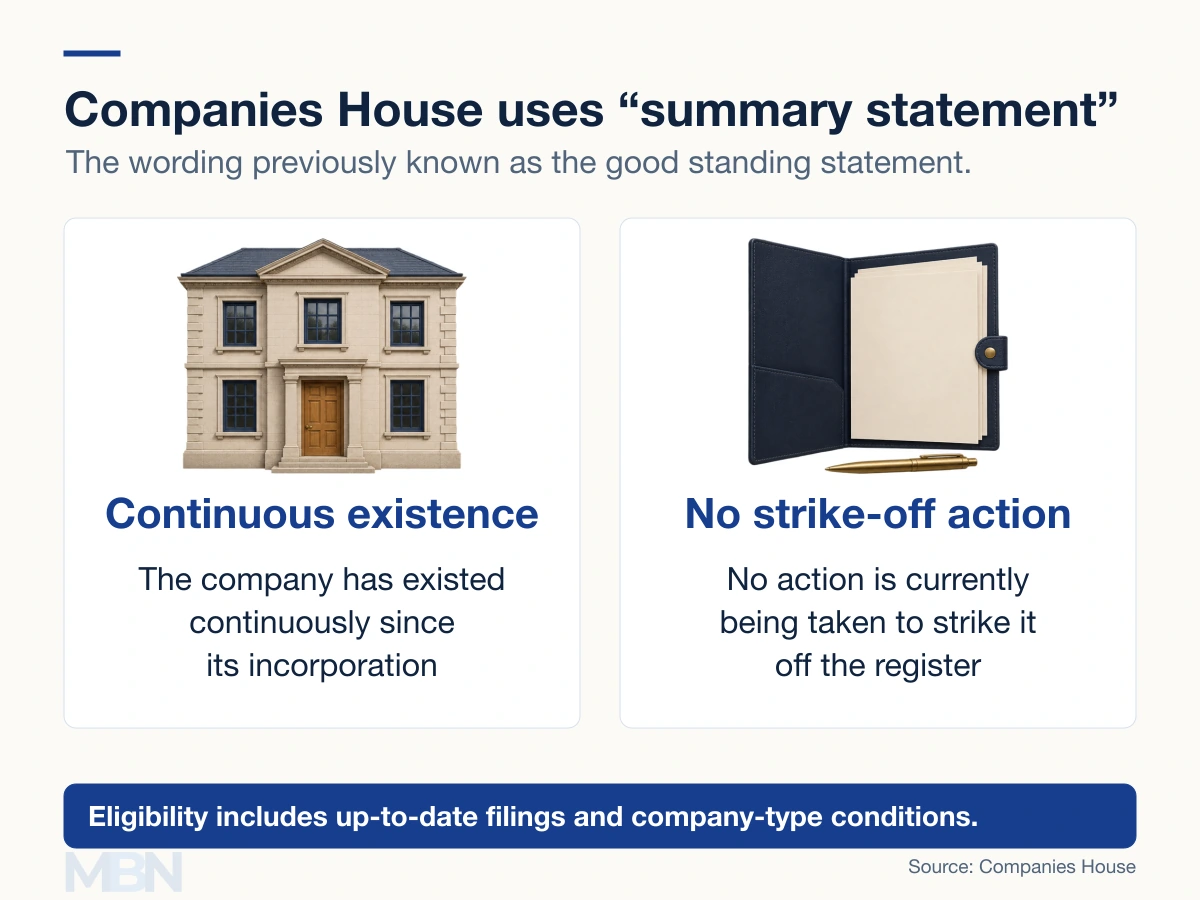
Companies House will issue that wording only when its eligibility conditions are met, including up-to-date filings and requirements relating to the company’s type and officers. The statement should not be described as a general solvency certificate.
Professional membership
A regulator or professional association may define standing through membership, payment, authorization or disciplinary rules. It is unsafe to assume that every certificate reports every complaint or pending matter.
The State Bar of California explains that “good standing” varies by jurisdiction. It offers different certificate types, including a complaint-check version. This illustrates why the precise document matters.
Good standing in everyday language
A person of good standing in a community is generally someone regarded as respectable or trusted. That reputation-based use is separate from a formal registry or professional status.
Specific applications may impose additional conditions. For example, UK passport countersignatory rules concern the person’s relationship to the applicant and other eligibility requirements. Holding a respected job alone does not settle eligibility.
Last checked and updated on November 2, 2026 by the MBN editorial team.