
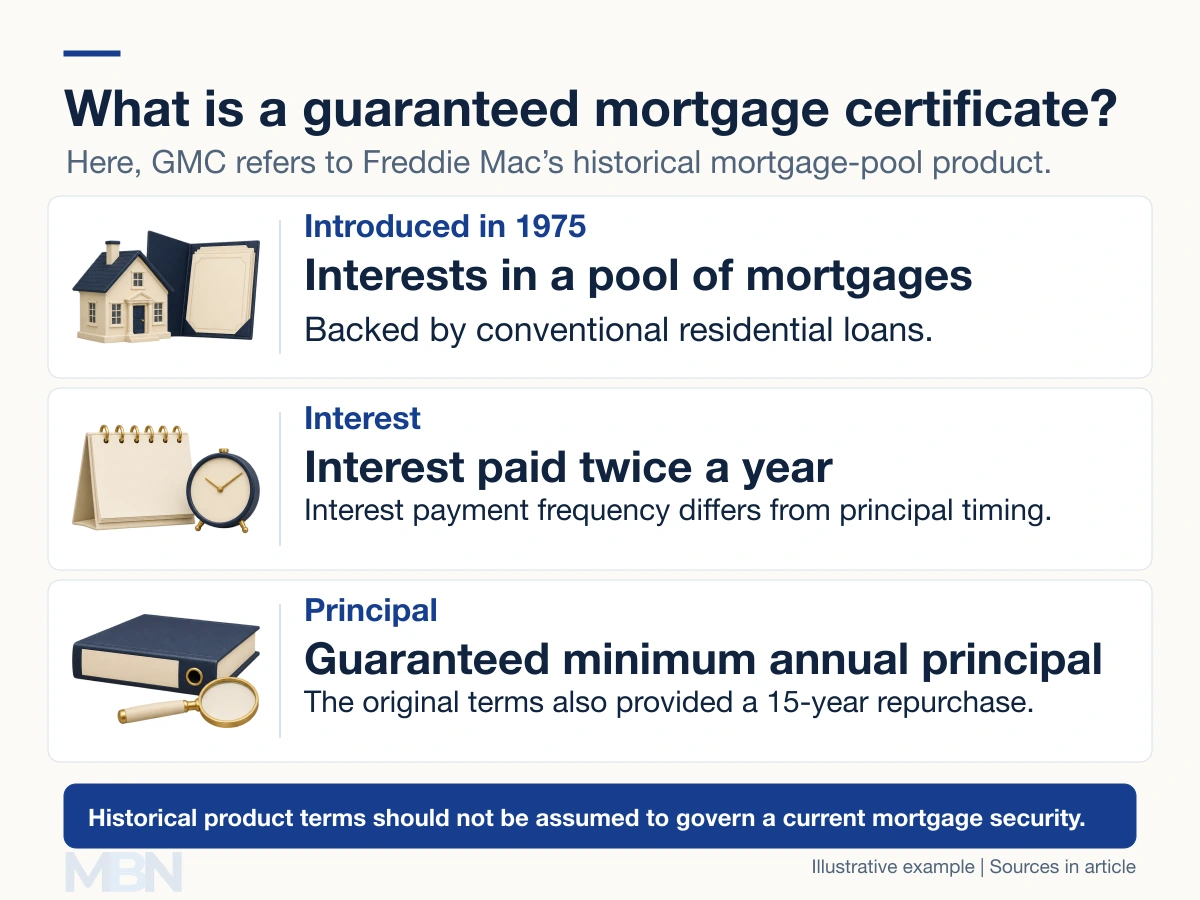
A guaranteed mortgage certificate, or GMC, historically refers to a Freddie Mac security introduced in 1975 that represented an interest in a pool of conventional residential mortgages. Its original design combined mortgage-pool backing with specified interest and principal-payment commitments.
This historical product name does not establish the terms of every mortgage-backed security described as guaranteed. The issuer, series and governing documents identify the actual promise.
How did the original certificates work?
The March 1975 Federal Home Loan Bank Board Journal, printed page 30, describes undivided interests in mortgages Freddie Mac had purchased. It specifies interest payments twice a year and principal payments annually in guaranteed minimum amounts.
It also describes Freddie Mac’s agreement to repurchase the certificate after 15 years at the unpaid principal balance. That is a repayment provision for the original design, not a promise that every investor earns interest for exactly 15 years.
A GAO examination of the 1975 financial statements, printed page 22, records two GMC series totaling $500 million issued that year. These are historical issuance figures, not an amount currently outstanding.
What does a guaranteed payment schedule mean?
A contractual minimum principal payment concerns how much must be returned by a specified date. It is different from an estimate of the security’s repayment pattern. Actual cash-flow rights depend on the issue’s terms, including the treatment of mortgage prepayments.
Faster repayments do not, by themselves, establish a universal rule that all remaining certificate principal becomes immediately payable. That conclusion requires the relevant contract.
How is average life different from maturity?
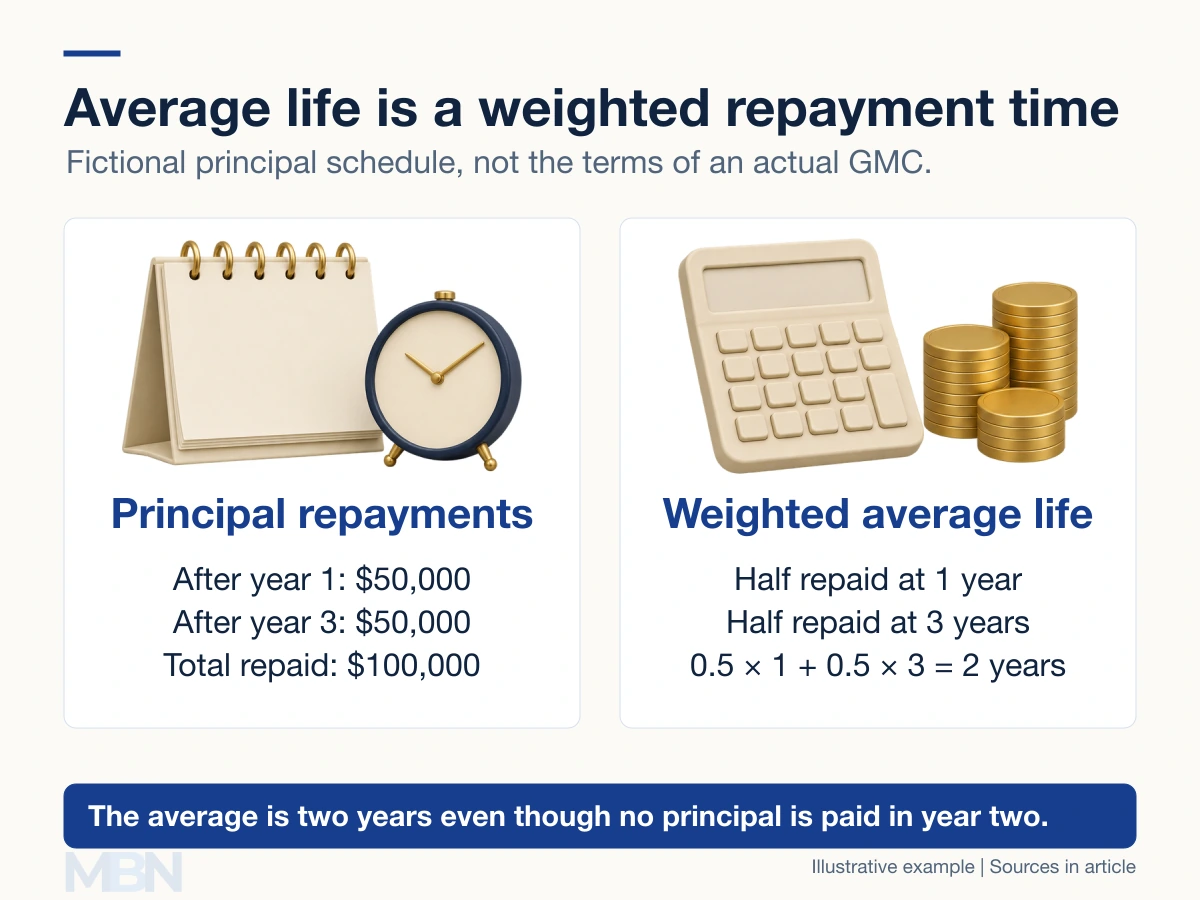
Average life weights each principal repayment by when it arrives. It is not the date of the final payment and is not a measure of investment yield.
Suppose a fictional $100,000 security returns $50,000 after one year and $50,000 after three years. Its weighted average life is two years: half the principal is weighted at one year and half at three years. Final principal repayment occurs after three years.
How does this relate to current mortgage securities?
Freddie Mac’s current legal-document library distinguishes UMBS, other MBS, participation certificates and multiclass products. Those documents, rather than a generic GMC definition, establish the applicable security’s guarantees and payment rules.
The SEC’s mortgage-security explanation describes how structures and prepayments affect investors. A payment guarantee does not automatically protect a purchase premium, resale value or a particular return.
The historical GMC illustrates how an issuer can reshape mortgage cash flows for investors. Its original payment schedule should remain attached to that product and period.
Last checked and updated on November 3, 2026 by the MBN editorial team.