
An International Bank Account Number (IBAN) is a standardized way to identify a bank account in a country that uses the IBAN system. It combines a country code, check digits and a country-specific account identifier.
The format supports automated processing of payments, particularly across borders. It is an account identifier, rather than a payment network, a separate bank account or a guarantee that a transfer will succeed.
How is an IBAN structured?
The Czech National Bank’s explanation identifies three main parts. The first two characters are letters identifying the country. The next two are numeric check digits. The remaining characters form the Basic Bank Account Number (BBAN).
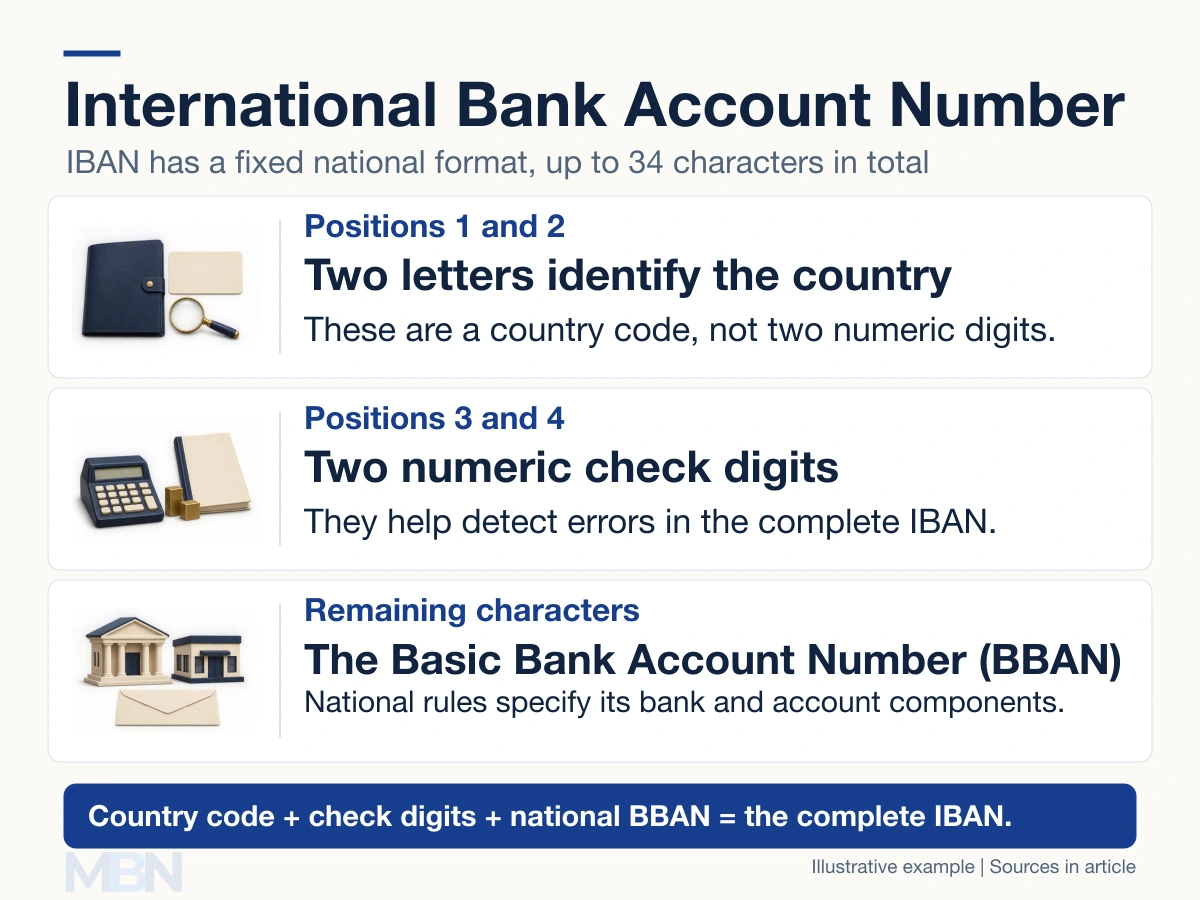
The international structure allows up to 34 alphanumeric characters. Each registered national format has its own fixed length and layout. The BBAN includes a bank identifier and account information, with other elements determined nationally.
For example, an IBAN beginning with CZ identifies the Czech national format. The two digits after CZ are check digits, not a bank code. This prefix explanation is not a complete account number.
IBANs are often displayed in spaced groups for readability. Those spaces are not additional characters in the electronic account identifier.
Which countries use IBAN?
IBAN is not universal, and a bank account in every country does not automatically have one. The official Swift IBAN Registry lists ISO-compliant national formats, their lengths and examples. Swift is the registration authority designated by the International Organization for Standardization (ISO).
The registry is a better reference than a static country map or an old list that mixes registered formats with other local conventions. IBAN adoption is also different from membership of the Single Euro Payments Area (SEPA), a framework for euro payments.
How does IBAN differ from a BIC?
An IBAN identifies an account. A Business Identifier Code (BIC), often called a Swift code, identifies an institution or other entity. A bank can have different identifiers for branches or functions. The BIC is not simply the two check digits inside an IBAN.
The information required from a payer depends on the transfer. For example, the Austrian central bank explains that IBAN-only rules apply to relevant euro payments within the European Economic Area. That is not a universal rule for every currency and destination.
What do the check digits prove?
A checksum is a mathematical test of the characters. It helps detect many entry errors, but passing it does not establish that an account exists, is open or belongs to the person requesting payment.
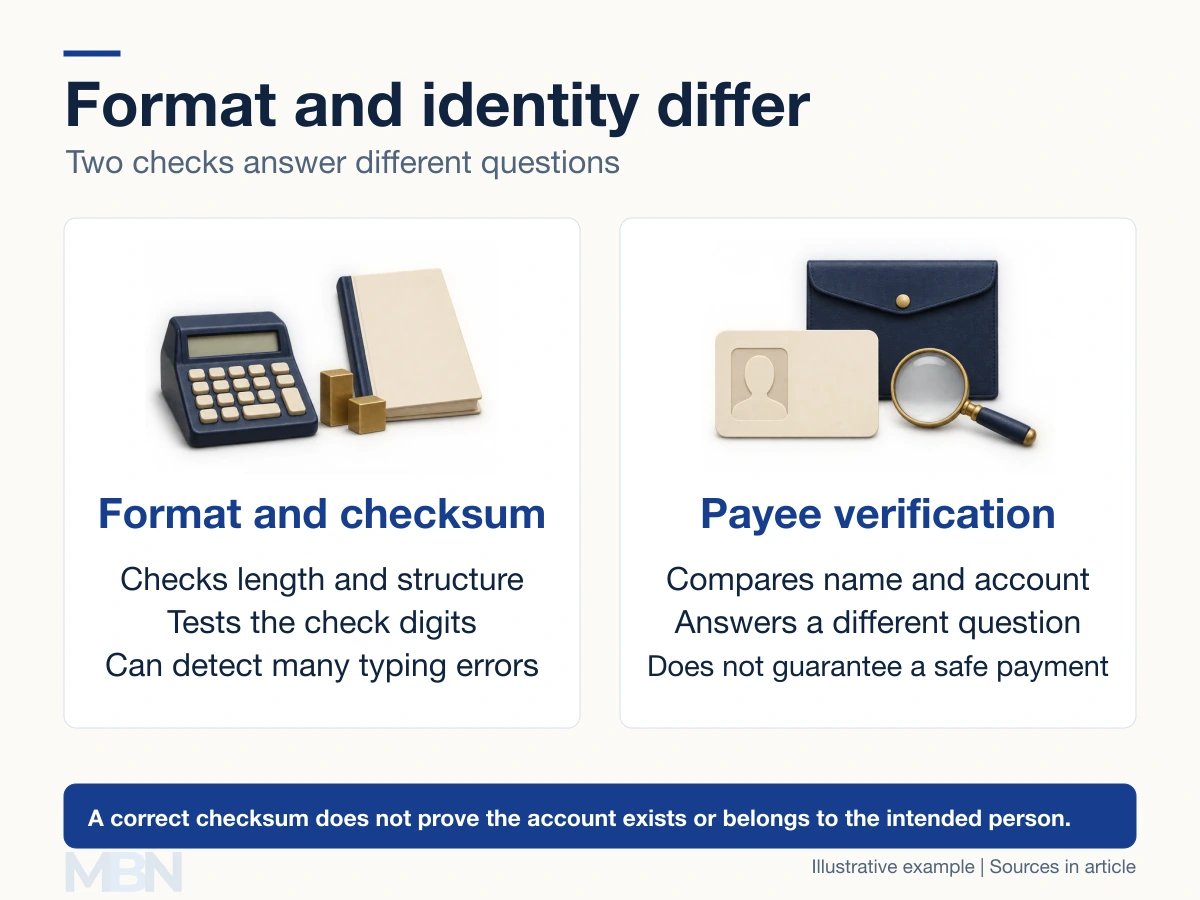
Verification of the payee’s name is a separate service. A valid-looking IBAN could still identify the wrong recipient. Payment providers may also apply other checks, so correct formatting alone does not establish legitimacy, fees or arrival time.
Why is IBAN useful?
A consistent format makes account details easier for systems to interpret and reduces some manual corrections. It can reduce avoidable delays caused by incomplete or mistyped information, while leaving other processing, compliance and payment requirements in place.
Last checked and updated on November 10, 2026 by the MBN editorial team.