
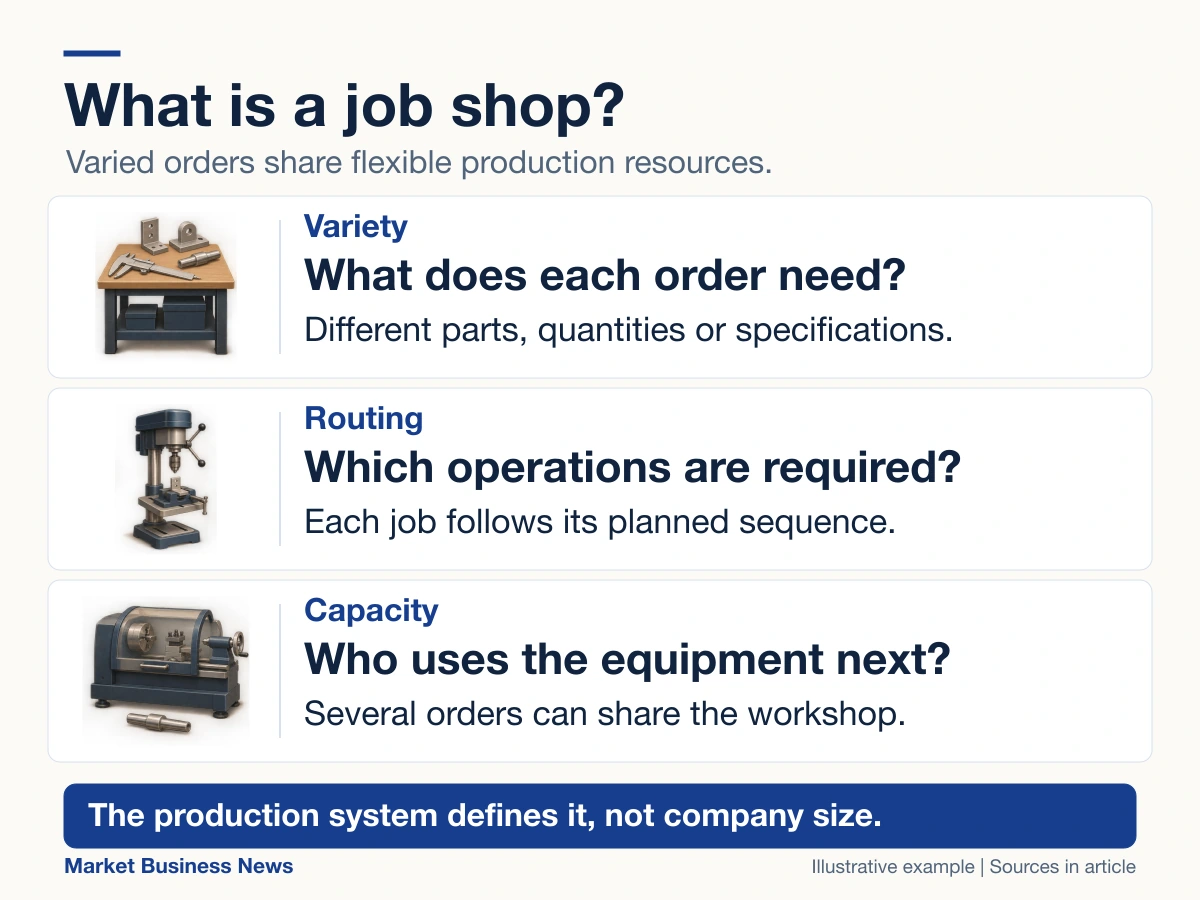
A job shop is a production operation that handles varied jobs, often in small quantities or to customer specifications. Different jobs may need different equipment and follow different routes through the workshop.
It can be an independent business or part of a larger manufacturer. Several orders can be in progress at once. Its defining feature is how production is organized, rather than the size of the company or a rule that it serves only one customer at a time.
How job-shop production works
A workshop might group similar equipment into areas for cutting, drilling, turning and inspection. A job visits the workstations needed for its particular design. Its route is planned; flexibility does not mean operations happen in a random order.
The operations-management text hosted by ETH Zurich describes this as a process or functional layout. Similar production equipment is grouped together, while each order follows its process plan.
A job can be a single item or a batch. A machine shop making replacement shafts, a fabricator making custom brackets or a workshop producing made-to-order furniture may use this approach. A business customer may use the finished item itself or incorporate it into another product.
An example with two orders
Imagine a metalworking shop with two orders: 10 brackets and two replacement shafts. In a simplified plan, the brackets need cutting, drilling and inspection. The shafts need turning and inspection.
The bracket order can be at the drill while the shaft order is at the lathe. Both later need the same inspection station. If that station is occupied, the next job may have to wait. Working on several orders does not mean one machine can perform incompatible tasks simultaneously.
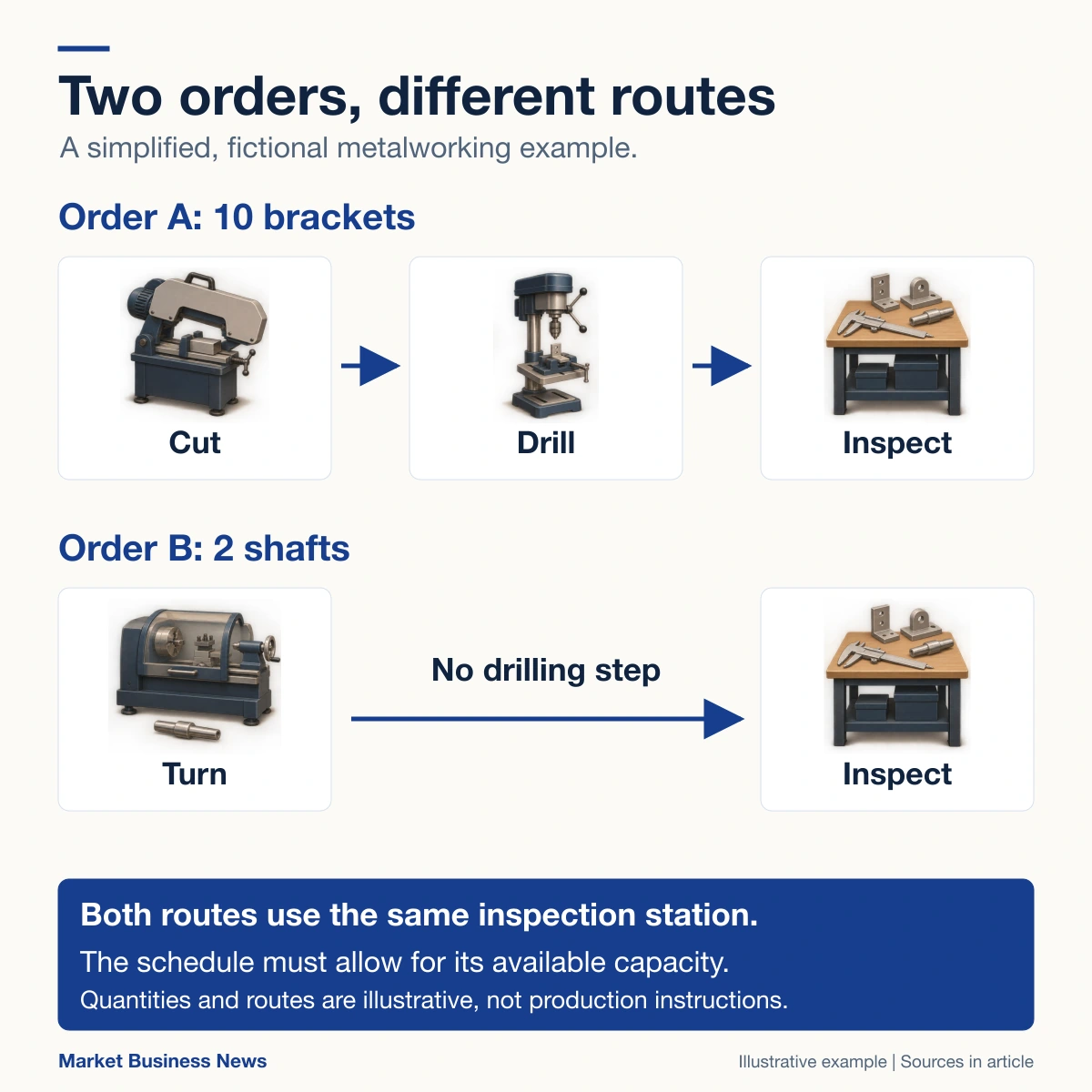
These are hypothetical quantities and simplified routes. A real process plan also specifies materials, dimensions, tooling, quality requirements and any other operations the product needs.
Why scheduling matters
Managers must coordinate the order of operations with available machines, people and materials. Changing a machine’s tools or settings for another job also takes time. The promised delivery date must allow for preparation, processing, waiting and inspection.
Google’s job-shop scheduling example illustrates two basic constraints: tasks must follow their required sequence, and a machine cannot process overlapping tasks. Real workshops can add further constraints, including maintenance and staff availability.
A flexible workshop can accept a wider mix of work, but coordinating that mix can be difficult. The NIST survey of job-shop scheduling identifies competing objectives such as reducing late jobs, balancing resource use and limiting unfinished work.
Job shops and flow production
In a flow shop, jobs follow a common sequence of production stages. Job shops allow different routes for different work. A dedicated line making repeated versions of a similar product therefore faces a different planning problem from a workshop handling varied custom orders.
The categories describe production arrangements. They do not make every job shop small, every flow line highly automated or every factory a pure example of one system. A manufacturer can combine different arrangements for different parts of its work.
Other uses of the term
In UK employment contexts, Cambridge Dictionary also records job shop as an organization that helps people find work. That is a separate meaning from the manufacturing system explained here.
A similarly sounding chop shop dismantles stolen vehicles for their parts. It has no connection to the legitimate production method.
Last checked and updated on November 2, 2026 by the MBN editorial team.