
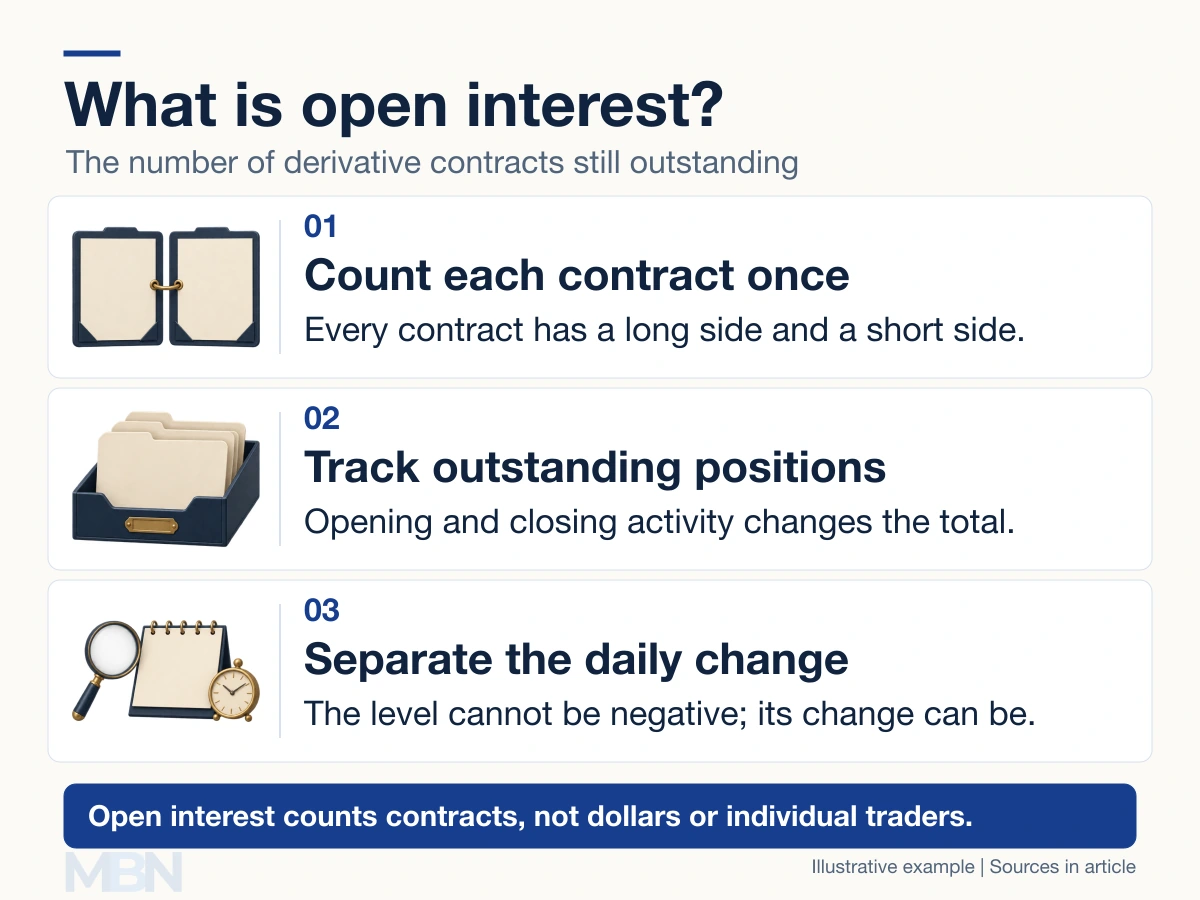
Open interest is the number of derivative contracts that remain outstanding at a stated time. A derivative is a contract whose value depends on an underlying asset, rate or other reference.
Futures and options markets report open interest. Each contract has a long side and a short side, but the paired contract is counted once. It is not counted as two merely because two counterparties are involved.
What does the number measure?
For an option, the reported figure may refer to a particular series, meaning contracts sharing the relevant underlying security, option type, strike price and expiration. A market-wide total aggregates a wider set of contracts. The scope and reporting time therefore matter.
CME Group distinguishes outstanding futures contracts from trading volume. Open interest is a contract count, rather than a direct measurement of cash flowing into a market. Contract sizes, prices, premiums and margin requirements can differ.
The open-interest level is zero or positive. Its change can be positive, negative or zero. For example, a fall from 500 to 480 means open interest is 480 contracts, with a change of minus 20. It does not mean open interest itself is negative.
How opening and closing trades affect it
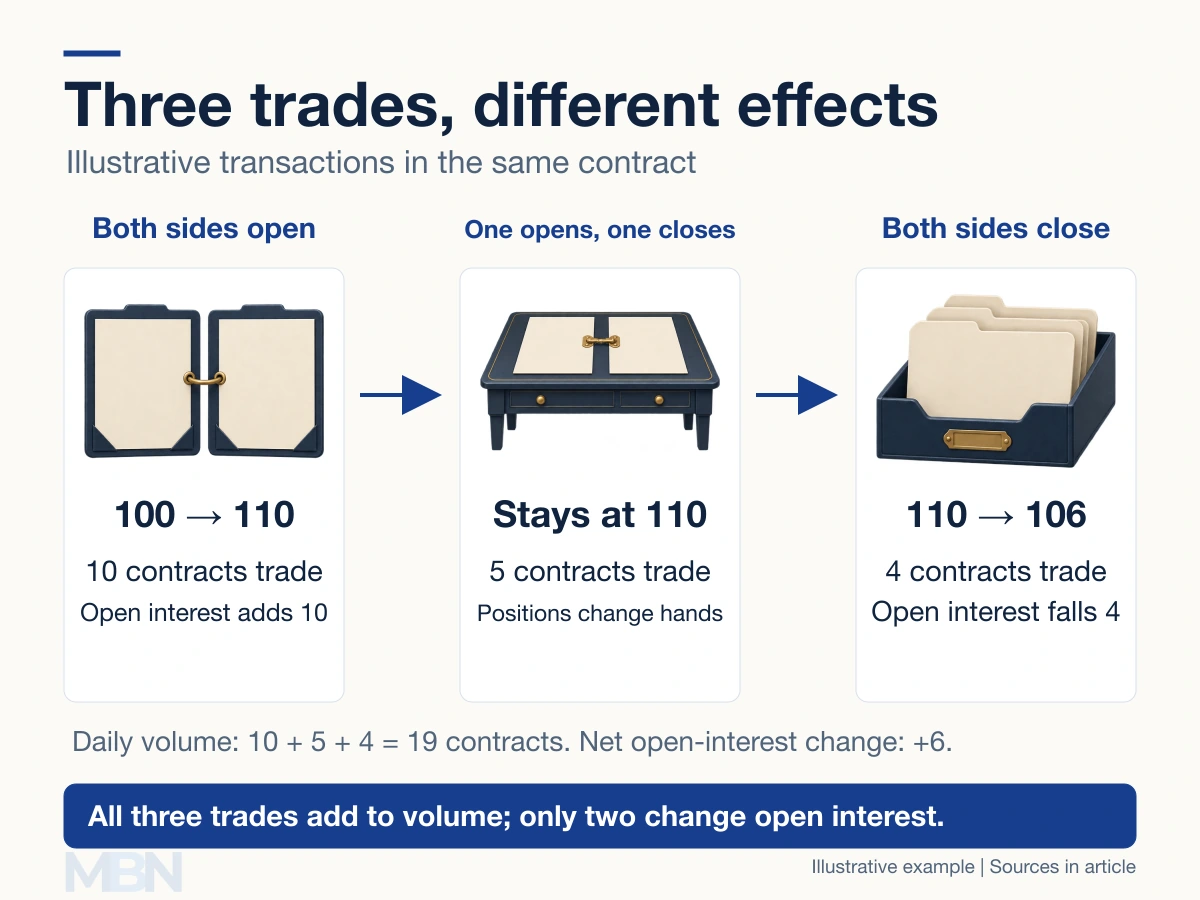
When both sides establish new positions, open interest increases. When both sides close existing positions, it decreases. When one side opens and the other closes, the outstanding total stays unchanged. The Options Industry Council explains these combinations and the role of clearing.
Suppose a contract starts with open interest of 100. A buyer and seller open 10 contracts, taking the count to 110. Another five contracts change hands between a closing holder and an opening holder, leaving it at 110. Finally, both sides close four contracts, reducing it to 106.
Open interest and volume answer different questions
In that example, trading volume is 19 contracts: 10 plus five plus four. Open interest rises by only six, from 100 to 106. Volume records trading activity during the period; open interest records contracts remaining outstanding.
Exercise and assignment, expiration and final settlement can also remove contracts from the outstanding total. Consequently, a busy trading session need not produce a comparable increase in open interest.
Reporting and interpretation
For US listed options, the Options Industry Council says OCC reports new open interest after end-of-day clearing. A displayed figure can therefore describe the previous completed reporting cycle rather than every trade occurring now.
CME’s volume and open-interest reports also distinguish preliminary figures from the following morning’s official Daily Bulletin. Readers should check the data timestamp and report status.
High open interest does not guarantee that a particular order can be executed at an attractive price. Current bids, offers and available quantities describe immediately executable liquidity more directly. Nor does a rise establish a bullish or bearish outlook: every open contract has opposing sides, which may form part of hedges or larger strategies.
Last checked and updated on November 5, 2026 by the MBN editorial team.