
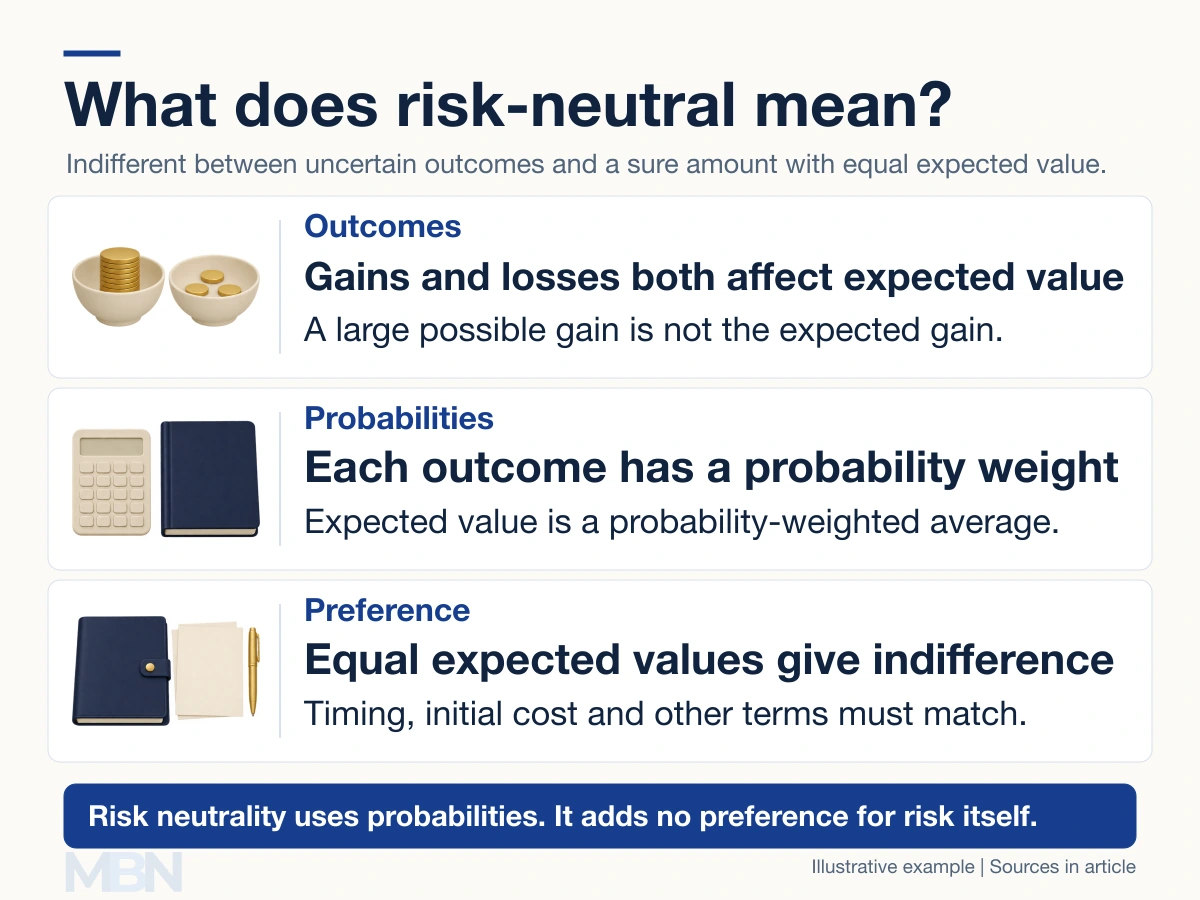
Risk-neutral describes a decision-maker who ranks uncertain monetary outcomes by their expected value. When an uncertain payoff and a guaranteed amount have the same expected value and otherwise comparable terms, the person is indifferent between them.
Expected value is a probability-weighted average. Calculating it requires counting possible losses as well as gains. It is not simply the best result that could occur.
How does the calculation work?
Multiply each outcome by its probability, then add the results. MIT’s uncertainty lecture describes this calculation and models risk-neutral preferences with linear utility. Utility is a representation of how the person values outcomes.
Suppose two fictional choices each require £500 now and pay one year later. Choice A pays £550 for certain. Choice B has a 50% chance of paying £650 and a 50% chance of paying £450.
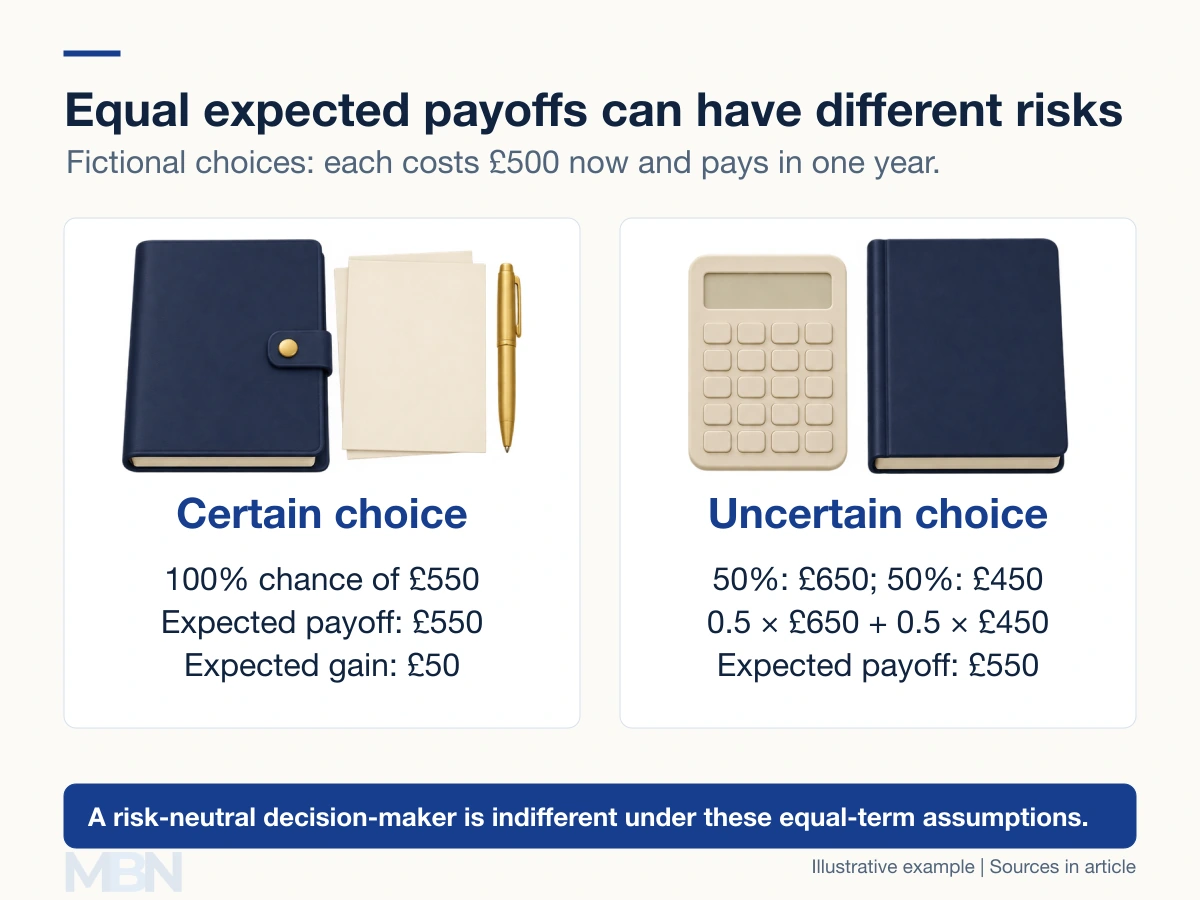
Choice B’s expected payoff is 0.5 × £650 + 0.5 × £450 = £550. Its expected gain is £50, the same as Choice A. Its actual gain is either £150 or a loss of £50.
A risk-neutral person is indifferent under those assumptions. Both expected gains are 10% of the same £500 initial cost. Equal upfront costs and matching payment dates make the comparison meaningful.
How does this differ from risk aversion?
The EconPort decision-theory guide distinguishes risk preferences. For the equal-expected-value choices above, a risk-averse person prefers the certain amount. A risk-seeking person prefers the uncertain alternative in the standard model. Risk neutrality sits between these preferences.
Risk aversion does not mean always choosing the least risky option regardless of its payoff. Nor does risk neutrality mean selecting whichever investment advertises the biggest possible gain. The probabilities and all monetary outcomes still matter.
Is expected value a promised result?
No. In Choice B, £550 is the average, yet neither listed outcome pays £550. The expectation describes the probability distribution rather than the result of one transaction.
A person’s preferences can also differ across situations. Constraints, liquidity needs and consequences beyond the monetary payoff must be defined before applying a simple model to a real decision.
What are risk-neutral probabilities?
This is a related but distinct finance concept. CFA Institute explains risk-neutral probabilities in derivative valuation: model-implied probabilities are used to price contingent payments under specified assumptions.
A Federal Reserve research survey distinguishes these from actual, or physical, probabilities. Their use does not establish that investors are personally risk-neutral or that the model probabilities are literal forecasts of real-world frequencies.
Last checked and updated on November 3, 2026 by the MBN editorial team.